 By st20113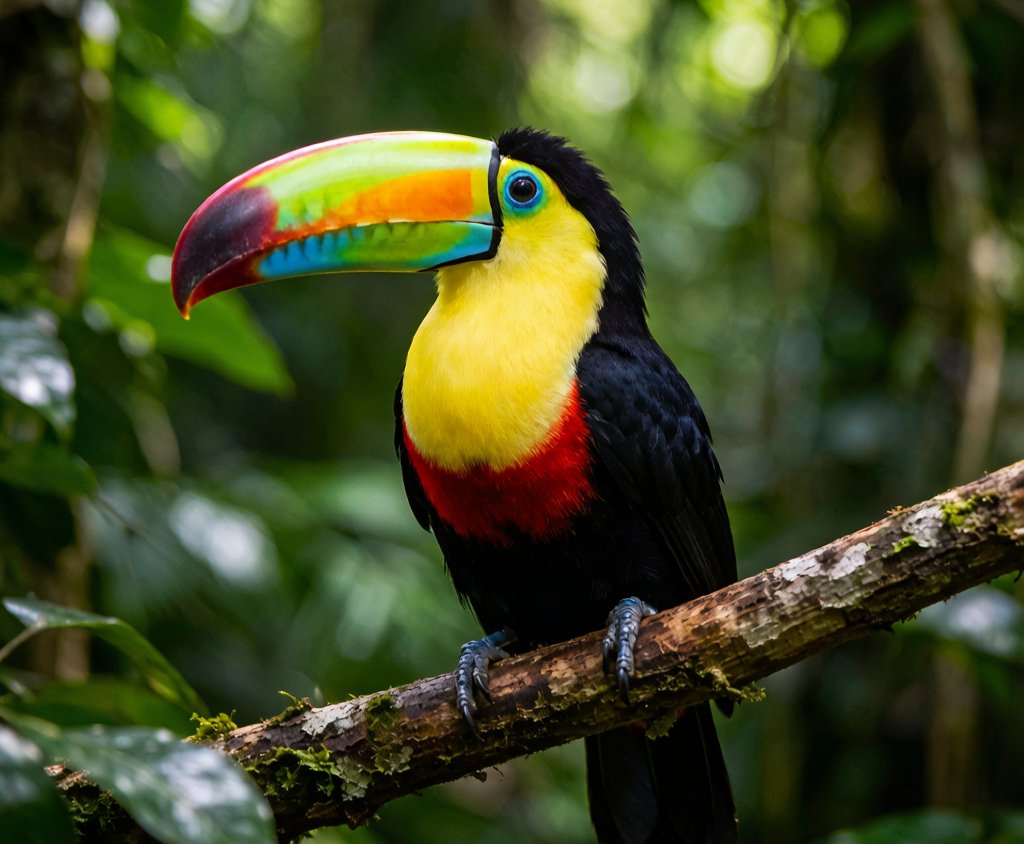
Introduction
The toucan is one of the most recognisable birds of the Neotropical forests, famous for its enormous, brightly coloured bill that can be longer than the rest of its body. The red-billed toucan, Tucanus tucanus, inhabits the humid lowland rainforests of the Amazon Basin. Though the bill looks heavy, it is remarkably light, made of a spongy keratin structure supported by thin bony struts. Toucans are social, noisy, and highly arboreal, spending almost their entire lives in the forest canopy. Their striking appearance and loud calls make them a symbol of the tropical Americas, much like the pelican is associated with wetlands.
Taxonomy
Toucans belong to the family Ramphastidae, which includes toucans, toucanets, and aracaris. Tucanus tucanus is one of the largest members of the genus Tucanus. They are related to woodpeckers and barbets within the order Piciformes, sharing traits such as zygodactyl feet—two toes pointing forward and two back. The family contains around fifty species distributed from Mexico to Argentina. Genetic analysis confirms their close evolutionary ties to the woodpecker lineage despite their very different appearance and diet.
Physical Characteristics
The red-billed toucan measures about 50 to 60 centimetres in length, with its bill alone accounting for up to a third of that. The bill is vivid red with a black tip and a yellowish lower mandible, while the body is mostly black with a white throat and a blue ring around the eye. The oversized bill helps with thermoregulation, shedding excess heat, and reaching fruit on slender branches. Toucans have short, rounded wings suited to flitting between trees rather than long flight. Like the eagle, they are strong perchers but prefer hopping through branches.
Habitat
These toucans live in lowland tropical rainforests, river-edge forests, and flooded varzea woodlands across the Amazon and Orinoco basins. They depend on mature forest with abundant fruiting trees and suitable tree cavities for nesting. They are rarely found far from woodland and avoid open habitats. The dense, multi-layered canopy provides both food and protection from hawks and other predators that share the treetops.
Diet
Toucans are primarily frugivorous, feeding on a wide variety of fruits and berries, which they toss into the air and swallow whole. They also eat insects, small lizards, bird eggs, and nestlings, making them opportunistic omnivores. Their role as seed dispersers is vital to forest regeneration, as many seeds pass through their digestive systems unharmed. They forage in pairs or small flocks, plucking fruit with the tip of the bill and often feeding each other in social displays.
Reproduction
Toucans nest in natural tree cavities or abandoned woodpecker holes, usually laying two to four white eggs. Both parents share incubation duties for about 15 to 20 days. The chicks are born blind and naked, with conspicuous heel pads that protect them on the rough cavity floor. Parents regurgitate food for the young, which fledge after roughly six to eight weeks. Family groups may remain together for a short period after the chicks leave the nest.
Conservation
The red-billed toucan is currently listed as a species of least concern, thanks to its broad range and adaptability. However, localized threats from deforestation, the pet trade, and hunting persist. Habitat fragmentation can isolate populations and reduce genetic diversity. Protected reserves within the Amazon help safeguard critical habitat, though ongoing clearing for agriculture remains the greatest long-term risk. Compared with the threatened owl populations of some regions, toucans remain relatively secure but are closely watched.
Fun Facts
The toucan’s bill can be up to a third of its body length yet weighs almost nothing because it is hollow. Toucans sleep with their bill tucked under their wings and tail, appearing to have no head at all. They use a variety of croaking, yelping, and rattling calls to communicate across the canopy. In many cultures the toucan is a symbol of playfulness and communication. Flocks often engage in “bill fencing,” gently tapping bills together as a social ritual.