 By st20113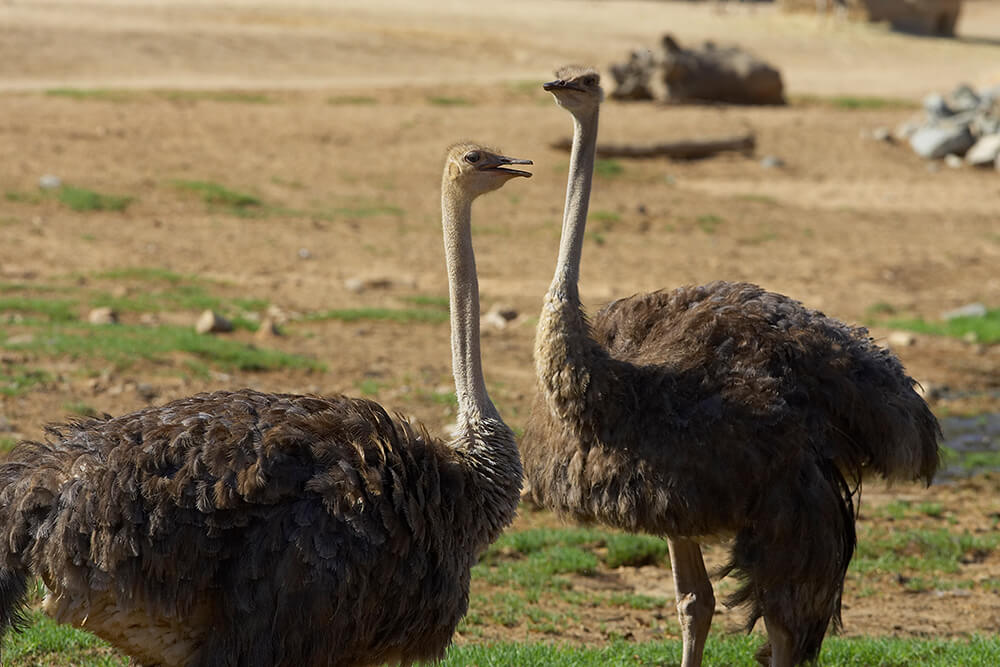
Introduction
The ostrich (Struthio camelus) is the world’s largest living bird, native to the open savannas and arid regions of Africa. Standing up to 2.8 meters tall and weighing as much as 156 kilograms, it is unmistakable — a towering giant with long bare legs, a massive body, and an elongated neck. Despite its inability to fly, it is an exceptional runner, capable of sprinting at speeds exceeding 70 km/h, making it one of the fastest land animals in Africa. Its eggs are the largest of any living bird, and its distinctive appearance has made it a symbol of the African wilderness for millennia.
Taxonomy
The ostrich belongs to the order Struthioniformes and the family Struthionidae, representing a very ancient lineage that diverged from other ratites over 50 million years ago. Five subspecies are currently recognized: S. c. camelus (North Africa), S. c. australis (southern Africa), S. c. massaicus (East Africa), S. c. molybdophanes (Somalia), and the extinct S. c. syriacus from the Arabian Peninsula. The ostrich’s closest living relatives are the southern cassowary and the emu, with which it shares the group of large flightless birds known as ratites.
Physical Characteristics
The ostrich displays striking sexual dimorphism: males are cloaked in glossy black plumage with bold white wing and tail feathers, while females and juveniles are a dull grayish-brown. Both sexes possess long, powerful bare legs ending in feet with just two toes — a unique feature among birds, with a large claw for kicking defense. The ostrich’s eye is the largest of any land vertebrate at approximately 50 millimeters in diameter, providing exceptional vision across the open savanna. Its neck can extend over 60 centimeters, allowing it to scan for African lions from a great distance. Wings are used in courtship displays and as rudders during high-speed running.
Habitat
Ostriches inhabit the open savannas, semi-desert plains, and sparse scrublands of sub-Saharan Africa, from Senegal in the west across to Ethiopia, and southward through Tanzania to South Africa. They thrive in regions with a mix of short grassland and scattered trees. Ostriches are highly nomadic, moving in small groups across vast distances in response to rainfall and food availability. They are well adapted to arid conditions, able to survive without free water for extended periods by metabolizing moisture from their food. Introduced populations also exist in Australia, where escaped farm birds have established wild breeding colonies.
Diet
The ostrich is primarily a herbivore, feeding on seeds, leaves, flowers, and fruit. Grass seeds, wild melon, and acacia fruit form the staple of its diet. Ostriches also consume insects, small lizards, and carrion, especially during the dry season when plant food is scarce. They swallow pebbles and sand to aid digestion in their muscular gizzard. Ostriches often associate with herds of zebras and gazelles, benefiting from increased predator alertness. An adult may consume up to 4.5 kilograms of food per day.
Reproduction
Ostriches are polygynous, with a dominant male mating with several females within a territory. The primary hen lays her eggs in a communal ground nest — a simple soil depression — where multiple females may deposit up to 20 or more eggs. The dominant male and primary hen share incubation for approximately 42 days. The chicks are precocial and leave the nest within hours of hatching, forming creches supervised by adults. They reach full size within 18 months but do not reach sexual maturity until three to four years of age.
Conservation
The common ostrich is listed as Least Concern by the IUCN, with wild populations exceeding 100,000 individuals. However, populations are declining in parts of North and West Africa due to habitat loss, human encroachment, and uncontrolled hunting. In contrast, the species has been extensively farmed around the world — particularly in South Africa, the United States, and Australia — for its meat, leather, and feathers. Conservation efforts focus on protecting key habitats and establishing wildlife corridors that allow ostriches to move freely between seasonal grazing areas.
Fun Facts
The ostrich produces the largest egg of any living bird — a single egg is roughly equivalent to 24 chicken eggs in volume. Despite the popular myth, ostriches do not bury their heads in the sand; when threatened, they run at high speed or deliver powerful kicks capable of seriously injuring large predators. An ostrich’s kick delivers more than 500 pounds of force per square inch. During breeding season, males produce a deep, booming call audible up to two kilometers away. In ancient Egypt and Rome, ostriches were kept in royal menageries and their feathers were prized as symbols of power and status.