 By st20113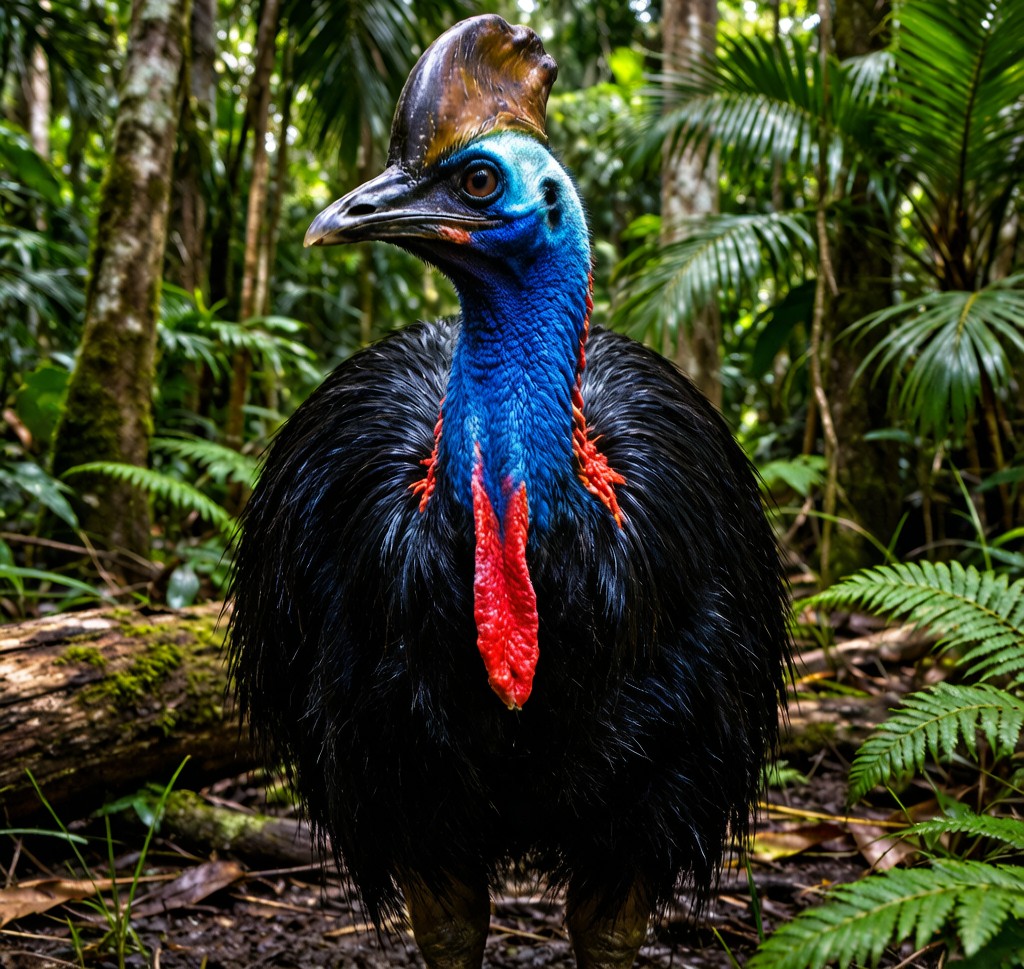
A Southern Cassowary (Casuarius casuarius) standing in the tropical rainforest of Queensland, showing its distinctive helmet, blue face, and red wattle
Overview
The Southern Cassowary (Casuarius casuarius) is one of the largest and most remarkable birds in the world – a flightless, dinosaur-like bird that inhabits the tropical rainforests of Far North Queensland, New Guinea, and nearby islands. Standing approximately 1.5 to 1.8 meters tall and weighing 29 to 58 kilograms, the Southern Cassowary is the second-largest bird in the world after the ostrich, and is widely regarded as the most dangerous bird to humans due to its powerful, razor-sharp claw on the inner toe of each foot, which can reach 12 centimeters in length and is capable of inflicting fatal wounds. The Cassowary’s striking appearance – jet black plumage, a vivid blue face and neck, a tall brown helmet-like casque atop its head, and long red double wattle hanging from the neck – makes it one of the most distinctive and memorable birds in the world.
The Cassowary’s helmet – called a casque – is one of its most mysterious features, and its function remains debated among scientists. The leading hypothesis is that the helmet helps the bird push through dense rainforest vegetation as it walks; another theory suggests it may be used for acoustic communication, amplifying the Cassowary’s deep, booming calls. The Cassowary’s powerful legs – which make up approximately 30 percent of its body mass – can deliver kicks of extraordinary force, and the inner toe’s claw can slash through clothing, flesh, and even bone. Despite this fearsome reputation, Cassowaries are generally shy and elusive birds that avoid humans when possible, and attacks on humans are extremely rare.
Habitat and Distribution
The Southern Cassowary occurs in the tropical rainforests of Far North Queensland in Australia, and throughout the lowland rainforests of New Guinea and the Aru Islands. In Australia, the Cassowary is restricted to a narrow coastal strip of rainforest between Cooktown and Townsville – an area that has been dramatically reduced by agricultural clearing and urban development, leaving Cassowary populations isolated in fragmented patches of rainforest. This fragmented distribution – with Cassowaries in only approximately 25 to 40 percent of their historic Australian range – makes the species particularly vulnerable to local extinction.
The Cassowary’s rainforest habitat is characterized by dense, multicanopy vegetation with abundant fruit trees, palms, and Pandanus – all important food sources for the bird. Cassowaries require large areas of contiguous rainforest to maintain viable populations – a single bird may range over 20 to 30 square kilometers in a year – and the isolation of populations in fragmented forest patches has led to genetic isolation and reduced long-term viability. The species is highly sensitive to habitat edge effects, and populations in small, isolated patches are at high risk of local extinction from stochastic events, disease, or inbreeding.
Diet and Ecosystem Role
The Southern Cassowary is a specialized frugivore – a fruit-eater – that consumes the fruits of over 240 plant species, making it one of the most important seed dispersers in the tropical rainforest ecosystem of northeastern Australia. Cassowaries are particularly important for the dispersal of large-seeded fruits – many of which are too large to be dispersed by any other animal in the Australian rainforest. The Cassowary swallows fruits whole, and the seeds pass through its digestive tract intact – germinating more readily after passage through the Cassowary’s gut. Research has shown that the Cassowary is essential for the survival of several tree species that have no other means of seed dispersal, making it a true keystone species in its ecosystem.
When fruit is scarce – during the dry season or in poor fruiting years – Cassowaries supplement their diet with fungi, insects, small vertebrates, and carrion. The Cassowary’s gut passage time is relatively long – approximately 22 to 67 hours – which allows seeds to be dispersed over considerable distances, often 200 to 1,000 meters from the parent tree. This long-distance dispersal is critically important for the genetic connectivity of rainforest tree populations, allowing genes to flow between fragmented habitat patches. The loss of Cassowaries from forest fragments therefore has cascading effects on forest regeneration and ecosystem function that extend far beyond the loss of the bird itself.
Reproduction and Conservation
Cassowaries are solitary except during the breeding season, when males attract females through a complex display that includes low-frequency booming vocalizations, lateral swaying, and head-bobbing. After mating, the female lays 3 to 5 large, bright green eggs – each approximately 9 by 14 centimeters – in a nest built by the male on the forest floor. The male then incubates the eggs and raises the chicks alone for approximately 9 months – one of the most intensive parental investments of any bird. Cassowary chicks are conspicuously striped when young – brown, black, and cream stripes that provide camouflage in the dappled rainforest light – and the male defends them fiercely against any potential threats.
The Southern Cassowary is listed as Endangered on the IUCN Red List, with Australian populations estimated at approximately 2,000 to 4,000 individuals and continuing to decline. The primary threats are habitat loss and fragmentation (road construction and agricultural clearing have isolated Cassowary populations in small forest patches), vehicle strikes (Cassowaries are frequently killed on roads that bisect their habitat), dog attacks (both domestic and feral dogs), and low reproductive success (Cassowaries raise at most 1 to 2 chicks per year, and many nests fail due to predation or flooding). Conservation efforts focus on protecting and connecting cassowary habitat through wildlife corridors, reducing road mortality through underpasses and signage, and community education programs to reduce dog attacks and retaliatory killings following poultry predation.
[…] S. c. syriacus from the Arabian Peninsula. The ostrich’s closest living relatives are the southern cassowary and the emu, with which it shares the group of large flightless birds known as […]
[…] belongs to the order Casuariiformes and the family Dromaiidae, making it a close relative of the southern cassowary and the ostrich. Genetic evidence has revealed that the extinct Tasmanian emu and King Island emu […]