 By st20113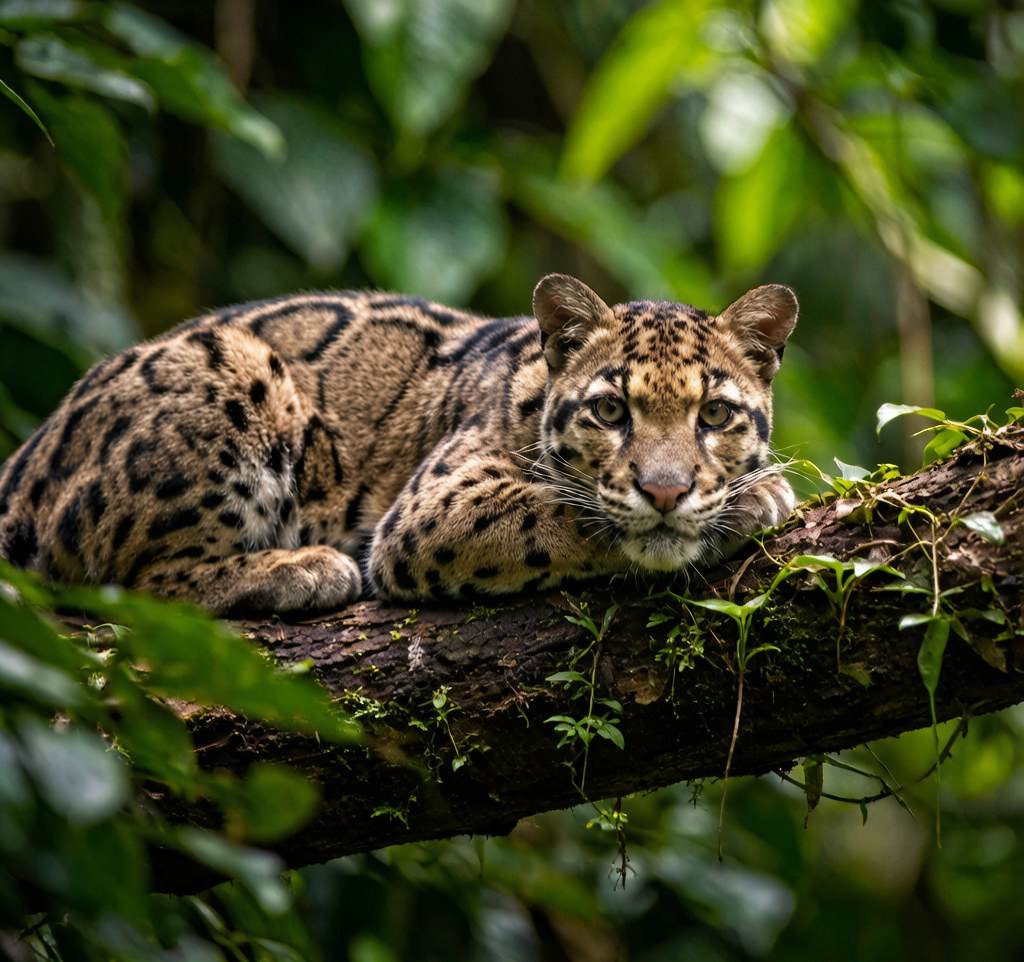
Introduction
The clouded leopard (Neofelis nebulosa) is a medium-sized wild cat native to the dense forests of Southeast Asia. Named for the distinctive cloud-like patterns on its coat, this elusive predator is considered an evolutionary link between big cats and small cats. Clouded leopards possess remarkable climbing abilities, enabling them to hunt in the trees as effectively as on the ground. Their mysterious nature and declining populations have made them a flagship species for forest conservation across their range. Unlike the high-altitude snow leopard, which inhabits rocky mountain terrain, the clouded leopard favors the humid tropical forests of lowland and hill regions.
Taxonomy
The clouded leopard belongs to the genus Neofelis within the family Felidae. British naturalist Edward Griffith first described the species in 1821. Genetic studies have shown that clouded leopards diverged from the other big cats around 6 million years ago. Two species are now recognized: the mainland clouded leopard (Neofelis nebulosa) and the Sunda clouded leopard (Neofelis diardi), found on Sumatra and Borneo. The Sunda species was only recognized as distinct in 2006 through DNA analysis. Together with the tiger, clouded leopards belong to the Pantherinae subfamily, sharing several anatomical features with their larger relatives.
Physical Characteristics
Clouded leopards are named for their stunning coat, which features large irregularly shaped blotches edged in dark brown against a pale yellow to grey background. They have a relatively long body, short legs, and a remarkably long tail that aids balance in the trees. Their most distinctive anatomical feature is the longest canine teeth relative to skull size of any living cat, comparable in proportion to the extinct saber-toothed cats. Adults weigh between 11 and 23 kilograms, with males significantly larger than females. Unlike the more familiar pattern of the Bengal tiger, clouded leopard markings are uniquely adapted for camouflage in the dappled light of the forest canopy.
Habitat
Clouded leopards inhabit tropical and subtropical forests across Southeast Asia, including parts of Nepal, Bhutan, Myanmar, Thailand, Malaysia, Cambodia, Laos, Vietnam, and southern China. They prefer dense primary forest but can also survive in secondary forests and selectively logged areas. These cats are highly arboreal, using their strong limbs and long tail to navigate the canopy with exceptional agility. They can climb down trees headfirst, hang upside down from branches, and even traverse horizontal branches by walking on the underside, making them unique among cats. Unlike terrestrial hunters such as the lion, the clouded leopard executes much of its hunting from an arboreal vantage point.
Diet
Clouded leopards are carnivorous predators that hunt a variety of prey including deer, wild boar, monkeys, squirrels, birds, and reptiles. Their arboreal lifestyle allows them to ambush prey from above, delivering a precise bite to the back of the neck using their elongated canines. In the trees, they prey on gibbons and macaques, while on the ground they take small deer and young wild boar. Their diet varies depending on prey availability throughout the seasons. Like the cheetah, clouded leopards rely on stealth and surprise rather than sustained speed when hunting, though their arboreal strategy is distinctly different.
Reproduction
Clouded leopards reach sexual maturity at around two years of age, though males may not successfully breed until they establish territory. Gestation lasts approximately 85 to 93 days, resulting in a litter of one to five cubs with two being most common. Newborn cubs weigh between 140 and 280 grams and are covered in spotted fur. They open their eyes at around 10 to 14 days and begin climbing at six weeks. In captivity, clouded leopards have proven notoriously difficult to breed due to male aggression toward females during courtship. Zookeepers have developed specialized introduction and pairing strategies to overcome this challenge. Unlike the forest-dwelling red panda, clouded leopard cubs are reared solely by the mother in dens hidden within the forest.
Conservation
The clouded leopard is classified as Vulnerable on the IUCN Red List, with an estimated population of fewer than 10,000 mature individuals. The primary threats are deforestation for palm oil, rubber, and timber plantations, as well as poaching for their beautiful pelts and body parts used in traditional medicine. Habitat loss has caused severe fragmentation of remaining populations across Southeast Asia. Protected areas like national parks and wildlife sanctuaries provide crucial refuges, but enforcement against poaching remains challenging. Conservation organizations work with local communities on habitat restoration, anti-poaching patrols, and sustainable land-use planning to secure a future for this remarkable cat.
Fun Facts
- Clouded leopards can rotate their ankles 180 degrees, allowing them to climb down trees headfirst like squirrels.
- They have the longest tail-to-body ratio of any cat, using it as a counterbalance when moving through branches.
- Unlike most cats, clouded leopards purr but cannot roar fully despite being classified as big cats.
- Their fossil record stretches back over 2 million years to the early Pleistocene epoch.
- Clouded leopards have been observed swimming across rivers between forest fragments.