 By st20113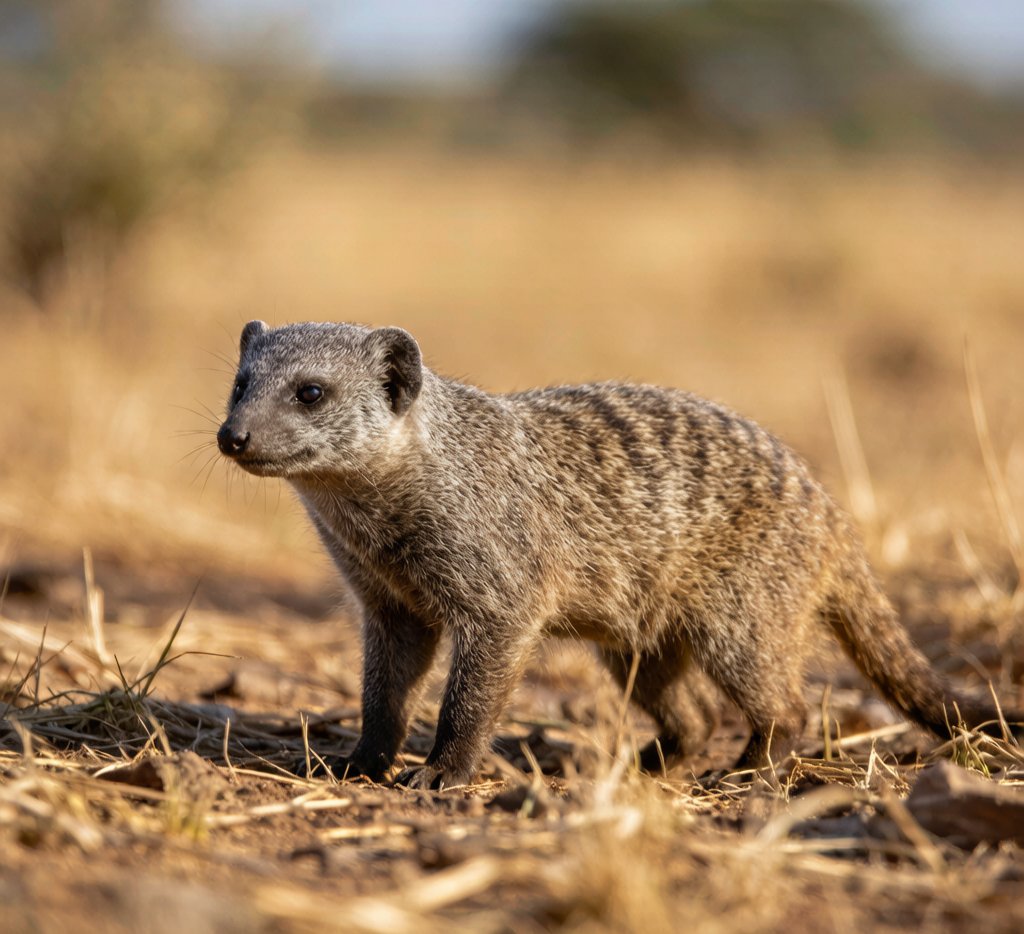
Introduction
The banded mongoose (Mungos mungo) is a small, sociable carnivore of the family Herpestidae, found across sub-Saharan Africa. Named for the dark bands that cross its brown back, it lives in troops of a dozen to dozens of individuals that cooperate to forage, defend territory, and raise young. Banded mongooses are among the most social of all mongooses, and their noisy, bustling groups are a familiar sight on savannas and in open woodlands, where they dig constantly for insects and small prey alongside the meerkat.
Taxonomy
Mungos mungo is the sole member of the genus Mungos within the family Herpestidae, which also includes the small Asian mongoose and the Indian mongoose. Mongooses are small carnivorous mammals related to civets and, more distantly, to cats. The species was long placed in the genus Herpestes before being moved to Mungos based on anatomical and genetic differences. Several subspecies are recognized across its African range. Its closest relatives are other African mongooses that share its preference for open, grassy habitats and cooperative living.
Physical Characteristics
Banded mongooses have a head-to-body length of about 30 to 45 centimeters and a tail of 15 to 25 centimeters, weighing between 1.5 and 2.5 kilograms. Their coarse fur is greyish-brown to reddish, with a series of dark transverse bands across the back and hindquarters that give the species its name. The legs are short and dark, the snout pointed, and the ears small. A long, tapering tail lacks a terminal tuft. Strong claws on the forefeet are adapted for digging, and the body is built for a life spent largely on the ground rather than in trees.
Habitat
Banded mongooses inhabit savannas, grasslands, open woodlands, and the edges of forests, generally avoiding dense rainforest and true desert. They are widespread across eastern and southern Africa, from Senegal and Sudan southward to South Africa. Troops use a network of bolt-holes and termite mounds as refuges. They prefer areas with short grass and bare soil where digging is easy, and they often live near human settlements, taking advantage of abundant insects and discarded food scraps around habitations.
Diet
Banded mongooses are primarily insectivorous. Their staple foods are beetles, grasshoppers, termites, and millipedes, but they also eat small reptiles, birds, eggs, rodents, and fallen fruit when available. Troops forage together, turning over stones and digging in the soil with their claws, and they often cooperate to overwhelm prey such as snakes. They are resistant to many venoms, allowing them to tackle dangerous prey. Like the honey badger, they are tenacious diggers that will excavate to reach a meal hidden underground.
Reproduction
Banded mongooses are unusual among carnivores in that multiple females in a troop may give birth on the same day, producing a synchronized crop of pups. After a gestation of about 60 days, the young are born in a communal den, often a reused termite mound or burrow. Pups are cared for by escort females who stay with them after the group moves on, and many troop members help babysit and feed them. This communal rearing greatly improves pup survival in the dangerous open savanna where predators are common.
Conservation
The banded mongoose is classified as Least Concern by the IUCN, with a large range and stable populations across much of sub-Saharan Africa. It adapts well to human-modified landscapes and is not currently at major risk. Local threats include poisoning and shooting where it is seen as a poultry raider, and road kills in busy areas. Because troops range widely and use varied habitats, broad habitat protection benefits them. Continued research on their complex social behavior supports informed, non-lethal management where conflicts arise with farmers.
Fun Facts
Banded mongooses hold a remarkable record: they are one of the few mammals in which all females in a group can give birth within the same twenty-four hours. To avoid infanticide, pups are constantly escorted by assigned guardians. Troops post sentinels that whistle alarms when predators such as eagles approach. They use a rich vocabulary of chirps and growls to coordinate. When a snake is found, the group may mob it together, relying on speed and numbers rather than solitary bravado to prevail.