 By st20113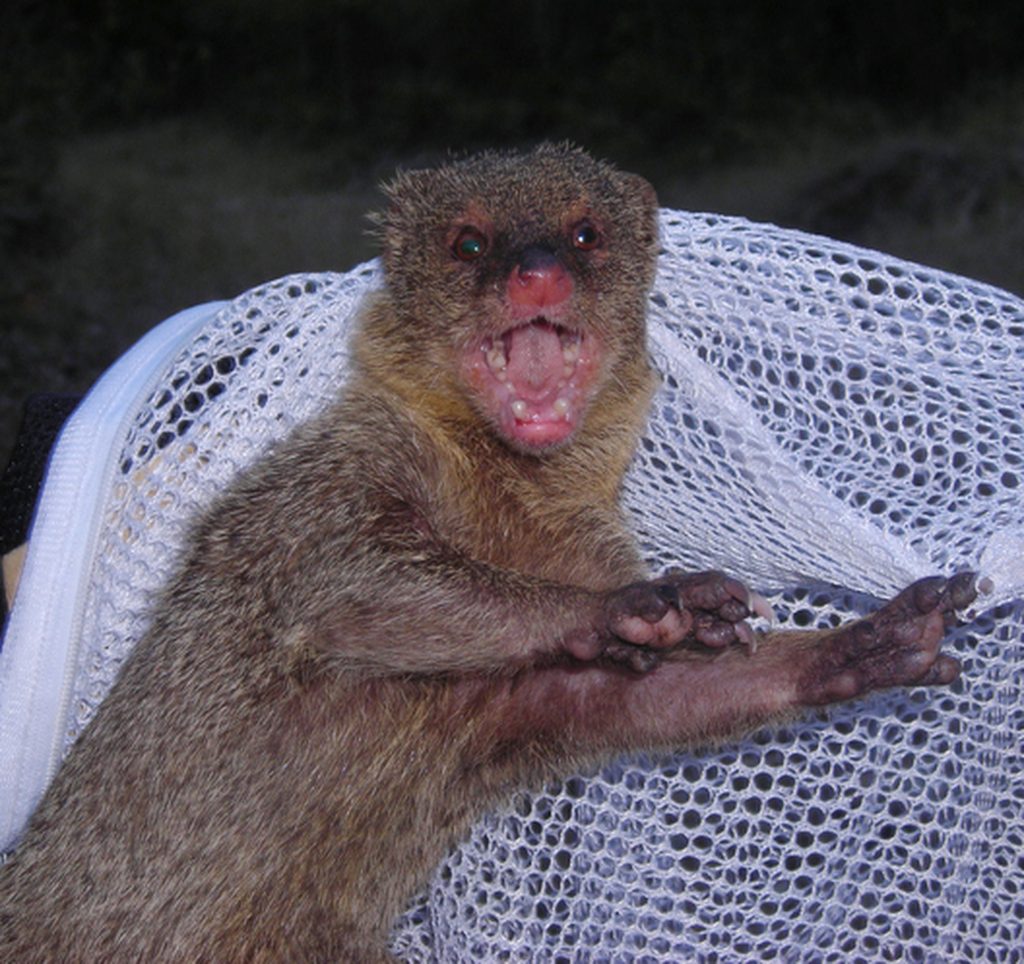
Introduction
The Small Asian Mongoose, scientifically known as Herpestes auropunctatus, is a slender, agile carnivore belonging to the family Herpestidae. Native to the Indian subcontinent and parts of Southeast Asia, this small mammal has become one of the most widely introduced predators on the planet. Measuring between 25 and 41 centimeters in body length with a tail of similar proportion, it typically weighs between 0.3 and 1.4 kilograms. Its reputation as a fearless snake fighter has made it both celebrated and notorious, and its introduction to islands around the world has reshaped local ecosystems.
Taxonomy
Herpestes auropunctatus was first described by the British zoologist Edward Blyth in 1851 under the genus Mangusta before being placed in Herpestes. The name auropunctatus derives from Latin, meaning golden-spotted, a reference to the speckled appearance of its coarse fur. For much of the twentieth century the Small Asian Mongoose was grouped with the Javan Mongoose, but genetic and morphological studies later separated them. It sits within the subfamily Herpestinae, which encompasses the Old World mongooses. Its small size and lightly built frame distinguish it from most of its larger cousins.
Physical Characteristics
The Small Asian Mongoose has a long, low-slung body supported by short legs, a pointed snout, and small rounded ears that lie close to the head. Its fur is grizzled brown to greyish, flecked with lighter speckles that give the animal its scientific name. The tail is bushy at the base and tapers toward the tip. Males are generally larger than females. A distinctive feature is the mongoose’s specialized acetylcholine receptors, which confer a degree of resistance to the neurotoxic venom of elapid snakes such as cobras. Its sharp, curved claws are well adapted for digging and probing crevices in search of prey.
Habitat
In its native range the Small Asian Mongoose occupies a broad variety of habitats, from open grasslands and scrubland to agricultural fields, forest edges, and the margins of human settlements. It is highly adaptable and tolerant of disturbed landscapes. Following deliberate introductions beginning in the late nineteenth century, the species established populations across the Caribbean, Hawaii, the Adriatic islands, and parts of South America. On many islands it thrives in coastal lowlands and cultivated areas where native ground-nesting birds and reptiles are abundant. In its home region it is also hunted by larger carnivores such as the red fox and the gray wolf, though its agility usually helps it escape.
Diet
The Small Asian Mongoose is an opportunistic omnivore with a strongly carnivorous lean. Its diet includes insects, crabs, frogs, lizards, snakes, small birds, rodents, and eggs. The species is famed for tackling venomous snakes, using speed, agility, and partial venom resistance to outmaneuver cobras and other elapids. It will also consume fruit, roots, and carrion when animal prey is scarce. This broad diet helped fuel its use as a plantation agent against rats and snakes, though it proved far more effective at raiding nests than at controlling pests.
Reproduction
Breeding can occur year-round in tropical climates, with peaks that vary by region. After a gestation of roughly forty-two to forty-nine days, the female gives birth to a litter of two to five blind, helpless young in a sheltered burrow, hollow log, or rock crevice. The pups are weaned at about four weeks and reach sexual maturity within their first year. Females may produce multiple litters annually where conditions are favorable, a trait that supports rapid population growth. High reproductive output is one reason the species establishes quickly after introduction.
Conservation
The Small Asian Mongoose is classified as Least Concern by the IUCN because of its large native range and stable populations. The conservation story is more complicated outside its home region, where it is regarded as a serious invasive species. On islands such as Jamaica, Fiji, and Hawaii it has contributed to the decline and extinction of native birds, reptiles, and amphibians through nest predation. Control programs involving trapping, hunting, and targeted removal have been attempted, with varying success. The species stands as a cautionary case in invasion biology, illustrating why introduced predators require careful assessment before release. Protecting native island fauna often means limiting mongoose numbers rather than the animal itself.
Fun Facts
The mongoose can twitch its nose more than a dozen times per second while hunting, scanning the air for scent cues. Despite stories, it is not immune to venom but more resistant than most mammals, and a large cobra can still kill it. A single mongoose may eat dozens of insects in one foraging bout. In Hawaii the species was introduced in 1883 to control rats in sugarcane fields, a plan that backfired because the mongoose is diurnal while rats are largely nocturnal. The animal’s Latin name, auropunctatus, refers to the golden speckles that shimmer across its dark coat in sunlight. Perhaps most surprising, the mongoose’s bold reputation earned it a starring role in Rudyard Kipling’s famous story of Rikki-Tikki-Tavi.