 By st20113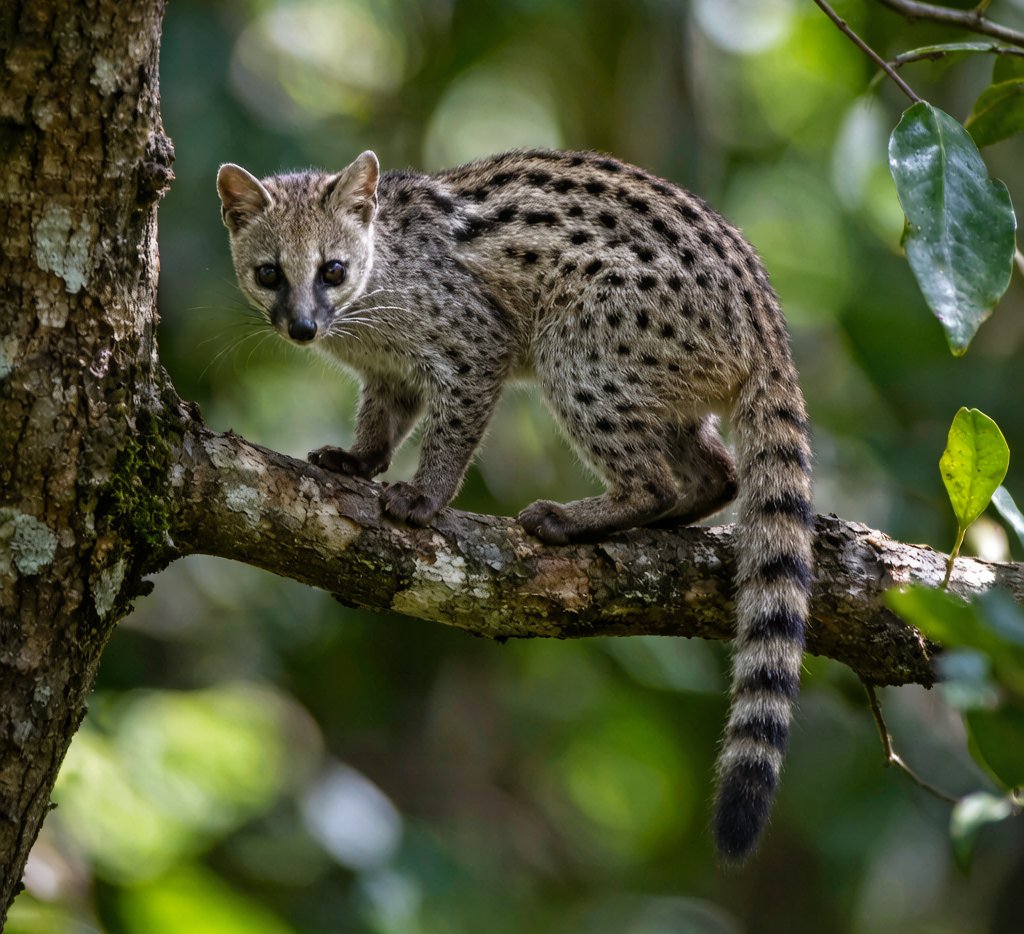
Introduction
The common genet (Genetta genetta) is a slender, agile carnivore of the family Viverridae, native to Africa and southwestern Europe. With its long body, short legs, raccoon-like banded tail, and large eyes, it resembles a small cat crossed with a ferret. Genets are nocturnal and solitary, spending the dark hours hunting insects, small vertebrates, and fruit across woodlands, scrub, and farmland. Introduced to parts of Europe centuries ago, they have become a familiar, if secretive, component of Mediterranean ecosystems from Iberia to the Balkans.
Taxonomy
Genetta genetta is the most widespread member of the genus Genetta, within the family Viverridae, a group related to the large-spotted civet and the binturong. Viverrids are Old World relatives of cats, and genets represent one of the most cat-like branches. The species has numerous subspecies across its African and European range. Genetic studies suggest that the genets now living in Europe descend from animals introduced by humans from North Africa, probably during the medieval period, rather than from natural spread northward.
Physical Characteristics
Common genets measure 40 to 55 centimeters in body length, with a tail almost as long at 35 to 50 centimeters, and weigh between 1.5 and 3 kilograms. Their coat is greyish to pale yellowish, marked with dark spots that merge into stripes along the neck and back, and their tail bears alternating black and white rings. A dark crest of erectile fur runs along the spine. Large rounded ears and big eyes suit their nocturnal life, while semi-retractable claws aid climbing. A musk gland near the anus produces a scent used in communication between individuals.
Habitat
Genets occupy a variety of wooded and bushy habitats, including evergreen and deciduous forests, maquis scrub, riparian thickets, orchards, and cultivated land with tree cover. They are excellent climbers and often rest by day in tree hollows, rock crevices, or abandoned nests, becoming active after nightfall. In Europe they are associated with the Mediterranean fringe, while in Africa they range across savannas and forests. They avoid open, treeless terrain and show a preference for edges where cover meets open foraging ground and prey is abundant.
Diet
The common genet is an opportunistic carnivore. Its diet centers on insects and small rodents, but it also takes birds, eggs, lizards, frogs, and fruit depending on the season. It hunts by stealth and rapid pounce, sometimes leaping to catch birds or bats in the air. Its foraging strategy is comparable to that of the fishing cat in its reliance on patient stalking, though the genet is far more terrestrial and arboreal. By eating pests, genets provide natural pest control around farms and villages where they live.
Reproduction
Genets are generally solitary except when mating or rearing young. After a gestation of about 56 to 77 days, the female gives birth to a litter of two to four cubs in a hidden den such as a hollow tree, rock cavity, or burrow. The cubs are born blind and spotted, open their eyes after about ten days, and are weaned by two months. The mother moves them between dens to keep them safe. Young genets become independent after several months and reach sexual maturity within their first year of life.
Conservation
The common genet is listed as Least Concern by the IUCN because of its wide range and adaptability. Populations remain stable across much of Africa and in southwestern Europe, though local declines occur where habitat is lost or persecution is intense. They are sometimes killed by traffic or by farmers protecting poultry. In parts of their range they are hunted for fur. Overall, their tolerance of varied habitats and ability to live near people helps secure their status, but continued monitoring remains useful for early warning.
Fun Facts
Genets can rotate their hind feet to descend trees headfirst, a skill shared with few other carnivores. They communicate with a range of purrs, chirps, and hisses, and a raised spinal crest signals alarm. In ancient Rome, genets were kept to control mice in homes and villas. Their banded tail is used for balance during daring leaps between branches. The secretive fossa of Madagascar is a distant viverrid cousin, reminding us how diverse this ancient family has become.