 By st20113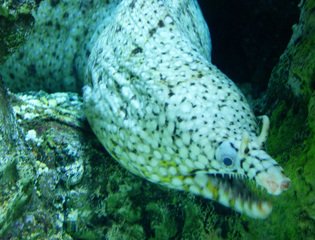
Introduction
Moray eels of the genus Gymnothorax form the largest and most diverse group within the family Muraenidae, with over 120 recognized species found in tropical and subtropical oceans worldwide. Their elongated, snake-like bodies and vivid color patterns have made them iconic residents of coral reefs and rocky coastlines. Despite their fearsome reputation, moray eels are secretive and shy, playing a vital role as apex predators in reef ecosystems. Their unique anatomy, including a second set of pharyngeal jaws, makes them one of the most extraordinary vertebrate hunters in the marine world.
Taxonomy
The genus Gymnothorax belongs to the order Anguilliformes and the family Muraenidae. With over 120 species, it is the most species-rich moray eel genus. Species range from the giant moray eel (Gymnothorax javanicus), reaching 3 meters, to small cryptic species barely 30 centimeters long. Mitochondrial DNA studies have resolved deep phylogenetic structure within the genus and identified species complexes previously masked by morphological similarity. The family Muraenidae diverged from other anguilliform lineages during the early Cretaceous.
Physical Characteristics
Gymnothorax moray eels have a cylindrical, scale-less body lacking pectoral and pelvic fins, with dorsal, caudal, and anal fins merged into a continuous ridge. Most species grow to 1–2 meters. Their thick, mucus-coated skin provides protection against parasites and abrasion. Coloration ranges from uniform gray to complex patterns of spots and reticulations that serve as camouflage. Their most remarkable feature is a second set of pharyngeal jaws in the throat, which can be projected forward to grasp and drag prey into the esophagus.
Habitat
giant squid giant squid shares comparable ocean habitats with this species.
Gymnothorax species inhabit coral reefs, rocky coastlines, and shallow lagoons at depths from the intertidal zone to around 200 meters. During the day they shelter in crevices and caves, emerging at night to hunt across the reef. Complex three-dimensional coral structure provides the crevice shelter essential for their survival. Coastal development, dredging, and coral bleaching that simplify reef structure directly reduce available shelter for moray eel populations.
Diet
great white shark great white shark shares comparable ocean habitats with this species.
Moray eels are carnivorous ambush predators feeding primarily on fish, crustaceans, and cephalopods. Their nocturnal activity reduces competition with diurnal reef predators. The pharyngeal jaw is deployed to grip large or struggling prey, allowing moray eels to swallow items exceeding the width of their heads. Some Gymnothorax species participate in cooperative hunting with , flushing prey toward the waiting fish in documented arrangements across Indo-Pacific and Atlantic reefs. Like the whale shark, moray eels rely heavily on chemical cues and sensory systems to locate prey in low-visibility conditions.
Reproduction
Gymnothorax moray eels are broadcast spawners that release eggs and sperm into the water column for external fertilization. Leptocephalus larvae drift in oceanic currents for weeks to months before metamorphosing into juvenile eels that settle on reefs. Age at sexual maturity ranges from 2–3 years in small species to 5–8 years in larger species. No parental care is provided after spawning. Some species may be protogynous hermaphrodites, transitioning from female to male at larger sizes.
Conservation
The IUCN has assessed most Gymnothorax species as Data Deficient or Least Concern due to limited population monitoring. Targeted fisheries affect some species locally, and bycatch in reef fisheries contributes to mortality. The most pervasive threat is habitat degradation, as coral reef decline reduces both shelter availability and prey abundance. Marine protected areas that enforce no-take zones benefit moray eel populations indirectly by maintaining prey populations and shelter quality.
Fun Facts
Moray eels are the only vertebrate animals that use a second set of pharyngeal jaws to actively capture and restrain prey—a feature so unusual it inspired the alien predator in the film Alien. Despite their snake-like appearance, they are specialized bony fish, not reptiles. Moray eels produce a thick, antibiotic mucus coating that protects their skin from parasites. They can live for more than 30 years in the wild, with individual giant moray eels documented on the same reef territory for decades. When threatened, they retreat into crevices and knot their bodies to wedge themselves in place. Like the seahorse, moray eels form monogamous pair bonds during the breeding season, though in their case this involves synchronized spawning behavior rather than physical pairing. Like the common octopus, moray eels are considered highly intelligent among fish, with documented problem-solving abilities and complex spatial memory.