 By st20113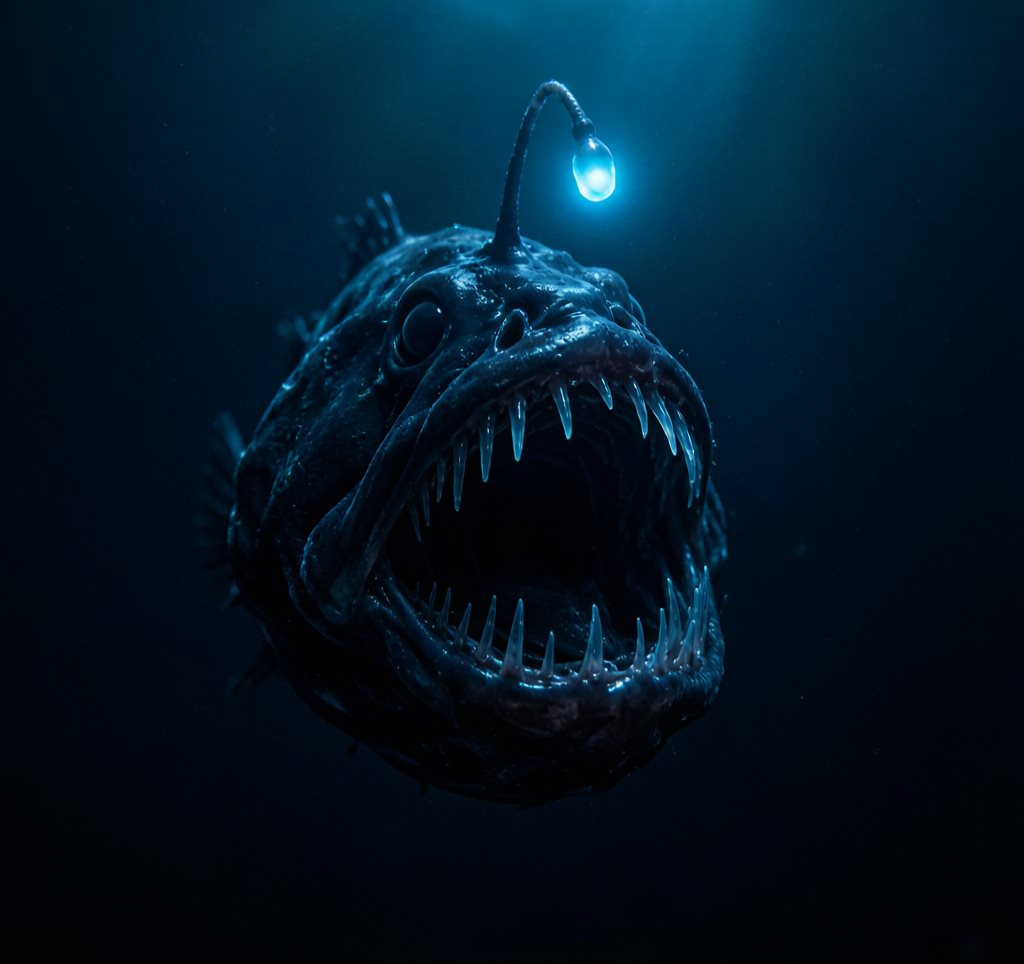
Introduction
The Humpback Anglerfish (Melanocetus johnsonii) is one of the most iconic and otherworldly creatures inhabiting the deep ocean. Belonging to the family Melanocetidae, this species is renowned for the extraordinary bioluminescent lure that extends from its forehead, a glowing beacon that has earned anglerfish a permanent place in marine biology lore. Found throughout the world tropical and subtropical oceans at depths far beyond the reach of sunlight, the Humpback Anglerfish exemplifies the extraordinary adaptations that arise in response to the extreme pressures, temperatures, and perpetual darkness of the deep-sea environment. The species name johnsonii honors James Johnson, a pioneering naturalist who contributed to early studies of deep-sea ichthyology.
The Humpback Anglerfish exhibits one of the most extreme examples of sexual dimorphism seen in the animal kingdom. Adult females grow to approximately 20 centimeters in body length and bear the characteristic esca, the bioluminescent lure. Males, by contrast, are tiny and free-living for only a portion of their lives, eventually fusing permanently to the body of a female in one of the most extraordinary reproductive strategies found in any vertebrate.
Taxonomy
The Humpback Anglerfish was formally described by George Shaw and Frederick Nodder in 1804, placing it in the genus Melanocetus, a name derived from the Greek words melas (black) and ketos (whale), reflecting the dark coloration of the fish. The family Melanocetidae contains fewer than ten recognized species distributed across two genera. Within the broader order Lophiiformes, which includes all anglerfish, the Humpback Anglerfish belongs to the suborder Ceratioidei, the deep-sea anglerfish, comprising approximately 160 species divided among 11 families.
The Blobfish, though belonging to a different family entirely, shares the Humpback Anglerfish deep-sea habitat and the physiological challenges of life in the bathypelagic zone. Molecular phylogenetic studies suggest that the Humpback Anglerfish lineage diverged from other deep-sea anglerfish groups during the Eocene epoch, approximately 34 to 56 million years ago. The parasitic male attachment system appears to have evolved independently in multiple anglerfish lineages, representing a striking example of convergent evolution driven by the unique pressures of deep-sea life.
Physical Characteristics
The Humpback Anglerfish possesses a body morphology heavily modified for deep-sea predation. The body is globular and somewhat compressed laterally, with a disproportionately large head that makes up roughly one-third to one-half of the total body length. The mouth is enormous, capable of opening to an angle of well over 100 degrees, framed by powerful, recurved teeth that interlock when the mouth is closed to prevent struggling prey from escaping. The teeth are sharp and fang-like, and they can be depressed inward to allow prey to pass into the mouth but prevent reverse passage. The body skin is thin, loose, and velvety to the touch, typically black or very dark brown, and is not covered by typical fish scales.
The most visually arresting feature of the female is the bioluminescent lure, technically called the esca, mounted on a stalk rising from the top of the head. This specialized dorsal spine is tipped with a light-producing organ called a photophore, containing colonies of bioluminescent bacteria that produce a steady or pulsating blue-green glow. The females skin also contains additional, smaller photophores scattered across the head and body, which may serve to disrupt the fish silhouette against the faint ambient light from above, a camouflage technique called counter-illumination. Males are dramatically different: tiny, approximately 2.8 centimeters in length, lacking the bioluminescent lure entirely.
Habitat
The Humpback Anglerfish inhabits the bathypelagic zone of the open ocean, generally occurring at depths between 1,000 and 4,000 meters below the surface, though it has been recorded as deep as 4,500 meters. This depth range corresponds to the bathypelagic layer, where sunlight is completely absent and temperatures hover near freezing, typically between 2 and 4 degrees Celsius. The species is found in all of the world major ocean basins, including the Atlantic, Pacific, and Indian Oceans, and its distribution is cosmopolitan across tropical and subtropical latitudes.
The bathypelagic habitat is characterized by extreme conditions that would be lethal to most marine organisms. Water pressure at these depths exceeds 100 to 400 atmospheres, and the environment is pitch-black except for faint bioluminescent glows produced by deep-sea organisms. Food is scarce, and encounters with potential prey are infrequent. The Giant Squid is another bathypelagic predator that has evolved to exploit the scarce resources of the deep ocean, using active pursuit rather than the ambush strategy employed by the Humpback Anglerfish.
Diet
The Humpback Anglerfish is an opportunistic ambush predator that employs its bioluminescent lure to attract prey in the absolute darkness of the deep ocean. The female hangs motionless in the water column, her esca glowing softly, and waits for curious deep-sea organisms to approach the light. When a potential meal comes within striking range, the Humpback Anglerfish lunges forward with explosive speed, swinging its massive head and opening its cavernous mouth to create a powerful suction force that pulls the prey inside. The strike-and-capture sequence takes only a few milliseconds, and the anglerfish elastic stomach allows it to swallow prey nearly twice its own body mass.
The diet consists primarily of crustaceans such as decapods and amphipods, and a wide variety of small to medium-sized fish. Squid, including juvenile specimens of larger deep-sea species, are also consumed when available. An interesting dietary item occasionally documented in stomach contents is the fecal pellets of large cephalopods, which sink through the water column and provide a nutrient-rich food source even in the absence of live prey. A large meal may sustain a female for weeks or months, allowing her to survive periods of extreme food scarcity that characterize the bathypelagic zone.
Reproduction
The reproductive biology of the Humpback Anglerfish is the most extraordinary aspect of an already extraordinary species. Adult males do not possess the bioluminescent lure or the enormous mouth that characterizes females, and they live only a brief free-living existence after hatching. During this phase, the male sole biological imperative is to locate a female. When a male encounters a female, he latches onto her body using his hook-like teeth and releases an enzyme that gradually dissolves both his and her skin, fusing the two individuals together at the circulatory level. Once fused, the male regresses into a parasitic appendage, losing most of its organs and becoming entirely dependent on the female bloodstream for nutrition.
A single female may carry multiple fused males simultaneously, with records documenting up to six or more individual males attached to a single female. Each fused male contributes sperm to the female reproductive system. When the female spawns, she releases egg strands containing thousands of embryos into the open water, where they develop and hatch as free-living larvae. The larvae drift in the upper ocean layers during early development before descending to greater depths as they mature.
Conservation
The Humpback Anglerfish is listed as a species of Least Concern by the IUCN Red List, reflecting its extremely broad geographic distribution and the fact that deep-sea trawling has not yet caused detectable population declines. However, deep-sea ecosystems remain among the least studied on Earth, and the Humpback Anglerfish naturally low population density means that detecting population trends requires extensive survey effort. The expansion of deep-sea fisheries, particularly bottom trawling operations, poses an increasing risk of bycatch mortality to non-target species.
Emerging threats from deep-sea mining operations represent a significant concern for Humpback Anglerfish populations and the broader deep-sea ecosystem. The physical disturbance of the seafloor, the generation of sediment plumes, and the potential for toxic metal release could have far-reaching consequences for deep-sea biodiversity. Microplastic pollution has been documented in the digestive systems of deep-sea fish across multiple ocean basins, suggesting that even the most remote organisms are not immune to the consequences of human activity at the surface.
Fun Facts
The Humpback Anglerfish is perhaps the most widely recognized deep-sea fish in the world, serving as the archetypal image of deep-sea weirdness in countless documentaries, films, and natural history illustrations. One remarkable aspect is the sheer size of its teeth relative to its body: the largest teeth can be over two centimeters long in a fish measuring only 15 to 20 centimeters in total length. The Tiger Shark shares the Humpback Anglerfish reputation as a formidable predator, though they operate in entirely different marine environments, from sunlit shallows to the pitch-black abyss.
Deep-sea anglerfish were unknown to science until the late nineteenth century, when early scientific expeditions began to sample the deep ocean using new trawling technologies. The discovery of the parasitic male was one of the most surprising zoological revelations of the era. Today, researchers continue to discover new species of deep-sea anglerfish in unexplored regions. Each new observation via remotely operated submersibles reveals previously unknown behaviors, underscoring how much remains to be learned about the mysterious world these remarkable fish call home.