 By st20113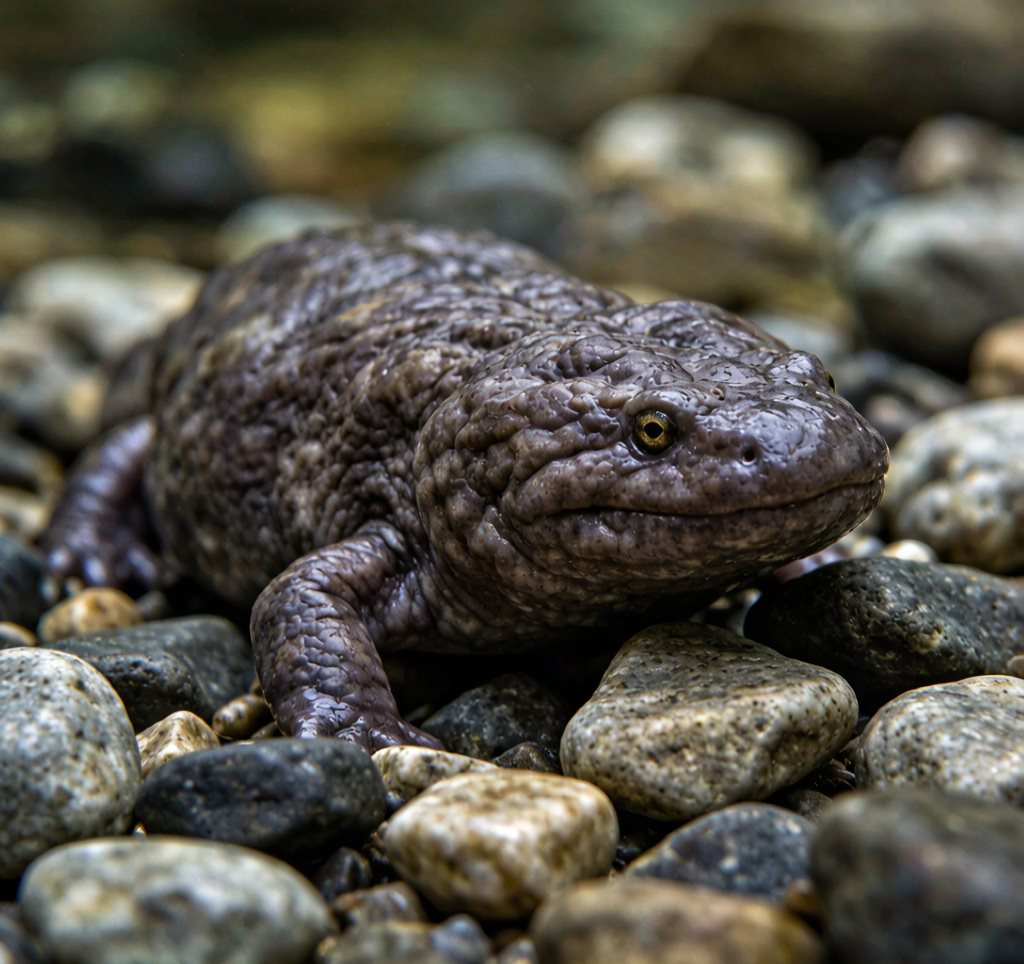
Introduction
The Hellbender (Cryptobranchus alleganiensis) is a large, fully aquatic salamander native to the fast-flowing rivers and streams of eastern and central North America. As one of the largest salamanders in the world and the largest completely aquatic salamander in the Western Hemisphere, it spends its entire life submerged in cold, well-oxygenated water. Often called the “groundpawn” in older folk traditions, the Hellbender has a distinctly primitive appearance that has led some to liken it to a living fossil. Despite its intimidating name, the Hellbender is a docile creature that poses no threat to humans and serves as a vital indicator species for the health of the freshwater ecosystems it inhabits.
The species comprises two subspecies: the Eastern Hellbender found from New York to Georgia, and the Ozark Hellbender restricted to the White River system in Missouri and Arkansas. Both subspecies have experienced dramatic population declines over the past half-century, earning the species a listing as Endangered under the U.S. Endangered Species Act. When Hellbender populations thrive, the surrounding aquatic ecosystem is almost certainly healthy.
Taxonomy
The Hellbender was formally described in 1821 by French naturalist Francois Marie Daudin, who placed it in its own genus, Cryptobranchus. The genus name derives from the Greek words kryptos (hidden) and branchos (gill), a reference to the externally visible gill structures retained throughout life. The species name alleganiensis references the Allegheny Mountains, a key region in the salamander historical range. The Hellbender belongs to the family Cryptobranchidae, a primitive group of salamanders that also includes the Axolotl (Ambystoma mexicanum) and the giant salamanders of Asia, representing one of the oldest lineages of modern salamanders.
Within Cryptobranchidae, the Hellbender is the only member of its genus and the only species of giant salamander in the Americas. Its closest relatives are the Asian giant salamanders of the genus Andrias, which include the Chinese Giant Salamander reaching lengths of nearly two meters. Genetic studies suggest that the Hellbender lineage diverged from its Asian cousins approximately 65 to 70 million years ago.
Physical Characteristics
The Hellbender is an impressively large amphibian, with adults typically measuring between 30 and 74 centimeters in total length. Its body is exceptionally flattened from top to bottom, an adaptation that allows it to squeeze beneath flat rocks and navigate the narrow crevices of fast-flowing stream beds. The head is broad and flattened, with a wide mouth and small, lidless eyes positioned on top of the head for vision from below. A distinctive fold of loose, baggy skin runs along each side of the body from behind the head to the tip of the tail, greatly increasing the surface area available for cutaneous respiration.
The limbs are short and stubby, each bearing four toes on the front legs and five on the rear, used primarily for maneuvering beneath submerged cover. The tail is flattened laterally and functions as the primary swimming organ. Coloration varies with habitat, typically ranging from mottled brown and gray to olive or reddish-brown, with darker blotches that provide effective camouflage against rocky stream bottoms. Like many aquatic salamanders, the Hellbender retains its external gills throughout life: three pairs of bushy, bright red external gills located just behind the head.
Habitat
Hellbenders are obligate inhabitants of clear, cold, fast-flowing streams and rivers with high dissolved oxygen content and a substrate of large, flat rocks that provide essential shelter. They require permanent flowing water systems that never dry up, freeze solid, or experience severe pollution. Temperature is a critical factor: Hellbenders require water temperatures below approximately 25 degrees Celsius, and populations decline sharply in streams that warm significantly during summer months. This thermal sensitivity restricts the species to higher elevations, spring-fed headwaters, and shaded valley floors where groundwater inputs help maintain consistently cool temperatures.
The quality of available cover, specifically large flat rocks that can be lifted to create a suitable shelter cavity, is the primary limiting factor for Hellbender populations in most streams. Where such cover is abundant, population densities can reach up to several hundred individuals per kilometer of suitable stream. The loss of large cover rocks due to stream channel modification, sedimentation, or flood control projects has been a major driver of population decline across much of the Hellbender range.
Diet
The Hellbender is a nocturnal predator that feeds primarily on crayfish and small fish, though its diet can include a wide variety of aquatic invertebrates depending on availability. Crayfish are the dominant prey item in most populations, sometimes accounting for 90 percent or more of total food intake. The Hellbender hunts by night, emerging from its shelter to prowl the stream bottom in search of prey. It uses a sit-and-wait strategy, lurking motionless beneath a rock and lunging at any small animal that passes within range. Prey is captured with a rapid snap of the wide, powerful jaws and swallowed whole.
Interestingly, Hellbenders do not feed during winter months when water temperatures drop significantly, entering a period of reduced metabolic activity from October through March. Fasting during this period is an energy-conservation strategy, as the salamander prey items are less active and less available in cold water. The Red-Eyed Tree Frog and the Hellbender, though vastly different in size and habitat, both serve as indicators of environmental health in their respective ecosystems.
Reproduction
Hellbenders reach sexual maturity at approximately five to eight years of age, and breeding occurs annually once maturity is reached. The breeding season takes place in late summer and early autumn, typically between August and October. During this period, males excavate a shallow nest cavity beneath a large flat rock, creating a depression in the gravel substrate that serves as a brood chamber. When a female enters the nest, the male coils his body around her and helps her release a string of eggs, which he immediately fertilizes externally. A single female may produce between 150 and 500 eggs per clutch, depending on her size and age.
The male remains with the clutch after fertilization, coiling his body around the egg mass and using fanning movements of his tail and limbs to aerate the eggs and prevent fungal growth. This paternal care is one of the most extensive examples of parental investment seen in amphibians. The eggs hatch after approximately 45 to 80 days, producing larval Hellbenders that resemble miniature adults but bear external gills. These larvae remain in the nest for several weeks before dispersing into the surrounding stream.
Conservation
The Hellbender is listed as Endangered by the IUCN Red List and is protected under the U.S. Endangered Species Act, with both subspecies facing severe population declines estimated at over 70 percent in many parts of their range over the past 50 years. The primary threats include habitat degradation caused by dam construction, channel modification, sedimentation, and agricultural runoff. Siltation smothers the rocky substrates that Hellbenders require for shelter and breeding, while agricultural runoff introduces excess nutrients and pesticides that degrade water quality.
Introduced species also pose significant threats. Non-native fish such as trout, stocked widely in Appalachian streams for sport fishing, compete with Hellbenders for food and space and may prey on juveniles. The disease chytridiomycosis, caused by the fungal pathogen Batrachochytrium dendrobatidis, has been detected in some Hellbender populations. Conservation programs are focused on habitat restoration, the placement of artificial cover structures, and the captive breeding of individuals for reintroduction into restored habitats.
Fun Facts
The Hellbender name derives from an old folk belief that the animal was venomous or could inflict harm with its bite. In reality, the Hellbender is completely harmless to humans and will not bite unless handled roughly. Despite its fearsome name and formidable size for a salamander, the Hellbender is a gentle giant that would far rather retreat into a rocky crevice than confront any potential threat.
The Hellbender breathes almost entirely through its skin and the membranes of its externally visible gills, making it one of the most completely aquatic of all amphibians. The loose, wrinkled skin contains a network of lateral line organs that can detect minute vibrations and pressure changes in the surrounding water, effectively giving the Hellbender a sixth sense tuned to the movements of prey and predators in the dark, fast-flowing environment it calls home. The Poison Dart Frog shares the Hellbender sensitivity to environmental contamination, and both species serve as bioindicators of habitat quality.