 By st20113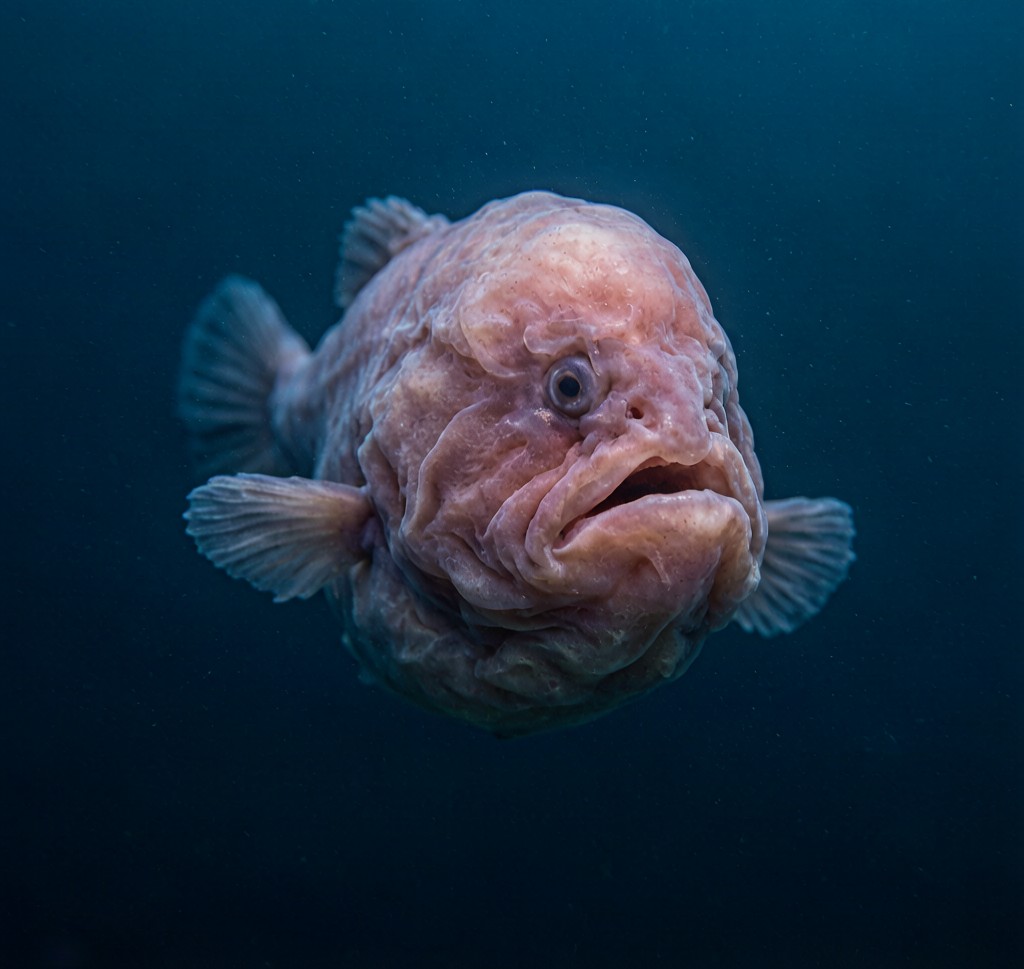
A Blobfish (Psychrolutes marcidus) in its deep-sea habitat, displaying its characteristic gelatinous body adapted to extreme ocean depth pressure
Overview
The Blobfish (Psychrolutes marcidus) is perhaps the most unusual-looking fish in the world and has achieved international fame as the “ugliest animal in the world” – a title bestowed by the Ugly Animal Preservation Society in 2013. Found in the deep waters off the coasts of Australia, Tasmania, and New Zealand at depths of 600 to 1,200 meters, the Blobfish has become an icon of deep-sea conservation and a symbol of the often bizarre and unexpected forms that life takes in the ocean’s least-explored depths.
The Blobfish’s peculiar appearance is entirely a product of its extreme habitat. At the ocean depths where it lives, the pressure is approximately 60 to 120 times greater than at the surface. To survive in this crushing environment, the Blobfish has evolved a body that is almost entirely gelatinous – a soft, watery, jelly-like mass with a density slightly less than that of seawater. This allows it to float just above the sea floor without expending energy on swimming. Its flesh is a semi-transparent, pinkish-grey gel that would collapse into a shapeless blob if brought to the surface, where the dramatic reduction in pressure would cause it to expand and lose all structural integrity. The sad, drooping face for which the Blobfish is famous is not its natural appearance at depth – it only manifests when the fish is removed from its high-pressure environment.
Deep Sea Habitat
The Blobfish inhabits the continental slope – the steep undersea terrain that descends from the continental shelf to the abyssal plain – at depths of 600 to 1,200 meters in the waters between southeastern Australia (particularly the slopes off Tasmania), and around New Zealand. At these depths, sunlight is entirely absent, water temperatures hover between 2 and 9 degrees Celsius, and the pressure would instantly crush most surface-dwelling organisms. The deep-sea environment is one of the most challenging and least-explored habitats on Earth, with conditions so extreme that only specially adapted organisms can survive.
Despite the apparent hostility of this environment, the Blobfish’s deep-sea habitat is teeming with life – including other gelatinous organisms like jellyfish and siphonophores, deep-sea fish with bioluminescent lures, bizarre crustaceans, and a diversity of invertebrates that form complex ecological communities on the seafloor. The Blobfish is part of this community, drifting just above the muddy sea floor where it feeds. The deep-sea floor in this region is relatively flat and featureless, covered in fine sediments that accumulate from the slow rain of organic material – the “marine snow” – from the productive surface waters above.
Biology and Behavior
The Blobfish grows to approximately 30 to 38 centimeters in length and has a soft, rounded body that lacks scales, swim bladders, and most of the musculature found in surface-dwelling fish. Its body is composed of a gelatinous matrix – a jelly-like substance – that is slightly less dense than seawater, giving the fish natural buoyancy. This adaptation allows the Blobfish to hover in place without using energy to swim, which is critical given the low food availability at these depths. The fish’s eyes are small and set high on its head, and its mouth is oriented upward, suggesting an ambush feeding strategy.
The Blobfish feeds on small crustaceans, sea urchins, and mollusks that drift across the sea floor or live in the sediment. Rather than actively hunting, the Blobfish is thought to simply open its mouth and suck in whatever prey items pass by – a passive, energy-conserving strategy that suits its low-metabolism lifestyle. The species’ reproductive strategy is unusual among fish: the Blobfish is one of a relatively small number of species that guard their eggs. Adults have been observed nesting in clusters on the seafloor, with both parents apparently guarding the eggs until they hatch.
Conservation
The Blobfish is currently listed as Vulnerable on the IUCN Red List, reflecting concerns about population declines driven primarily by bottom trawl fisheries. Despite its deep-water habitat, the Blobfish is inadvertently caught by deep-sea trawlers who target other species – particularly the Orange Roughy and other deep-sea fish. As a slow-growing, late-maturing species with low reproductive rates, the Blobfish is extremely vulnerable to even modest levels of bycatch mortality, and populations may take many decades to recover from any decline.
The Blobfish has become a conservation flagship species for the protection of deep-sea ecosystems – environments that are increasingly threatened by expanding deep-sea fishing, oil and gas extraction, and the emerging practice of deep-sea mining. The deep-sea floor habitats where the Blobfish lives are home to a remarkable diversity of unique and highly specialized species, many of which are yet to be scientifically described. Conservation efforts focus on reducing deep-sea trawl fishing through marine protected areas, improving bycatch mitigation measures in existing fisheries, and increasing scientific exploration of deep-sea ecosystems to understand their biodiversity and vulnerability to human impacts.