 By st20113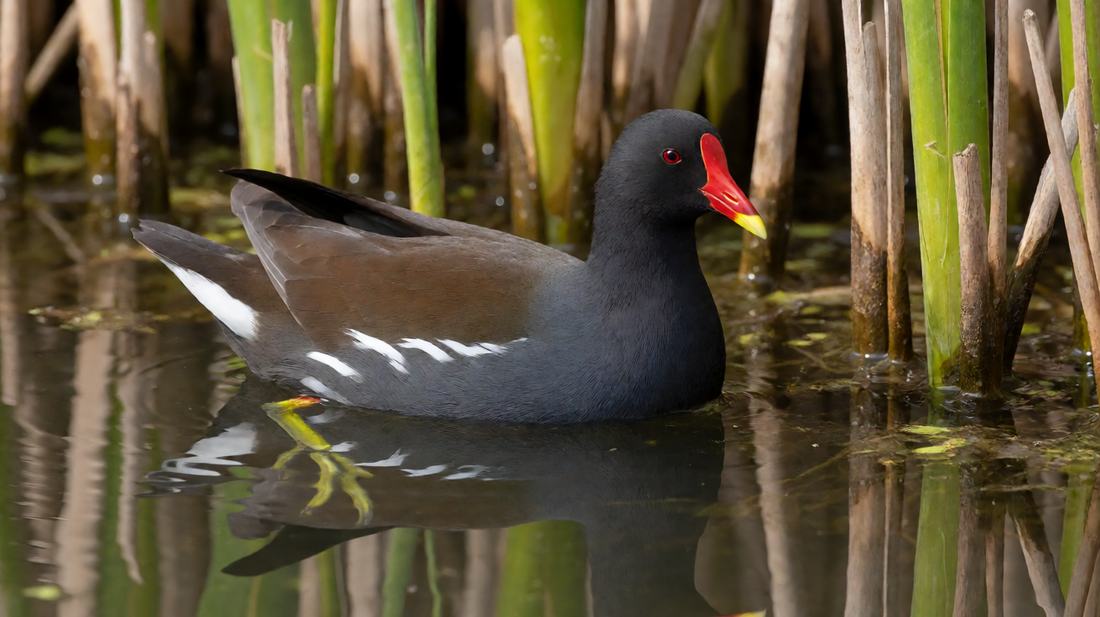
Gallinula chloropus | Common Moorhen
Species Profile · Rallidae
Common Moorhen
A stocky rail of the pond edge that walks the lily pads on unwebbed toes — slaty-black, red-billed, and one of the few wetland birds that has thrived on the modern landscape.
IUCN: Least Concern
Range
Length
Weight
Nest
Broods
The bird of the pond edge
A rail that lives with people
The common moorhen is a stocky, short-winged bird of the rail family Rallidae. It is among the most widespread waterside birds of the lowland landscape. The same bird slips through the reed beds of a village pond in Europe. It also walks the margin of a mountain tarn in Asia and a city lake in Africa. It is among the most cosmopolitan of all rails. It is one of the few that has thrived alongside people. The bird is unmistakable on the water. Its body is slaty black.
Its bill is red and yellow. Its frontal shield is red. Its long greenish legs trail behind as it swims. It is a bird of the edge, not open water. It feeds by walking on floating leaves and stems. It dives only when hard pressed. It flicks its white-cornered tail as it walks. It gives a loud, explosive alarm.
This makes it a constant presence of the pond and ditch. The drab young and the smart adult show the clearest change with age among rails. The moorhen likes still or slow water, not rivers or the sea. In Europe its numbers have spread and grown. The digging of gravel pits and the making of amenity lakes gave it more homes. It is now abundant across the lowlands. It is moving north as the climate warms.
Family tree
Gallinula, the small rails
The common moorhen is in the genus Gallinula, a group of small rails. They differ from the coots by the round, not lobed, toe. They have a frontal shield at the bill base. The moorhen is close to the Eurasian Coot (Fulica atra). That larger, more aquatic rail shares the habit of swimming with the head dipped and the tail cocked.
This shows that the rails are an ancient, successful group of ground birds. They have colonised the wetlands of every continent. In the moorhen and the coot they produced two of the commonest birds of the temperate pond. Linnaeus described the bird in 1758. Experts now see a large number of subspecies across the huge range.
The small dark birds of the Pacific islands differ from the large pale birds of mainland Australia. The European form is the nominate chloropus. It differs from its tropical kin by the bright shield and the clean black underparts. The spread to the southern oceans produced forms that some treat as species and others as races of one wandering bird.
Shield, bill and trailing legs
How to identify one
An adult common moorhen is 30 to 38 centimetres long. Its wingspan is 50 to 55 centimetres. The smaller bird weighs about 0.2 kilogram. The larger one can reach 0.5 kilogram. The long toes give it a low shape as it walks the lily pads. Its flight is weak. It flaps just above the surface and seldom flies long. The adult is slaty black above and below. The back is browner.
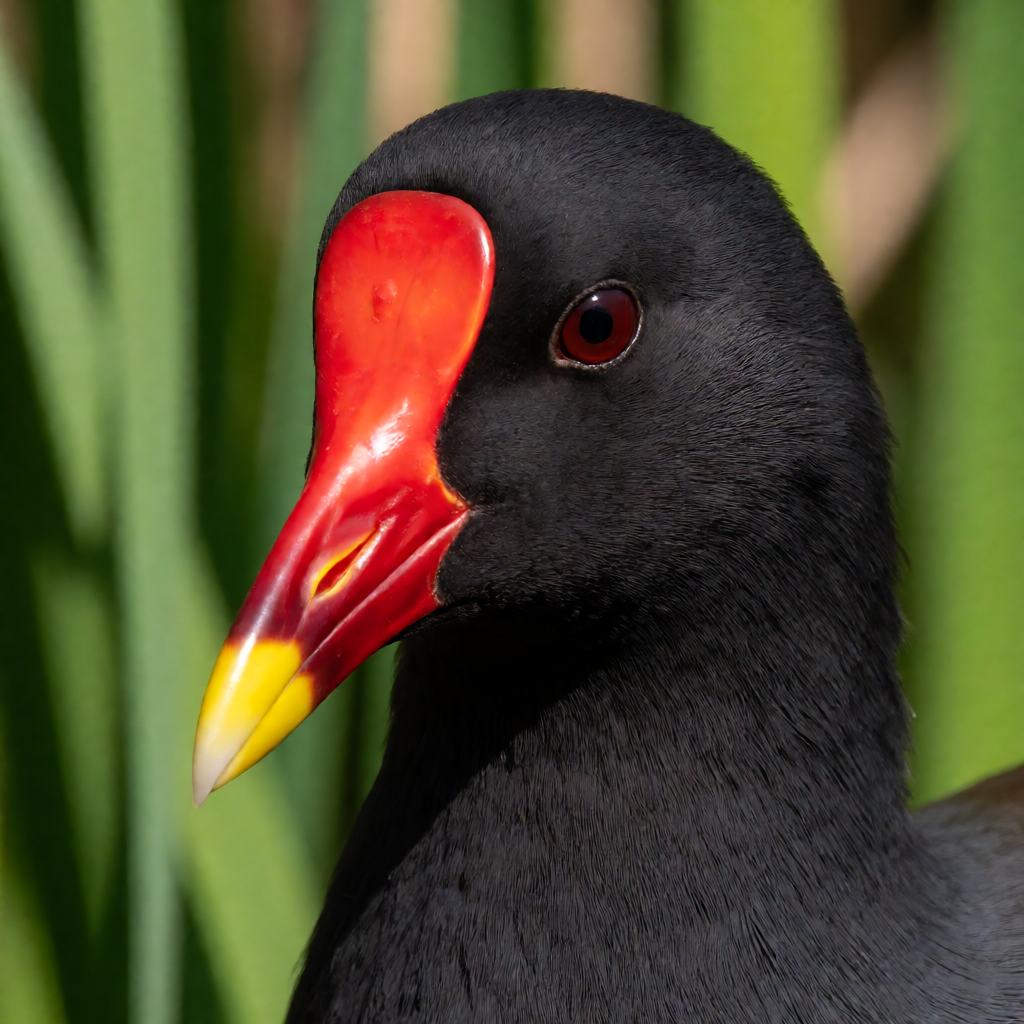
The flank is greyer. The bill is red and shades to yellow at the tip. The frontal shield is red on the forehead. The legs are greenish yellow and lobed but not webbed. They spread the weight so the bird can walk on floating plants. The undertail coverts are white. This patch shows as the bird flicks its tail. It is one of the best field marks. The young bird is plain dark grey-brown with a greenish bill and no shield.
The two are told apart by the face and the bill. The wings are short and round. Flight is weak and direct with the legs dangling. The voice is a loud, explosive series of notes. It serves as alarm and in flock disputes. The wing feathers moult soon after breeding. The flightless adults keep to thick cover for the weeks they cannot fly.
1
2
3
Ponds, ditches, gravel pits
Where it lives
The moorhen lives on still or slow fresh water with a fringe of plants. Above all it needs the cover of reed, rush and waterside shrub to hide, feed and nest. Beyond lies the open water. The species is absent from fast rivers and the open sea.
It is a creature of the pond, ditch, canal, gravel pit, marsh and flooded meadow of the lowland and mountain alike. In Europe the birds are resident across the milder west and north to the limit of ice-free water. They breed from the lowland fens to the upland tarns wherever the plants are thick. In the colder east the birds move south in winter to the ice-free waters of the Mediterranean and Caspian.
The moorhen is a weak, reluctant migrant. It travels chiefly at night and for short distances. Rings show a single bird may stay on one pond for the whole of a life that can exceed ten years. The young disperse along the waterways to find their own ground.
An omnivore of the margin
What it eats
The moorhen is an omnivore of the waterside. Its diet mixes leaves, seeds and shoots of margin plants. It takes these by walking on floating plants and reaching up to the stems. It also takes the small animals that live among them. A bird on a weedy pond eats the soft parts of reed and sedge. It eats grass and herb seeds.
It eats the insects and snails of the mud. It eats the worms of the bank. When it can, it takes small fish, tadpoles and the eggs of other reed-bed birds. The moorhen feeds by walking and probing, not by diving. It swallows grit to help the gizzard crush the hard seed. It tolerates the polluted, rich water of the town well.
This is why it thrives on the canals and amenity lakes of the city. It is one of the few wetland birds that has grown, not shrunk, under the modern landscape. The gravel pit and the ornamental pond are exactly the homes it favours. The spread of these let it reach country where it was once absent.

A cup in the reeds
The breeding cycle
Moorhens pair in the spring. The bond lasts one breeding season or, in the mild west, the whole year. The two adults share the nest, the sitting and the care of the young. The male takes a full part in the brood. This is odd among rails. It lets the pair raise several families in one summer.
Nesting starts in late April and runs into early autumn. The site is a bulky cup of dead leaves and stems in dense plants at the water’s edge. It is often over a shallow flooded margin and hidden among the reeds. The female lays a clutch of five to eleven eggs. They are spotted dark on a pale ground. Both sexes sit on them for twenty-one to twenty-five days.
The birds may rear two or three broods in a good year. The chicks are born downy and black with a red bill. They leave the nest within a day or two of hatch. The parents feed them and defend them against marsh predators. They can fly at forty to fifty days. By then the family has split up and the young have dispersed along the waterways to find their own ground.
A bird that has spread
Conservation
The common moorhen is Least Concern on the global Red List. Its recent history is mostly a win. The European population has grown and moved north with the warming climate. The spread of gravel pits and amenity lakes helped this. The tropical and southern populations have held their numbers across the huge range. The species is now among the commonest birds of the temperate and warm pond. It is still spreading in many parts of its range.
The species is protected across its range. In Europe the key wetlands are reserves. They are managed to hold the plant fringe the bird needs. The international deals on migratory waterbirds have cut the shooting on passage and winter flocks. Yet the bird depends on still water and dense cover. It is vulnerable to the drainage and clearing of the lowland marsh. It is listed on the African-Eurasian Waterbird Agreement as a bird of interest.
The main threats are the loss of reed bed and waterside shrub to canal and lake work. The predation of the nest by introduced and feral mammals is another. The pollution of town water hurts. Recreation disturbs the best margins. Managing the moorhen means keeping the cover and still water across the lowlands and controlling the mammals that take the eggs.
Quick hits
Five things to remember
- The moorhen walks on the floating leaves and stems of the pond on long greenish toes that are not webbed. They spread the weight. This lets it step on a lily pad that would sink a bird with ordinary feet.
- The adult has a bright red frontal shield on the forehead and a red bill that shades to yellow at the tip. The young moorhen is a plain dark grey-brown bird with a greenish bill and no shield. The two look like different species.
- The moorhen flicks its white-cornered tail as it walks. The flash of white is one of the best ways to tell it from the darker, more aquatic coot it often shares the water with.
- Both sexes share the nest, the sitting and the care of the young. This lets a pair raise two or three broods in one summer. Such care by the male is odd among rails.
- The moorhen is among the most widespread birds of the pond. The same species walks the margin of a village pond in Europe, a mountain tarn in Asia and a city lake in Africa. It has thrived alongside people on every continent.