 By st20113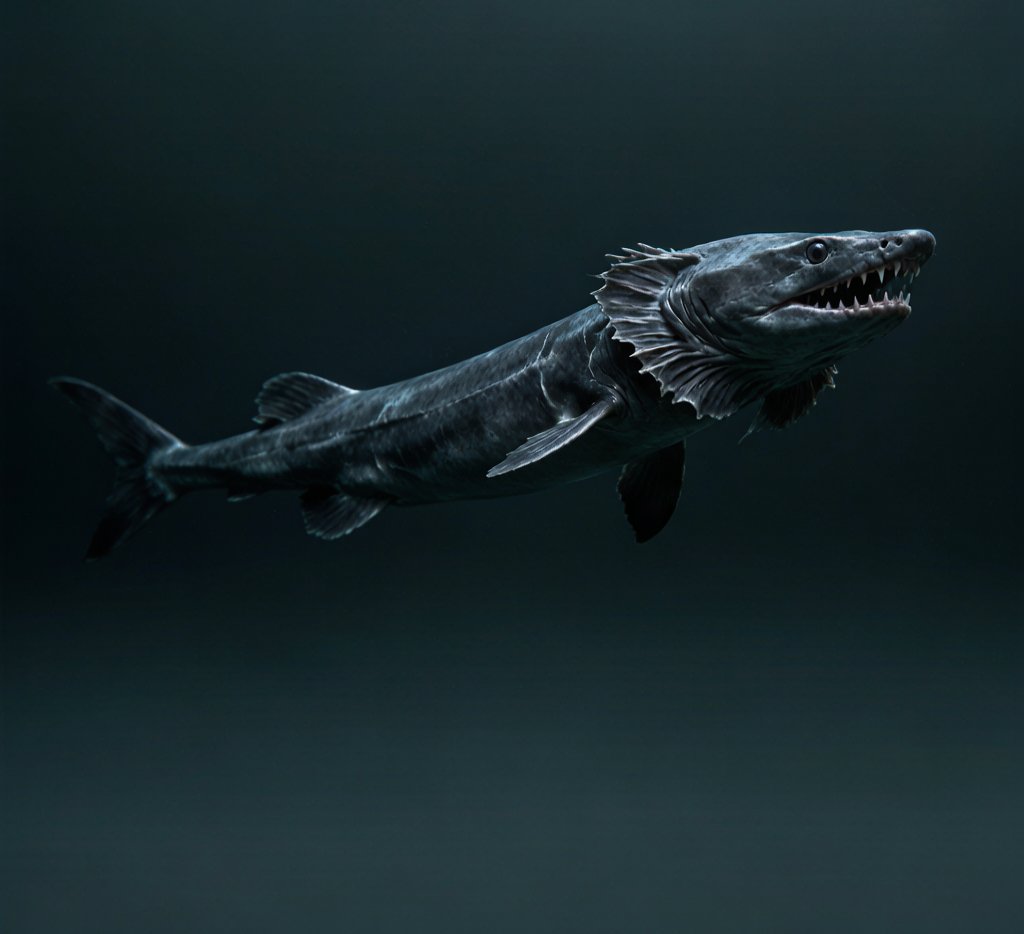
Introduction
The frilled shark (Chlamydoselachus anguineus) is one of the most primitive and unusual shark species alive today. With an elongated, eel-like body and six pairs of frilly gill slits resembling a ruffled collar, this deep-sea dweller looks more like a mythical sea serpent than a conventional shark. The species belongs to one of the oldest surviving shark lineages, having changed remarkably little from ancestors that swam the Cretaceous seas over 80 million years ago. Despite its serpentine appearance, the frilled shark is entirely aquatic, spending its life in deep, cold waters far from human contact. It was first formally described in 1884 from specimens found in Japanese waters, though coastal communities had long been aware of its existence through accidental catches.
Taxonomy
The frilled shark belongs to the family Chlamydoselachidae and the order Hexanchiformes, which also includes cow sharks. Its scientific name translates from Latin as sheath-like serpent shark, a reference both to its frilled gill slits and its sinuous body form. It is the only living species in its genus, making it a true living fossil. Fossil evidence suggests the frilled shark lineage diverged from other sharks during the Late Jurassic or Early Cretaceous, and very little morphological change has occurred since. Some researchers have argued it warrants its own separate order, given its unique combination of primitive and derived traits.
Physical Characteristics
The frilled shark has a cylindrical, eel-like body reaching up to 2 meters (6.6 feet) in length. Its mouth holds approximately 300 trident-shaped teeth in 25 rows, each bearing three cusps adapted for grasping slippery prey such as squid and fish. The six pairs of frilly gill slits are the species’ most distinctive feature, partially visible even when the mouth is closed. The skin is dark brown to blackish-gray, providing effective camouflage in the dimly lit deep-sea environment. Like the whale shark, the frilled shark has a soft, flexible body that bends and maneuvers through complex seafloor terrain. There is no anal fin.
Habitat
Frilled sharks inhabit the outer continental shelf and upper continental slope at depths between 120 and 1,300 meters (390 to 4,270 feet). They have been recorded off Norway, France, Portugal, the Azores, the United States, Brazil, southern Africa, Japan, New Zealand, and Australia. They prefer deep, cold waters with muddy or sandy bottoms, and are almost never encountered by humans. Most scientific knowledge comes from specimens accidentally caught in deep-sea nets or found in coastal strandings. The frilled shark appears to be most active near the seafloor but can swim through the water column when pursuing prey.
Diet
The frilled shark feeds primarily on cephalopods, including squid and octopuses, as well as various deep-sea fish. Its elongated body and highly distensible jaws allow it to swallow surprisingly large prey whole, a strategy well suited to an environment where successful captures are infrequent. Studies of stomach contents have also revealed fragments of other sharks and cartilaginous fish. Like the great white shark, the frilled shark relies on ambush and surprise rather than sustained speed. Its 300 inward-pointing teeth form an effective trap that prevents slippery prey from escaping once captured.
Reproduction
The frilled shark is ovoviviparous, with eggs hatching inside the mother’s body and live young being born. Gestation is extraordinarily long, estimated at approximately 3.5 years, the longest of any known vertebrate. Litter sizes range from 6 to 12 pups, each measuring roughly 40 to 60 centimeters (16 to 24 inches) at birth. Newborns are immediately independent of the mother. The extremely slow reproductive rate, combined with the species’ deep-sea habitat, makes the frilled shark highly vulnerable to population decline from fishing pressure or other human impacts.
Conservation
The frilled shark is classified as Near Threatened by the IUCN, reflecting concerns about its limited reproductive capacity and exposure to deep-sea fisheries. While not commercially targeted, it is frequently caught as bycatch in bottom trawls and longlines. Because the species produces few offspring after a long gestation, recovery from any population decline would be extremely slow. Regional fisheries management organizations have begun considering broader protections for deep-sea sharks.
Fun Facts
The frilled shark is sometimes called the living dinosaur of the shark world. Its eel-like body enables it to bend its head and neck to strike at prey in a snake-like motion. With a gestation period of approximately 3.5 years, the frilled shark holds the record for the longest pregnancy of any known vertebrate, even longer than the African elephant, whose gestation lasts about 22 months. Its 300 trident-shaped teeth are arranged in 25 rows and point inward, creating a trap for prey. Despite its fearsome looks, the frilled shark poses virtually no danger to humans due to its deep habitat and relatively modest size.
[…] live in deep water and are rarely seen. A relative that shares its deep, dark world is the Frilled Shark. That fish also lives in deep water and is seldom caught. Both have soft bodies and simple shapes. […]