 By st20113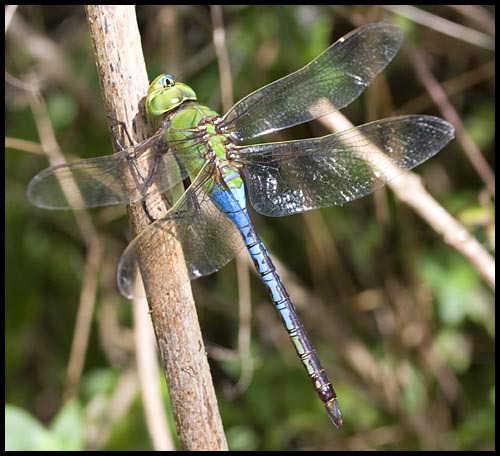
Introduction
The common green darner (Anax junius) is one of the largest and most widespread dragonfly species in North America. Its name comes from the vivid green coloration on the thorax and the perceived resemblance between its thick abdomen and a darning needle. A member of the family Aeshnidae, the green darner is a powerful flyer capable of long-distance seasonal migrations, and a familiar sight over ponds, lakes, marshes, and slow streams from southern Canada through Central America. Its large size, striking colors, and bold hunting behavior have made it a favorite of nature photographers and entomologists alike.
Taxonomy
The common green darner belongs to the order Odonata, suborder Anisoptera (dragonflies), family Aeshnidae, and genus Anax. Its scientific name was assigned by French entomologist Pierre Andre Latreille in 1805. The genus Anax contains roughly 30 species worldwide, many of which rank among the largest dragonflies on the planet. Within North America, the green darner is the largest and most abundant member of its genus. Recent genetic studies have revealed subtle differentiation among populations across different regions, suggesting the species may harbor multiple distinct lineages not yet formally recognized.
Physical Characteristics
The common green darner is a robust insect with a body length of 70 to 80 millimeters (2.8 to 3.1 inches) and a wingspan reaching 90 to 110 millimeters (3.5 to 4.3 inches). The thorax is bright green, while the abdomen is sky-blue in mature males and duller brownish-green in females and juveniles. A distinctive black spot sits between the large compound eyes, which are composed of thousands of individual lenses providing wide-angle vision essential for detecting prey and avoiding predators. Like the blue and yellow macaw, the green darner uses vivid coloration for species recognition and mate attraction. The wings are clear with a slight amber tint near the base and a pale pterostigma near each wingtip.
Habitat
The common green darner inhabits a wide range of freshwater environments, including ponds, lakes, marshes, canals, and slow streams, with a preference for waters bordered by emergent vegetation. Such plants provide ideal egg-laying sites for females and shelter for nymphs. The species is highly adaptable and thrives in both natural and human-made water bodies, from mountain lakes to urban retention ponds. Outside the breeding season, adults hunt in meadows, gardens, and open habitats far from water. The green darner is among the most migratory dragonflies in North America, with individuals traveling southward in large numbers during autumn and returning north in spring, sometimes forming swarms visible on weather radar.
Diet
The common green darner is a voracious predator at both the nymph and adult stages. Aquatic nymphs feed on mosquito larvae, small fish, tadpoles, and the nymphs of other dragonfly species. Adults catch insects in mid-air using basket-like legs, consuming mosquitoes, midges, butterflies, moths, and even smaller dragonflies. The species can exceed 50 kilometers per hour (30 miles per hour), ranking among the fastest flying insects. Like the golden eagle, the green darner uses soaring and gliding to conserve energy during long-distance travel, switching to rapid pursuit when actively hunting. Underwater nymphs shoot out a modified lower lip called a labium to seize unsuspecting prey in a lightning-fast strike.
Reproduction
Mating occurs in flight, with the male grasping the female behind the head using claspers at the tip of his abdomen, forming the characteristic wheel position. After mating, the female deposits eggs alone, typically inserting them into the stems of submerged plants or directly into mud. Eggs hatch into aquatic nymphs after several weeks, and the nymph stage lasts one to four years depending on conditions. Unlike many dragonfly species, green darner nymphs are active hunters rather than ambush predators. Upon reaching maturity, the nymph climbs out of the water and sheds its exoskeleton in a process called eclosion, emerging as a fully winged adult.
Conservation
The common green darner is one of the most abundant and widespread dragonflies in North America and is not currently considered at risk. However, like all freshwater insects, it faces long-term threats from habitat loss, water pollution, and climate change. Wetland drainage, stream channelization, and pesticide use all negatively affect nymph and adult populations. The species tolerates some habitat disturbance better than more sensitive species. Community-based monitoring programs provide valuable data for tracking the green darner’s status over time.
Fun Facts
During autumn migrations, large swarms of green darners can appear on weather radar images as concentrated clouds moving southward, much like flocks of birds. The species is among the fastest insects on the planet, capable of sustained high-speed flight. Like the flamingo, the green darner’s bright colors are produced partly by the physical structure of its body scales, which scatter light to create iridescent effects.
[…] The order carries the lacewings, the antlions and a few other groups. It holds them in a single family of the long-winged hunters. The green lacewing sits with the other members of the genus Chrysopa. It is one of the few of that genus that spreads across both sides of the Atlantic. Its close relatives are the gold and the green-antlered lacewings. They are told apart only by the small structure at the base of the wing. The green lacewing shares the order with the common green darner. […]
[…] other Anax species live in Europe. One of them crossed the Atlantic long ago. The Common Green Darner is that American cousin. Both hunt on the wing, though the styles […]