 By st20113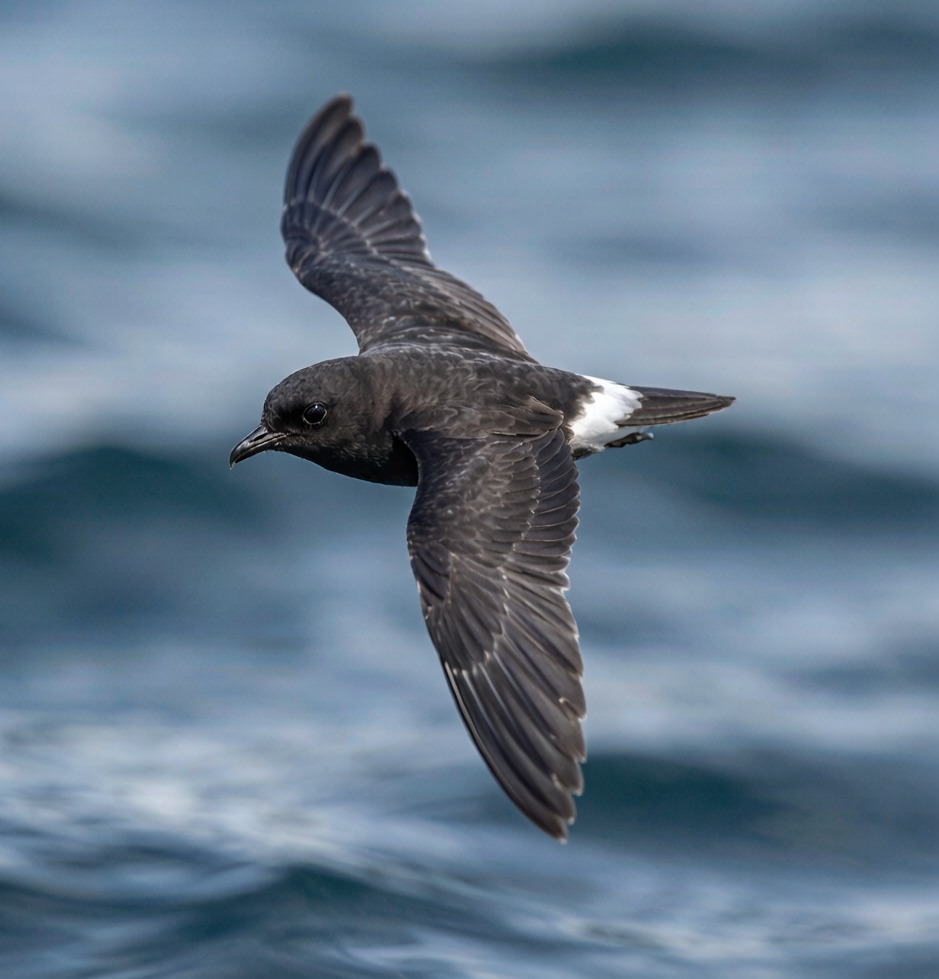
Introduction
The European Storm Petrel (Hydrobates pelagicus) is a diminutive seabird, one of the smallest of all procellariiformes, that spends most of its life far from land on the open Atlantic. Known to sailors as Mother Carey’s Chicken, it is a master of the wind, dancing across wave troughs on stiff wings while pattering the surface with its feet. Its nesting colonies on remote islands come alive at night with a distinctive purring song, one of the most evocative sounds of seabird cliffs.
Taxonomy and Evolution
The European Storm Petrel is the type species of the family Hydrobatidae and the genus Hydrobates, making it the namesake of the entire order. It was first described by Johann Friedrich Naumann in 1822. Genetic analysis confirms its position as one of the more basal storm petrel lineages, diverging from relatives some 5 to 7 million years ago. The British breeding population is genetically distinct from Mediterranean populations, with minimal mixing. Its closest relatives include the Leach’s Storm Petrel and the Band-rumped Storm Petrel of the North Atlantic, both similarly pelagic.
Physical Characteristics
At just 15 to 16 cm in length with a 36 to 39 cm wingspan, the European Storm Petrel is among the smallest seabirds in the world. Its plumage is uniformly sooty black with a bold white rump that wraps around the sides of the tail base, a key mark distinguishing it from the all-dark Leach’s Storm Petrel, which has a forked tail and no white rump. The wings are narrow and pointed. The bill is short, black, and tubular, with tube-like nostrils on top for salt excretion. The legs are black with webbed feet that dangle below the tail in flight, aiding steering.
Habitat and Distribution
This pelagic species spends 8 to 9 months of the year far from any coastline, distributed across the North Atlantic from Iceland and Scandinavia to the Canaries. During breeding it requires remote isolated islands with suitable nesting crevices in rocky terrain, old stone walls, or scree burrows. Major colonies include the Faroe Islands, St Kilda in Scotland, Skellig Michael in Ireland, and islands off Norway and Iceland. The entire world population breeds in Europe, making it significant for European bird conservation and a priority for island habitat protection.
Diet and Feeding Behavior
European Storm Petrels feed almost exclusively on planktonic crustaceans, particularly copepods and amphipods, small fish, and surface-schooling fry, obtained by a unique pattering behavior, running across the water surface with feet spread and wings raised, picking items from the surface film. They are strongly attracted to plankton slicks and offal behind fishing boats and associate with whale groups that drive prey upward. They can drink seawater and excrete excess salt through nasal tubes. They typically feed at night as well as by day, often kilometers from the colony where they nest.
Reproduction and Life Cycle
Storm petrels return to colonies from May onward, with egg-laying in June and July. They nest in dark crevices and burrows, laying a single white egg which both parents incubate in shifts of 1 to 4 days over 38 to 42 days. The chick hatches in August and is brooded for a week before parents leave it alone by day. Both parents feed it by regurgitation, delivering a lipid-rich stomach oil. Chicks fledge at 56 to 73 days, usually in September, and head to sea without parental guidance. They return to breed at 4 to 5 years, showing strong site fidelity to their natal colony.
Conservation Status
Listed as Least Concern with a European population of 430,000 to 550,000 breeding individuals, the storm petrel is secure overall though local populations face threats. Predation by introduced rats and cats on island colonies can cause catastrophic breeding failure, and grounded fledglings may fall prey to the red fox on larger islands. In Scotland the St Kilda population has declined in recent decades for unknown reasons. The species is highly sensitive to artificial light near colonies, and on migration they are vulnerable to bycatch in pelagic longline fisheries alongside the peregrine falcon and other seabirds.
Fun Facts
The storm petrel holds the record for smallest body size among all tube-nosed seabirds. Its purring song, given at the nest entrance on moonless nights, is an eerie continuous trill that inspired sea-spirit tales among coastal communities. Fishermen considered it a good omen and killing one was thought to bring bad luck. The scientific name Hydrobates means water walker, perfectly describing its pattering gait across wave surfaces. Some individuals live over 30 years, returning to the same crevice each breeding season. On offshore platforms they sometimes attempt to nest, attracted by lights.
[…] petrels. Its members are the smallest of all the seabirds. The bird is a close relative of the European Storm Petrel (Hydrobates pelagicus). That is the other member of the genus that breeds in the north-east Atlantic. The 2 are very alike […]