 By st20113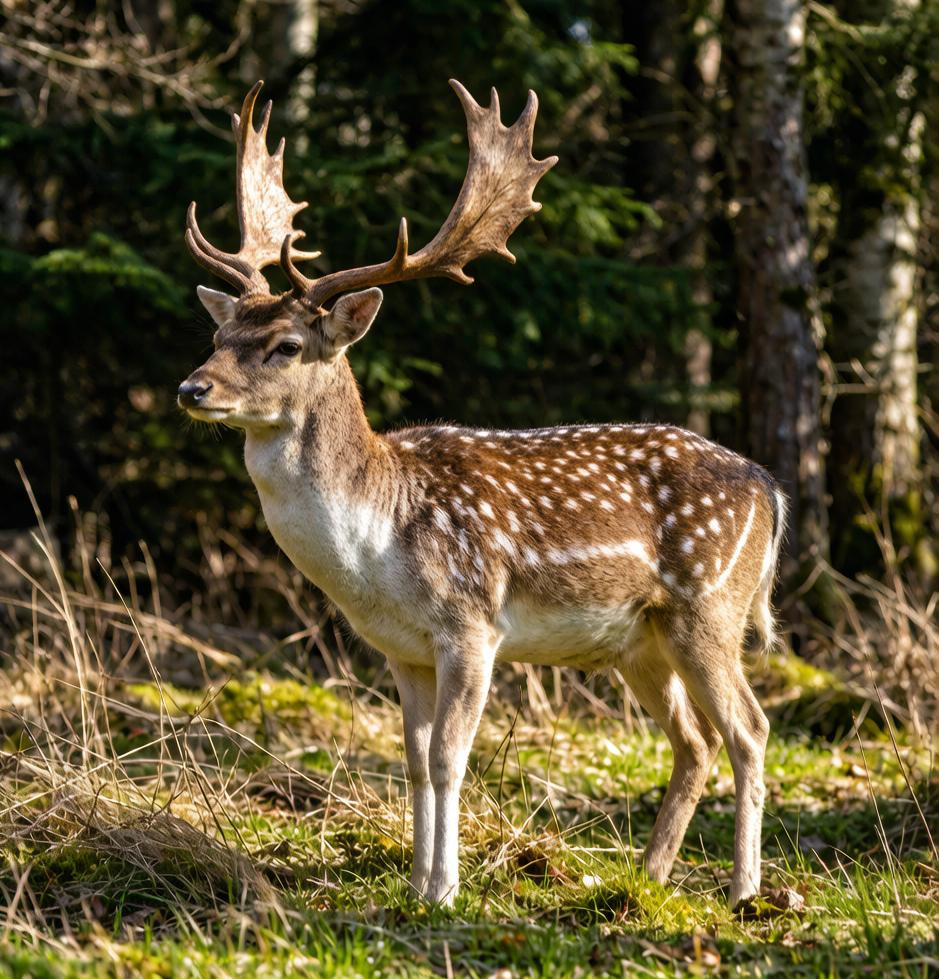
Introduction
The Fallow Deer (Dama dama) is a medium-sized cervid native to the eastern Mediterranean that has become one of the most widespread deer across Europe through Roman introductions and medieval hunting estates. Together with the red deer it forms the classic European deer fauna of parkland and woodland. Its palmate antlers, spotted coat, and adaptability make it familiar in both wild forest and manicured estate.
Taxonomy and Evolution
The Fallow Deer belongs to the family Cervidae within the order Artiodactyla. Carl Linnaeus first described it in 1758 as Cervus dama. It is the only living member of the genus Dama, though the extinct giant Cretan Fallow Deer is known from fossils. Molecular studies place it as a sister group to the giant deer lineage, sharing a common ancestor with the red deer some 3 to 4 million years ago. Genetic evidence also shows it diverged from the Eurasian deer complex during the Pleistocene.
Physical Characteristics
Fallow deer show remarkable coat variation. The common phase is rich chestnut brown with a white rump patch bordered by black. The menil phase is paler with year-round white spots. Males, called bucks, weigh 46 to 93 kg and stand 84 to 94 cm at the shoulder, carrying broad flattened antlers spanning up to 70 cm. Females, called does, are smaller at 35 to 56 kg and lack antlers. The body is stocky with a long neck and slender legs adapted for rapid bursts through dense cover, and the coat thickens markedly in winter.
Habitat and Distribution
Originally inhabiting forested landscapes of the eastern Mediterranean, fallow deer have been introduced across most of Europe, North America, South Africa, Australia, and New Zealand. They thrive in deciduous and mixed woodland with open clearings, yet readily adapt to parkland, farmland margins, and coastal scrub. They often share oak woodlands with the wild boar and, in eastern Europe, with the gray wolf, using dense thickets for shelter. Their dietary flexibility lets them occupy everything from dense forest to open grassland, provided adequate cover for resting and raising young.
Diet and Feeding Behavior
Fallow deer are versatile browsers and grazers whose diet shifts seasonally. In spring and summer they favor fresh grasses, herbs, and leafy browse; in autumn they consume fallen fruits, acorns, and fungi; in winter they rely on woody browse, bark, and evergreen vegetation. They feed most actively at dawn and dusk and rest at midday in sheltered cover. Like other deer they visit mineral licks to supplement sodium, and they can digest highly fibrous plant matter through a four-chambered stomach that ferments cellulose efficiently.
Reproduction and Life Cycle
The rut peaks in October and November. Bucks establish and defend temporary territories marked by thrashing vegetation and wallowing in mud. They produce characteristic groans to attract does and deter rivals. After a 7.5-month gestation, does give birth to a single spotted fawn in May or June, hiding it in dense vegetation for two weeks. Fawns are weaned at about 7 months and reach sexual maturity at 14 to 16 months. Lifespan reaches 16 years in the wild and considerably more in captivity.
Conservation Status
The Fallow Deer is listed as Least Concern by the IUCN, with wild populations estimated above 2 million globally. While abundant in parts of its introduced range, native populations in Greece and Turkey have declined through habitat loss and overhunting. In Britain, where it is non-native, it is a naturalized species managed for venison and wildlife watching. Its impact on native vegetation in some regions, particularly woodland regeneration and ground-nesting birds, remains a subject of ecological study and active management.
Fun Facts
Fallow deer were among the most prized hunting quarry in medieval Europe, and the term fallow became synonymous with prime targets. Some populations show a rare melanistic coat phase, while the white phase is pale cream without spots, prized in parkland breeding. Fallow deer use a unique pacing gait at slow speeds, moving both legs on the same side together. In parts of England, fallow deer herds have continued uninterrupted since the Norman Conquest, among the oldest managed wildlife populations in the world.