 By st20113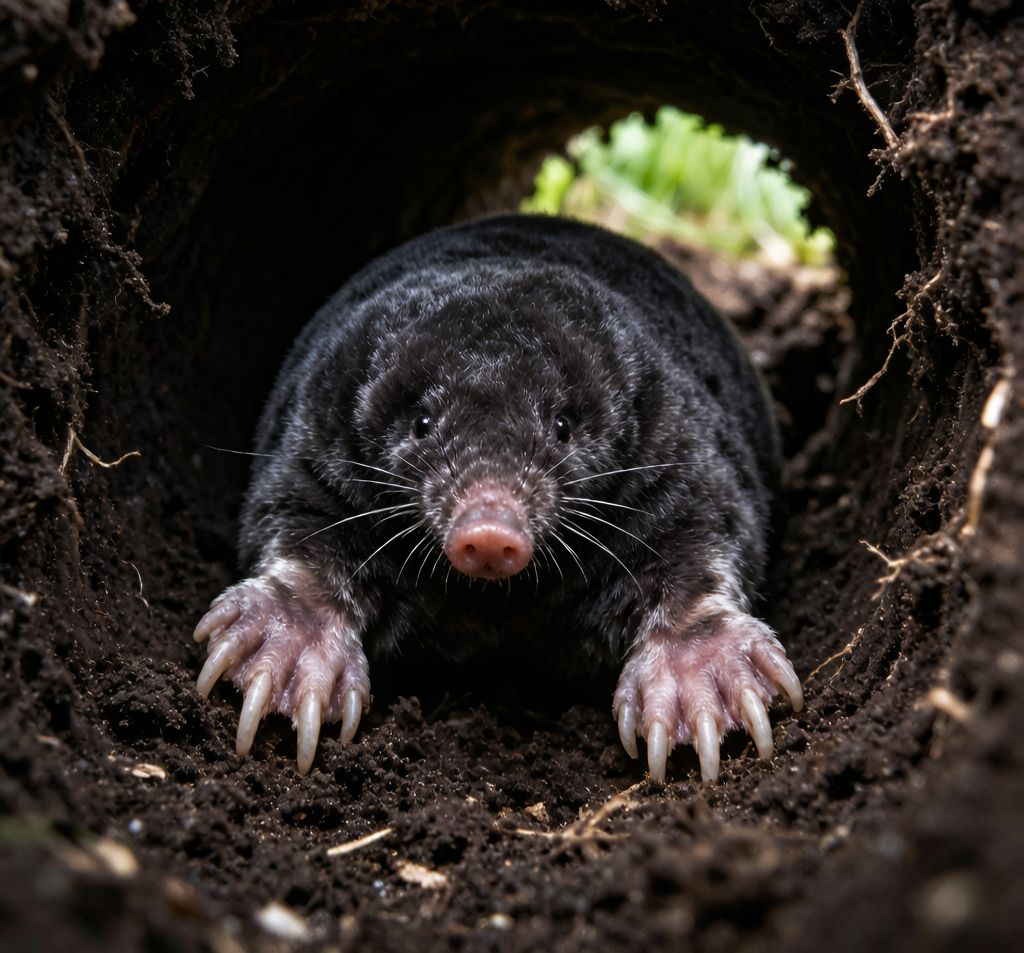
The European mole is a small, subterranean mammal belonging to the family Talpidae. Native across much of temperate Europe and parts of western Asia, it inhabits grasslands, woodlands, and farmland where loose, moist soils allow the construction of its elaborate tunnel systems. Though rarely seen above ground, the mole plays a significant ecological role in aerating soils and regulating invertebrate populations. Its velvety dark fur, powerful forelimbs adapted for digging, and near-blind eyes make it one of Europe’s most specialised mammals. Remarkably, it is also a capable swimmer and has been recorded crossing lakes and rivers during dispersal. In parts of Europe the mole shares its subterranean habitat with the common toad, and encounters with the red fox above ground are also common..
Taxonomy
The European mole (Talpa europaea) belongs to the family Talpidae within the order Eulipotyphla. Molecular phylogenetic studies place it within the genus Talpa, which comprises approximately 16 species of burrowing moles distributed across Europe and Asia. Its closest relatives include the blind mole (Talpa caeca) of the Mediterranean region and the Caucasian mole (Talpa caucasica). The species was first formally described by Carl Linnaeus in 1758. Four subspecies have been recognised across its range, distinguished by minor differences in skull dimensions and body mass. Phylogenetic analyses indicate that Talpa diverged from other talpid moles during the early Miocene.
Physical Characteristics
Adults measure 11-16 cm in body length with a 2-4 cm tail and weigh between 65 and 120 g. The cylindrical body is covered in dense, velvety, slate-grey fur that can lie in any direction, facilitating reverse movement through tunnels. The most striking adaptation is the pair of broad, spade-like forelimbs, each bearing five strong claws and rotated outward for powerful excavation. The eyes are tiny and buried beneath opaque skin; vision is limited to distinguishing light from dark. Hearing is acute, and the nose and facial whiskers are highly sensitive tactile organs. The dental formula is 44 teeth, adapted for crushing invertebrate prey.
Habitat
The European mole occupies habitats with deep, loose, moist, and well-drained soils that permit tunnel construction. Preferred environments include deciduous and mixed woodlands, permanent grasslands, river floodplains, farmland with pasture, and parks. It avoids acidic peat, compacted heavy clay, waterlogged ground, and very sandy or rocky substrates. In mountains it occurs up to approximately 1,800 m elevation. A network of shallow surface feeding tunnels and deeper permanent tunnels is maintained year-round; digging activity peaks in spring and autumn.
Diet
The European mole is an obligate insectivore, feeding primarily on earthworms, which can constitute up to 90 percent of its diet. It also consumes insect larvae, adult beetles, caterpillars, slugs, spiders, and centipedes. Foraging occurs within surface tunnels where prey falls through the soil; prey is located by vibration and scent rather than sight. An adult consumes roughly its own body weight in food each day due to its exceptionally high metabolic rate. Surplus earthworms may be stored alive in dedicated larders, their immobilised state keeping them fresh for several days.
Reproduction
Breeding takes place once annually, beginning in late winter or early spring. After a 30-35 day gestation, the female gives birth to a litter of two to seven naked, blind young in a grass-lined nesting chamber deep within the tunnel system. The young are weaned at five to six weeks and begin foraging independently by early summer. Both parents assist with feeding the offspring until independence. Sexual maturity is reached the following spring; wild lifespan is typically three to five years, with annual adult mortality estimated at 30-50 percent.
Conservation
The European mole is listed as a species of Least Concern by the IUCN, with population estimates in the millions across Europe and stable overall trends. Primary threats include the use of earthworm-toxic pesticides in intensive agriculture, mechanical field operations that collapse tunnel networks, and road mortality. The species is legally protected in several European countries but is sometimes treated as an agricultural pest. Conservation benefits from maintaining permanent grassland, reducing pesticide application, and preserving uncultivated field margins that support healthy earthworm populations.
Fun Facts
The dense, silky texture of mole fur inspired the term moleskin for a class of sturdy cotton fabrics widely used in workwear. In folklore across northern Europe, moles were thought to be weather prophets, with their surface foraging behaviour allegedly predicting approaching storms or rainfall. Its tunnel systems can extend for several hundred metres and may be inhabited by successive generations over many decades. The species is remarkably long-lived for its size, with records of individuals surviving more than five years in the wild.
[…] animal shares the family with the European Mole. That family holds about 40 species. All of them dig with broad front […]