 By st20113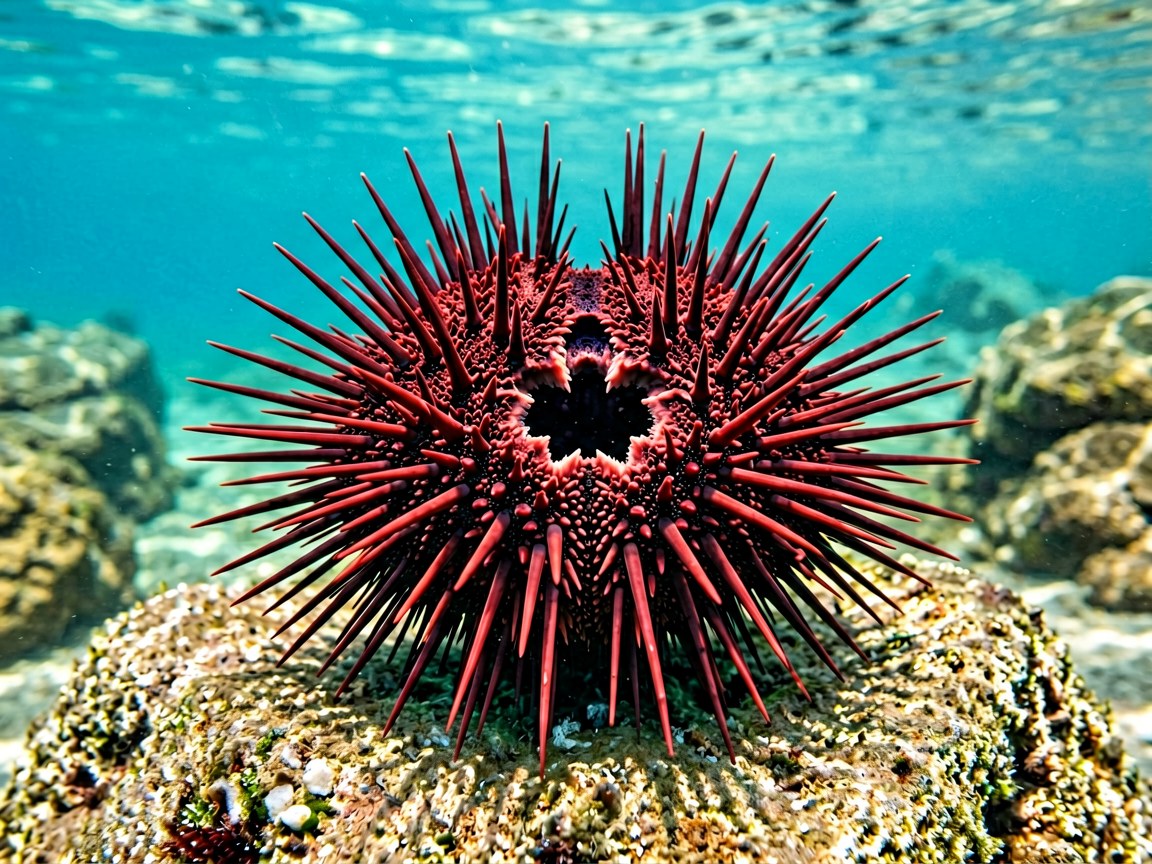
Echinus esculentus | Edible Sea Urchin
Introduction
The edible sea urchin (Echinus esculentus) is the classic spiky ball of the rocky seabed—a rounded, red-brown test bristling with movable spines. A relative of starfish, it creeps slowly over the rock, grazing on algae with a beak like a parrot’s. Common around the coasts of Britain and western Europe, it is both a familiar sight to divers and, in some places, a valued seafood for its golden roe.
Taxonomy
Echinus esculentus is an animal in the phylum Echinodermata—the spiny-skinned sea creatures—within the class Echinoidea, the sea urchins. It is a cousin of starfish and of brittle stars, and like other shore animals such as Mytilus edulis, the common mussel, it is a settled inhabitant of the same rocky marine zone, though the urchin grazes rather than filters.
Physical Characteristics
The urchin has a globe-shaped shell, or “test,” 7–10 cm across, made of fused plates and covered with five rows of short, strong, movable spines used for walking and defence. On the underside is a five-toothed jaw—the Aristotle’s lantern—that scrapes algae. On top, five paired pores mark the lines of its water-vascular system. Colour ranges from red and purple to pale, and the whole animal is built like a slow, armoured grazer.
Habitat
Edible sea urchins live on hard substrata from the lower shore down into subtidal water, favouring rocky reefs and kelp forests where algae are abundant. They are common in clear, current-swept water and can form dense “barrens” where their grazing keeps the rock bare of seaweed. They are found around the north-east Atlantic and the Mediterranean.
Diet
Urchins are herbivores and detritivores. Their lantern jaws rasp algae, biofilm, and decaying matter from rock surfaces, and they also gather food with their tube feet and sticky podia. They are powerful grazers; in large numbers they can strip kelp forests to bare rock. They do not chase prey, but their steady scraping shapes the whole look of the seabed.
Reproduction
Sea urchins have separate sexes and spawn by releasing eggs and sperm into the water, where fertilisation occurs. The larvae drift as plankton, feeding and growing, before settling and transforming into tiny urchins that grow their spines. They can live for many years, and a single female may shed millions of eggs in a season, only a few of which survive to adulthood.
Conservation
The edible sea urchin is common and not considered threatened, though in some regions it is collected for food and can be fished down locally. As a grazer it strongly influences kelp forests and rocky reefs, so its numbers matter to the wider ecosystem. Sustainable harvesting and protected rocky habitats help keep both urchins and the habitats they shape in balance.
Fun Facts
- Its five-toothed jaw is called Aristotle’s lantern, after the philosopher who described it.
- The five rows of spines are worked by tiny muscles, letting it walk and right itself.
- It spawns by broadcasting eggs and sperm into the open sea by the million.
- In some cuisines its roe is a prized delicacy, bright orange and creamy.
- Heavy grazing can turn a kelp forest into a bare “urchin barrens.”
[…] to keep and easy to breed in the lab. The purple sea urchin shares the class Echinoidea with the edible sea urchin. That is a larger and redder animal of deeper water in the north-east Atlantic. The two are built […]