 By st20113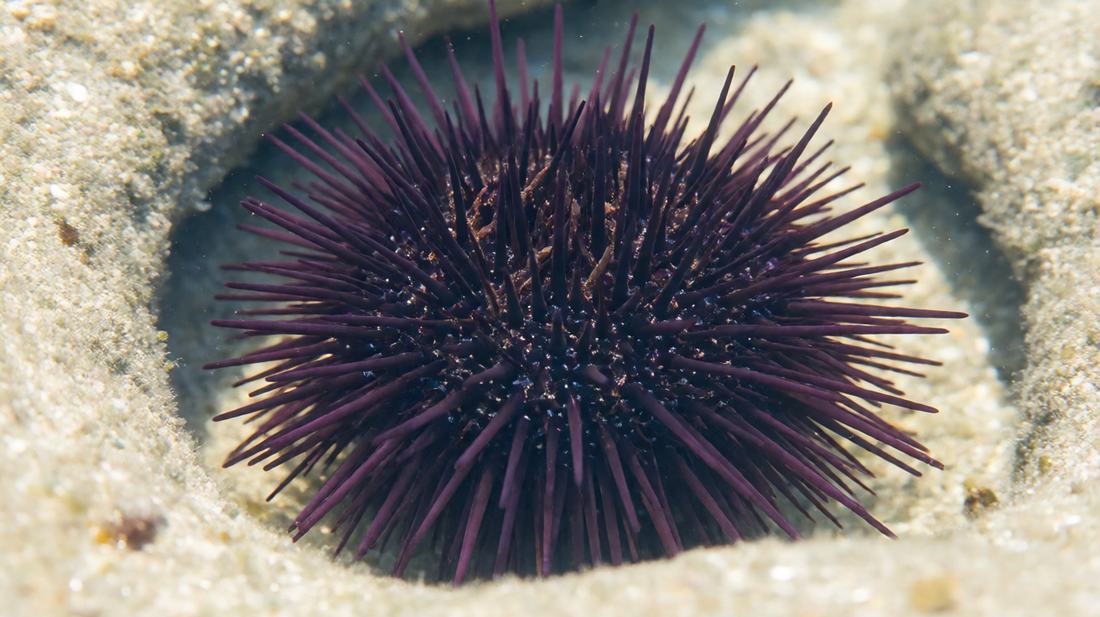
Paracentrotus lividus | Purple Sea Urchin
Species Profile · Parechinidae
Purple Sea Urchin
The spiny purple urchin of Mediterranean rock, with a five-toothed jaw that scrapes reefs clean — and the power to turn a weedy reef into bare stone.
IUCN: Not Evaluated
Range
Shell
Spines
Teeth
Life
The purple rock grazer
Europe’s best-known sea urchin
The purple sea urchin is the spiny, dark purple animal of Mediterranean rocky sea beds. It is the species most people mean when they talk about sea urchins in Europe. It is a regular urchin. The shell is rounded and covered in a dense forest of sharp, movable spines. Fine tube feet push out between them. The colour runs from deep purple through brownish purple to olive green. The spines can be almost black or pale at the tip. The urchin lives wedged into hollows and crevices in rock.
It often braces its spines against the sides. It comes out at night to graze. It eats algae, and it eats a great deal of it. It scrapes the rock clean with a jaw that has 5 teeth. People call that jaw Aristotle’s lantern. Where urchins are common they can strip a rocky sea bed of all its seaweed. They leave bare rock behind. Divers call that state an urchin barren.
The species lives in the Mediterranean and the nearby north-east Atlantic. It runs from Ireland and western France south to Morocco and into the Canary Islands. People harvest it for its roe in several countries. In parts of the Mediterranean that fishing has cut numbers hard. In other places the fish that eat urchins have gone. There the urchins have increased and made barrens instead.
Family tree
Parechinidae, the urchins
The purple sea urchin is in the family Parechinidae and the genus Paracentrotus. Lamarck named the species in 1816. The genus name means near the centre. It refers to the position of the pores in the shell plates. The species name lividus means bluish or leaden. That describes the usual colour. The family sits in the order Camarodonta and the class Echinoidea. That class holds the sea urchins, sand dollars and heart urchins. It sits in the phylum Echinodermata.
Echinoderms are defined by their five-fold symmetry. They have a water vascular system and a chalk skeleton of plates. The sea urchins are the branch whose plates are fused into a rigid shell, or test. That shell carries movable spines. Paracentrotus is a small genus with only a few species. This one is by far the best known. It has been mixed up in the books with Atlantic groups that differ in colour and in spine length. Genetic work has suggested the Mediterranean and Atlantic urchins may not be one uniform group. The species is the main commercial urchin of Europe.
It is one of the most studied urchins in the world. It is easy to keep and easy to breed in the lab. The purple sea urchin shares the class Echinoidea with the edible sea urchin. That is a larger and redder animal of deeper water in the north-east Atlantic. The two are built on the same plan. Both are harvested for their roe. But they live at different depths and in different seas. The edible urchin likes cold water. This one likes warm water.
Spines, tube feet and teeth
How to identify one
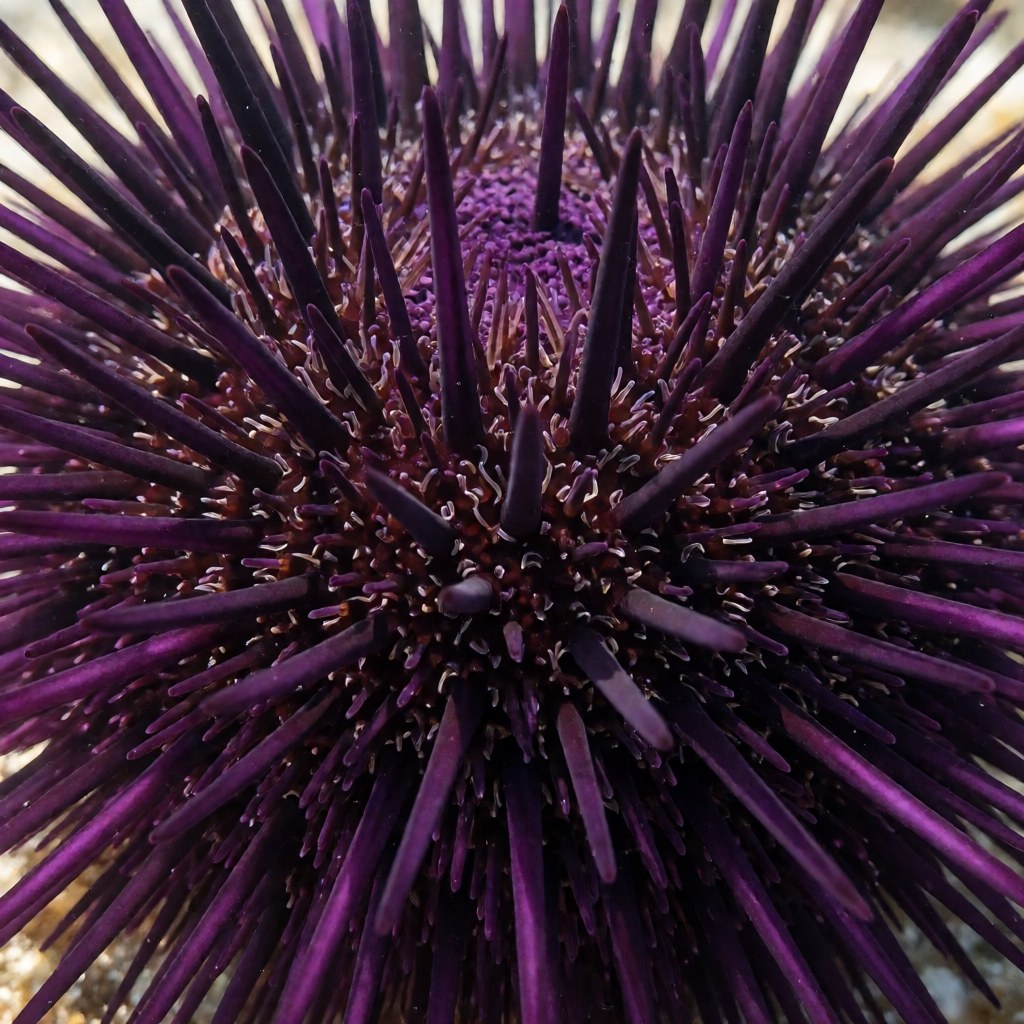
The shell, or test, of the purple sea urchin grows to about 5 to 7 cm across. It is slightly flattened. In outline it is rounded rather than domed. It is made of 10 double columns of chalk plates fused into a rigid case. Each column carries 2 rows of small holes. The tube feet pass through them. The spines are the clearest feature. They can be 3 cm long. They are slender, sharply pointed and slightly rough. They sit on ball joints.
That lets them be aimed in any direction. The spines are usually deep purple or brownish purple. Some are greenish or olive. The tips may be paler. Between the spines the tube feet push out. They are thin, flexible tubes with suckers on the ends. They are longer than the spines. The urchin uses them for walking, for gripping, for sensing and for breathing. Scattered among them are small pincer-like parts called pedicellariae. They keep the shell clean.
They also help defend against settling larvae. The mouth is on the underside. It holds Aristotle’s lantern. That is a jaw of 5 hard teeth set in a ring. Muscles work it. The urchin uses it to scrape and bite. The anus and the genital pores are on the top. It has no head and no brain. It runs its spines through a nerve ring.
1
2
3
Rocky shallows and crevices
Where it lives
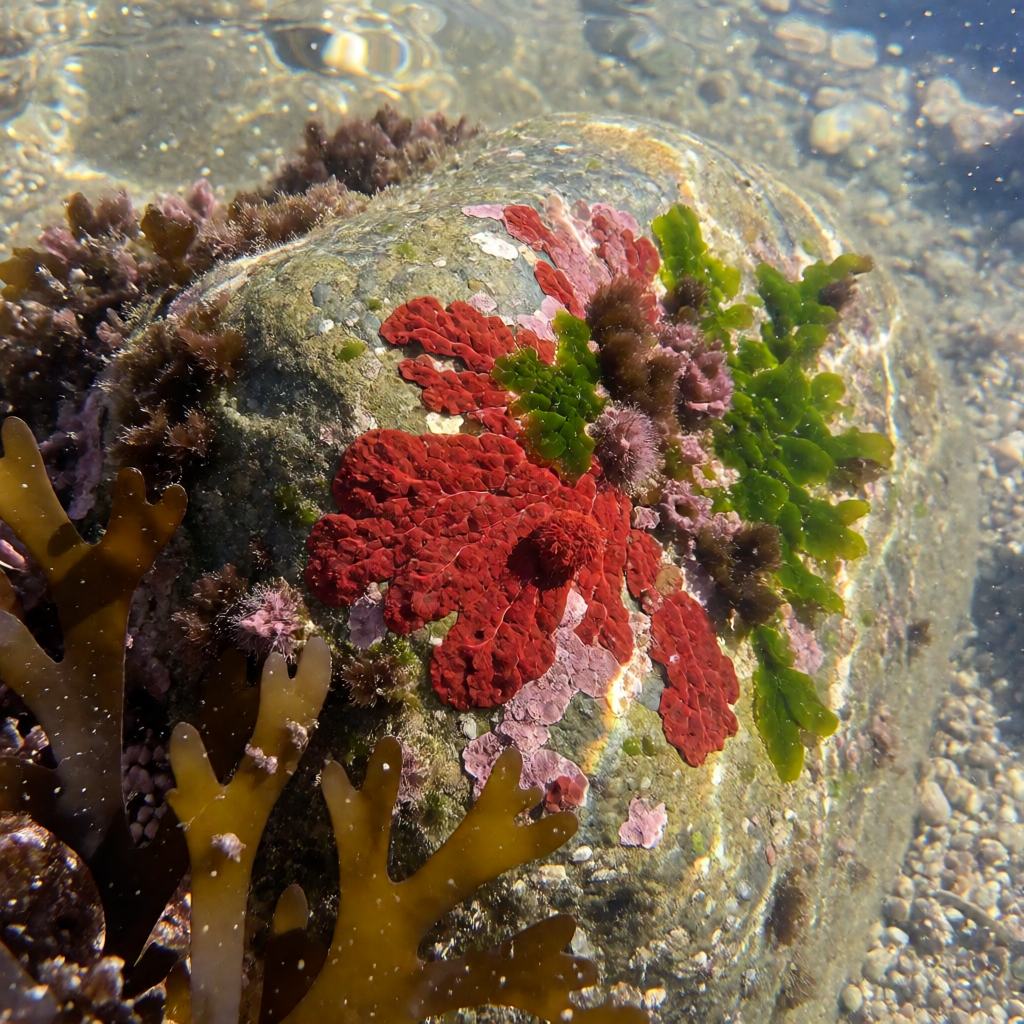
The purple sea urchin lives on hard bottoms in shallow water. It is found on rocky sea beds, boulders, reefs and walls. It lives on the underside of overhangs and in rock pools. It lives from just below the low-tide mark down to about 30 m, and at times deeper. The best home is a hollow or crevice in the rock that fits its shell. The urchins dig and enlarge these holes themselves. They scrape with their teeth and soften the rock a little. So a reef with many urchins gets pitted with small dents.
They also bore into soft rock. They bore into the holdfasts of large seaweeds. Shelter matters because the spines are brittle. It matters too because several fish eat them. Where cover is short, urchins pile up on open rock. They form dense groups. That is the situation that makes barrens. The species lives throughout the Mediterranean.
It runs from Spain and France to Greece, Turkey and the Levant. It lives along the Atlantic coast of Iberia, France, Ireland and western Britain. It runs south to Morocco, the Azores and the Canary Islands. It likes warm water. It is most common in the western Mediterranean. It stands a wide range of salt levels. It can live in sheltered lagoons and harbours. It cannot live in fresh water or in heavy silt.
A grazer of algae
What it eats
The purple sea urchin is mainly a plant eater. It grazes algae off hard rock. The main food is fleshy algae and crust algae. It eats the thin film of young algae that coats any bare rock. It eats the turf of small red and green algae. It eats upright brown seaweeds. It eats the coralline algae that cement reef surfaces together. Seagrass is grazed as well.
The urchins eat both the leaves and the algae growing on them. It is not purely a plant eater. It takes sponges, bryozoans and hydroids. It eats detritus and the organic film on sediment. It takes dead flesh readily. Feeding is done with Aristotle’s lantern. The 5 teeth scrape and bite the rock. The scraped material passes up into the gut.
The urchin can rasp through hard coralline algae. Over time it deepens its own hole. Grazing is heaviest at night. That is when the urchins leave their holes and move over the rock. It slows in winter in the colder parts of the range. Where urchin numbers are high, the grazing strips the whole algal turf. The rock is kept bare. That is how an urchin barren forms.
Drifting larvae, long drift
The breeding cycle
The purple sea urchin has separate sexes. Males and females look alike from the outside. Spawning happens mainly in spring and early summer. In some places there is a second, smaller spawning in autumn. Warmer water triggers it. Gametes are released into the open water through the pores on the top of the shell. Fertilisation is external. The urchins often spawn at the same time within a local group.
That raises the chance that eggs and sperm meet. The new egg grows into a drifting larva called a pluteus. That is a small, clear animal with long ciliated arms. It uses them to swim and to feed on phytoplankton. The larval stage lasts several weeks. In that time the larva drifts with the currents. It can be carried a long way from where it was spawned. Then it settles onto hard substrate.
That is usually in a crevice or among coralline algae. There it turns into a tiny urchin. The settling cue matters. Larvae settle where the right coralline algae are present. That is why urchin barrens, once formed, tend to persist. Adults come at 2 to 3 years. The urchins can live more than 10 years. They go on growing slowly throughout life.
Not Evaluated, fished and feared
Conservation
The purple sea urchin is not listed as threatened on the global Red List. It is abundant across a wide range. It stands a broad set of conditions. It can reach very high densities. Interest in the species runs in 2 opposite ways. In the first, overfishing is the problem. The roe is the orange gonad tissue inside the shell. It is a prized food.
People gather urchins by hand and by diving in France, Spain, Italy, Greece, Croatia and Turkey. That fishing has cut local numbers hard. In places the largest urchins have been almost wiped out. Those are the ones that make the most eggs and sperm. Several countries now regulate the fishing. They use closed seasons, size limits and restricted zones. In the second way, urchin numbers are too high. Where the fish and other hunters that eat urchins have been fished out, urchin numbers have risen.
The urchins have grazed rocky reefs down to bare rock. Those barrens hold far less life than a weedy reef. They are slow to recover. Bare rock favours more urchin settling. Warm water and weaker storms may make barrens more likely. So handling the species means handling its hunters and the fishing at the same time.
Quick hits
Five things to remember
- The jaw is called Aristotle’s lantern, because Aristotle wrote about it more than 2000 years ago, and it has 5 hard teeth that can scrape solid rock.
- The urchin digs its own hole in the rock by scraping with its teeth, and a reef with many urchins gets pitted with small dents.
- Urchins often cover themselves with bits of shell, algae and debris, held on by the tube feet, which may shade them and hide them from hunters.
- The larvae settle where coralline algae are present, which is why a bare urchin barren tends to attract more urchins and persist for years.
- Where the fish that eat urchins are gone, the urchins can strip a rocky reef of all its seaweed and leave bare rock, a state called an urchin barren.