 By st20113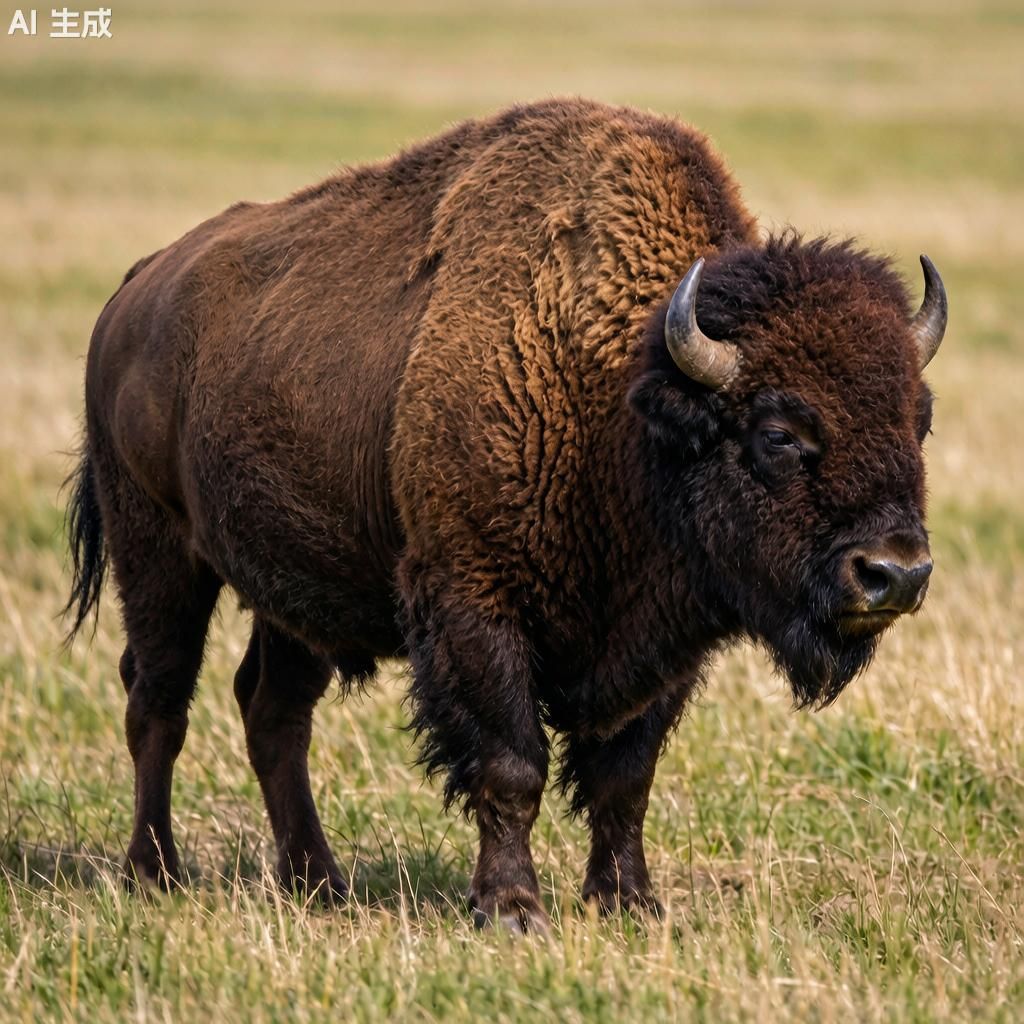
Introduction
The Bison bison, known as the American bison or, more informally, the buffalo, is the largest land mammal native to North America. Standing up to six feet tall at the shoulder and weighing as much as a ton, these massive bovines once thundered across the continent in herds that blackened the prairie horizon. Today they endure as a living symbol of the American West and a remarkable conservation success story. Despite their popular nickname, true buffalo belong to a separate Old World lineage; the American bison is a distinct genus that evolved on the plains of North America.
Taxonomy
Bison belong to the family Bovidae, the same broad group that includes cattle, sheep, antelope, and the Muskox of the Arctic tundra. Within this family they sit in the subfamily Bovinae alongside other large, hollow-horned ruminants. Scientists recognize two subspecies: the plains bison (Bison bison bison) and the wood bison (Bison bison athabascae), the latter being slightly larger and darker. Their closest living relatives are the European bison, or wisent, though the two have been separated by geography and time for hundreds of thousands of years. Genetic studies confirm that bison diverged from the lineage leading to domestic cattle roughly two to three million years ago.
Physical Characteristics
An adult bison is built like a furry battering ram. A pronounced muscular hump rises over the front shoulders, supported by elongated vertebrae, and provides the leverage needed to sweep aside snow in winter. The head is enormous, carried low, and topped with a black, woolly mane. Both sexes grow short, curved horns that are never shed. A thick, shaggy coat of dark brown hair insulates against brutal prairie winters, while a lighter, shorter summer coat keeps the animal cool. Beneath the hide lies a layer of fat and dense muscle that makes the bison deceptively agile for its bulk.
Habitat
Historically, bison ranged from the Great Plains eastward to the Appalachian foothills and northward into the boreal forests of Canada and Alaska. They favor open grassland, mixed prairie, and river valleys where nutritious grasses grow in abundance, but wood bison also inhabit northern woodlands. Today, most bison live in protected parks, refuges, and private ranches rather than free-ranging herds. In these landscapes they share the plains with swift grazers such as the Pronghorn, another animal superbly adapted to open country, and with the predators that once shaped their lives.
Diet
Bison are grazing ruminants, built to convert coarse grasses and sedges into energy through a four-chambered stomach. They feed mainly on grasses such as blue grama and buffalo grass, but will also browse on woody shrubs, herbs, and the tender shoots of weeds when forage is sparse. Like cattle, they spend much of the day with their heads down, cropping vegetation in a slow, methodical sweep. Their constant movement and selective grazing help maintain the diversity of prairie plant communities, making them a keystone species on the plains they once dominated.
Reproduction
The bison breeding season, or rut, peaks in late summer, when mature bulls bellow, wallow, and clash horns in contests for access to cows. After a gestation of roughly nine and a half months, a single reddish-brown calf is born in spring. Twins are rare. Calves can stand within minutes and begin nursing almost immediately, though they remain camouflaged and sheltered in tall grass for their first weeks. Young bison stay close to the herd for protection, growing rapidly on rich milk before transitioning to grass within a few months.
Conservation
Few animals illustrate the power of conservation like the bison. In the early 1800s, an estimated 30 million roamed North America; by 1890, fewer than 1,000 remained after decades of commercial hunting and deliberate slaughter. A handful of individuals protected in Yellowstone National Park and on private ranches formed the foundation of recovery. Today, roughly half a million bison exist, though most are managed as livestock rather than wild, free-ranging populations. Ongoing efforts aim to restore ecological bison herds to tribal lands and large landscapes, supported by the fact that they face no immediate threat from the Gray Wolf at population scale, though calves remain vulnerable to predation.
Fun Facts
Despite their ponderous appearance, bison can sprint at speeds near 35 miles per hour and are surprisingly maneuverable swimmers. They communicate with a range of grunts, snorts, and bellows, and bison calves are born a sandy orange color that fades to brown. The animals create shallow depressions called wallows by rolling in dust and mud, which double as cooling spots and social hubs. Perhaps most surprising, bison and the Blue Wildebeest of Africa occupy parallel ecological roles on opposite continents, both serving as the dominant grazers of their respective grasslands. Even the Grizzly Bear of the northern Rockies will scavenge a bison carcass, linking these giants of plain and mountain in a single food web.
[…] as Bos grunniens in its domestic form. Its closest relatives include the water buffalo and the European bison, though all diverged along separate evolutionary lines within the tribe Bovini. The wild yak is […]