 By st20113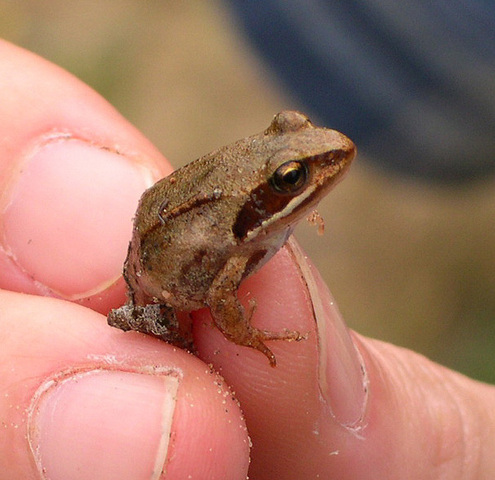
Introduction
The common frog (Rana temporaria) is a widespread amphibian found across much of Europe, from the British Isles and Scandinavia to the foothills of the Alps and the Balkans. Adults typically measure between 6 and 9 centimetres in length, with females slightly larger than males. Their skin colour is highly variable, ranging from olive green and brown to grey or even reddish, often marked with irregular dark blotches that provide effective camouflage among wet vegetation. Unlike many tropical relatives such as the red-eyed tree frog, the common frog relies on subdued earth tones rather than bright warning colours. It is one of the most familiar frogs in temperate regions and a frequent visitor to garden ponds.
Taxonomy
Rana temporaria belongs to the family Ranidae, the true frogs, within the order Anura. The species was first formally described by the Swedish naturalist Carl Linnaeus in 1758. It is a member of the genus Rana, which includes many Holarctic frog species. Genetic studies have confirmed its close relationship to other European brown frogs, though it remains reproductively isolated from them. No widely accepted subspecies are currently recognised, although populations from different mountain regions show subtle morphological differences shaped by local climate.
Physical Characteristics
The common frog has a slender body, long hind limbs adapted for powerful leaps, and a pointed snout. A distinctive feature is the presence of a dark temporal patch behind each eye, sometimes called a mask. The tympanum, or eardrum, is visible behind the eye and is larger in males. Toe pads are absent, but the long toes are partially webbed, aiding both swimming and jumping. The skin is smooth and moist, supplied with mucus glands that prevent desiccation. During the breeding season males develop rough nuptial pads on their forelimbs to grip females during amplexus.
Habitat
This species occupies a broad range of habitats including woodlands, grasslands, marshes, gardens, and agricultural fields, provided suitable freshwater is nearby for breeding. It spends much of the year in cool, damp terrestrial environments and returns to ponds, lakes, and slow streams to reproduce. The common frog tolerates colder conditions better than most amphibians and can be found at altitudes up to 2,500 metres. Shelter is sought beneath logs, stones, and leaf litter, where humidity remains high and predators are less likely to detect the resting animal.
Diet
Adults are generalist carnivores that feed on a wide variety of small invertebrates. Their diet includes insects such as flies, beetles, and aphids, as well as spiders, worms, and even smaller amphibians when opportunities arise. The common frog hunts primarily by sight, flicking out its sticky tongue to capture moving prey. Tadpoles are Herbivorous or detritivorous, grazing on algae and decaying plant matter in the water. In turn, adult frogs are hunted by birds such as the great white pelican and a range of mammalian and reptilian predators.
Reproduction
Breeding begins in early spring as frogs migrate to their ancestral ponds, often in large numbers. Females lay clusters of eggs, known as frogspawn, attached to submerged vegetation. A single female may deposit between 1,000 and 2,000 eggs, each enclosed in a protective jelly coat. Tadpoles hatch after two to three weeks and undergo metamorphosis over the following two to three months, gradually losing their tails and developing limbs. Young frogs leave the water in late summer, dispersing into surrounding terrestrial habitats where they mature over two to three years.
Conservation
The common frog is currently classified as a species of least concern by the IUCN, thanks to its extensive range and adaptable habits. However, local populations face pressures from habitat loss, pond drainage, pollution, and the spread of the chytrid fungus Batrachochytrium dendrobatidis. Road mortality during migration and predation by introduced fish also reduce numbers in some areas. Garden pond creation and the protection of wetland corridors have proven effective at supporting stable local populations across Europe.
Fun Facts
Common frogs can absorb oxygen through their skin as well as their lungs, allowing them to hibernate underwater in mud during winter. They can leap more than twenty times their own body length in a single bound. When threatened, some individuals produce a loud distress call and may release urine to startle predators. Their colour can shift slightly with temperature and background, and some highland populations turn almost entirely black to absorb more solar heat in cold mountain environments.
[…] The American bullfrog (Lithobates catesbeianus) is the largest frog native to North America, famous for its deep, resonant “jug-o-rum” call that carries across ponds and lakes on warm summer nights. A formidable aquatic predator, it will attempt to eat almost anything it can fit into its wide mouth. Native to eastern North America, it has been widely introduced elsewhere for food and aquaculture, sometimes becoming an invasive species that disrupts local ecosystems. Its adaptability and vocal presence have made it one of the most recognisable frogs on the continent, a giant among species such as the common frog. […]