 By st20113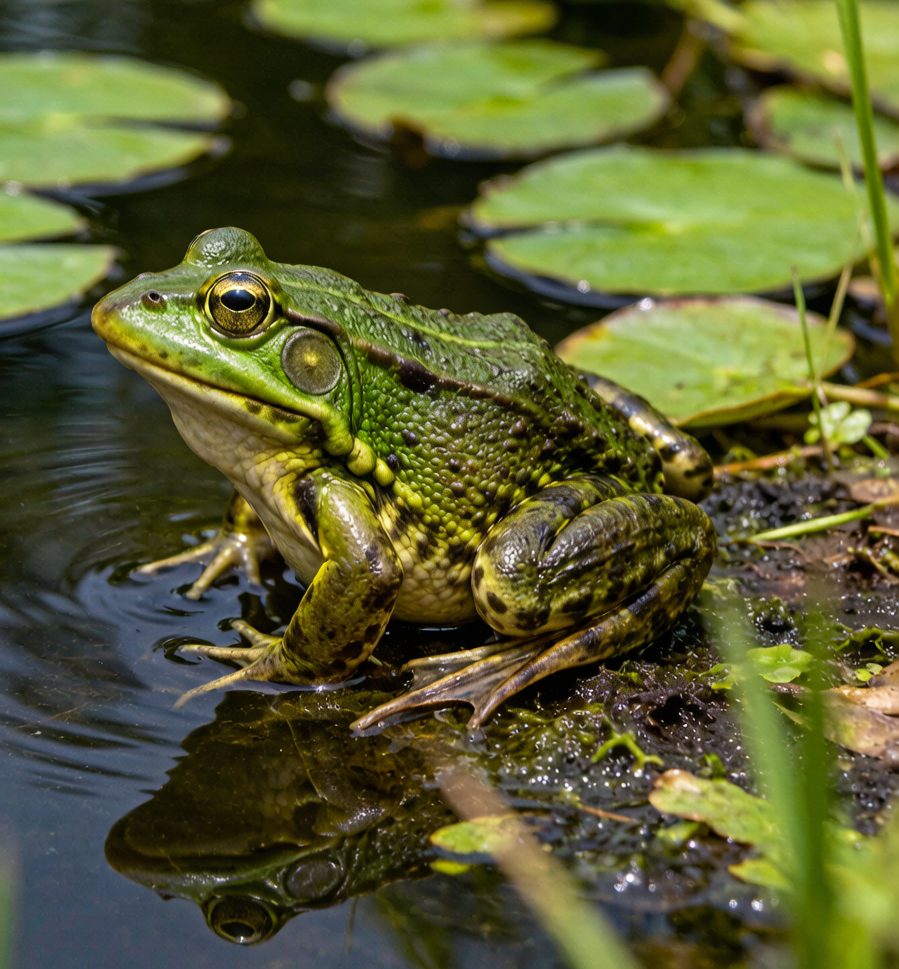
Introduction
The American bullfrog (Lithobates catesbeianus) is the largest frog native to North America, famous for its deep, resonant “jug-o-rum” call that carries across ponds and lakes on warm summer nights. A formidable aquatic predator, it will attempt to eat almost anything it can fit into its wide mouth. Native to eastern North America, it has been widely introduced elsewhere for food and aquaculture, sometimes becoming an invasive species that disrupts local ecosystems. Its adaptability and vocal presence have made it one of the most recognisable frogs on the continent, a giant among species such as the common frog.
Taxonomy
The American bullfrog belongs to the family Ranidae, the true frogs, within the order Anura. Long placed in the genus Rana, it is now classified as Lithobates catesbeianus, described by Shaw in 1802. The genus Lithobates encompasses the North American water frogs. Bullfrogs are among the most derived ranids, specialised for a largely aquatic, predatory lifestyle. Genetic studies support the separation of New World ranids into Lithobates, distinct from the Old World Rana species of Eurasia and Africa.
Physical Characteristics
American bullfrogs are massive, typically 10 to 20 centimetres in body length and weighing up to 0.5 kilograms or more, with females larger than males. Their colour is green to brown above with variable mottling and a pale, often yellow-tinged belly. They have a broad, flat head, large protruding eyes with horizontal pupils, and powerful hind legs built for jumping and swimming. The tympanum, or ear disc, is noticeably larger in males. A prominent ridge of skin runs from behind the eye around the eardrum, distinguishing them from similar species. Their wide mouth and extensible tongue make them effective ambush predators.
Habitat
Bullfrogs inhabit permanent freshwater bodies including ponds, lakes, marshes, slow streams, and ditches, favouring warm, vegetated shallows. They require stable water for breeding and ample cover such as lily pads and reeds. Highly tolerant of disturbance, they thrive in farm ponds, canals, and suburban waterways. In introduced ranges they colonise similar habitats, often outcompeting native amphibians. They are mostly aquatic, retreating to water when threatened, but may travel overland on humid nights to disperse between water bodies.
Diet
Bullfrogs are indiscriminate, sit-and-wait predators with a remarkably broad diet. They consume insects, crustaceans, fish, other amphibians including their own species, small reptiles, birds, and mammals. Using a swift, sticky-tongued strike, they capture prey at or near the water’s edge. Their voracious appetite and large size allow them to take prey unavailable to smaller frogs. Invasive bullfrogs can depress populations of native frogs, tadpoles, and fish through both predation and competition. In turn, bullfrogs are preyed upon by large fish, snakes, birds, and mammals, especially as juveniles.
Reproduction
Breeding occurs in warm months when males establish territories and produce the deep, low call to attract females. Females lay large surface films of eggs, often 10,000 to 20,000 at a time, attached to vegetation in quiet water. Tadpoles are large, olive-green, and take one to two years to metamorphose, longer than most native frogs, which leaves them vulnerable to drying and predation. The prolonged tadpole stage is a key reason introduced bullfrogs persist and spread. Sexual maturity is reached at one to two years, and adults may live several years in the wild, longer in captivity.
Conservation
In its native range, the American bullfrog is listed as Least Concern, abundant and widely distributed. Outside North America, however, it is considered a highly problematic invasive species in parts of Europe, Asia, and South America, where it threatens native biodiversity and is subject to control programmes. Harvest for frog legs and the pet trade has also affected populations locally. Conservation in native areas focuses on wetland protection, while management in introduced regions aims to limit spread and protect vulnerable endemic amphibians from predation and competition.
Fun Facts
The bullfrog’s call can be heard more than a kilometre away on a still night, a deep “br-wum” that gives the species its name. It can leap distances several times its body length using its powerful hind legs, an escape tactic when startled. Bullfrogs will eat creatures nearly half their own size, including small turtles, snakes, and even bats caught at the water surface. Their tadpoles can take up to two years to transform, the longest of any North American frog. A bullfrog’s eyes and nostrils sit atop its head, allowing it to breathe and watch for danger while almost fully submerged.