 By st20113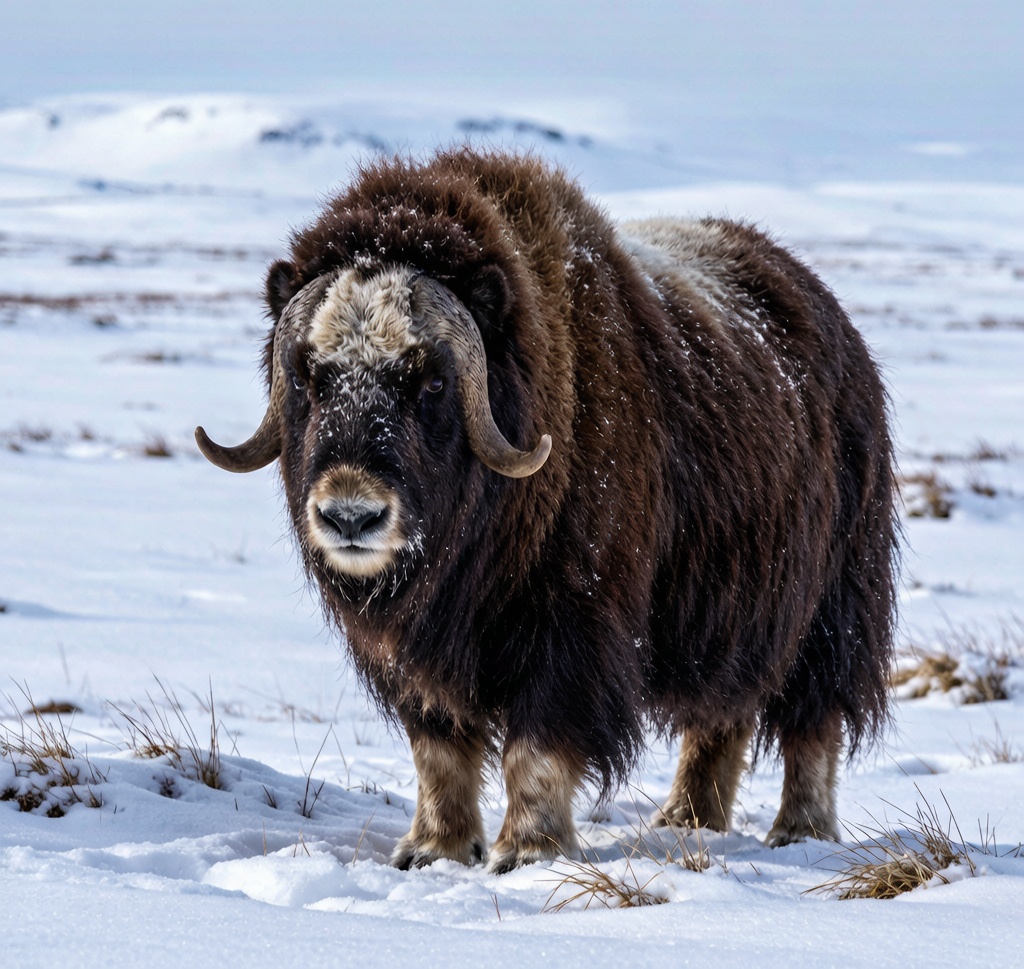
Introduction
The muskox (Ovibos moschatus) is one of the most iconic mammals of the Arctic tundra, instantly recognizable by its massive, shaggy double-layered coat that hangs nearly to the ground. Standing roughly 1.2 meters at the shoulder, males can weigh up to 400 kilograms. Despite its name, the muskox belongs to the Bovidae family alongside sheep and goats, and it is the sole living member of its genus—a remarkable distinction. Wild populations persist across Greenland, the Canadian Arctic, and a reintroduced stronghold in Alaska, totaling approximately 130,000 individuals. Inuit and Indigenous peoples of the North have valued and sustainably hunted this species for thousands of years.
Taxonomy
The scientific name Ovibos moschatus translates to “musky sheep-ox,” reflecting its unusual blend of bovid characteristics. Classified within the subfamily Caprinae, the muskox shares evolutionary ties with the Norwegian Lemming and other Arctic herbivores. Fossil records show that muskoxen once ranged across the northern hemisphere during the Pleistocene epoch alongside the woolly mammoth. Two subspecies are recognized: O. m. moschatus of Greenland and the High Arctic, and O. m. niphoecus of the Canadian mainland and Alaska. The species was formally described by Zimmerman in 1780.
Physical Characteristics
The muskox’s most striking feature is its extraordinary fur coat, known as qiviut—finer, softer, and more insulating than cashmere. The outer guard hairs can reach 60 centimeters in length, while the dense underwool traps warm air against the skin. The coat ranges from dark brown to nearly black with a distinctive pale saddle across the back. Both sexes carry horns that sweep downward then curve sharply upward, used for head-on clashes during the autumn rut and to clear snow from winter feeding grounds.
Habitat
Muskoxen inhabit the Arctic tundra—treeless landscapes of permafrost, sedge meadows, and rocky ridges where summer temperatures rarely exceed 10 degrees Celsius. They prefer areas with reliable snow cover in winter, which insulates the ground and makes foraging easier. During summer, they gather along river valleys and coastal lowlands where vegetation is most abundant. The species thrives in the High Arctic islands of Canada and Greenland, where few other large grazers can endure the brutal conditions.
Diet
As a grazer adapted to the nutrient-poor Arctic tundra, the muskox feeds on grasses, sedges, mosses, and lichens, shifting seasonally to whatever plant material is accessible through the snow. In winter, it uses its broad, rounded hooves to clear snow from feeding craters. Despite their large size, muskoxen are remarkably efficient at extracting nutrients from low-quality forage through a four-chambered stomach. They do not need to drink free water during winter, obtaining sufficient moisture from snow and food.
Reproduction
Breeding occurs during late summer, when dominant males compete through dramatic ritualized clashes. After approximately 8 to 9 months’ gestation, a single calf is born in late April through June, timed to coincide with spring forage. Calves can stand and run within hours of birth—a crucial adaptation in an environment where predators are always nearby. Mothers place calves in the center of the herd’s defensive circle when threatened by Arctic Wolves or Polar Bears.
Conservation
The muskox is listed as a species of Least Concern by the IUCN, with a global population of roughly 130,000. The species made a remarkable recovery from near-extinction in Alaska during the early 20th century, when hunting reduced the population to fewer than 200. Translocations and hunting regulations restored numbers. Today, climate change poses a growing threat by altering snow conditions and plant growth cycles. Sustainable harvest quotas managed by Indigenous and governmental authorities have kept most populations stable.
Fun Facts
The muskox’s qiviut underwool is among the warmest natural fibers in the world, shed each spring in large, soft clumps that can be collected without harm to the animal. When threatened by Arctic Foxes, wolves, or bears, muskoxen form a legendary defensive circle—a formation so tight that predators typically cannot penetrate. This behavior has become one of the most iconic images of wild nature. Despite its name, the muskox does not produce true musk; the musky smell comes only from males during the breeding season.
[…] belong to the family Bovidae, the same broad group that includes cattle, sheep, antelope, and the Muskox of the Arctic tundra. Within this family they sit in the subfamily Bovinae alongside other large, […]
[…] breeds specialized for wool, meat, or milk. Sheep share lineage with wild relatives such as the muskox and, more distantly, with goats, though the two are separate genera that do not readily […]