 By st20113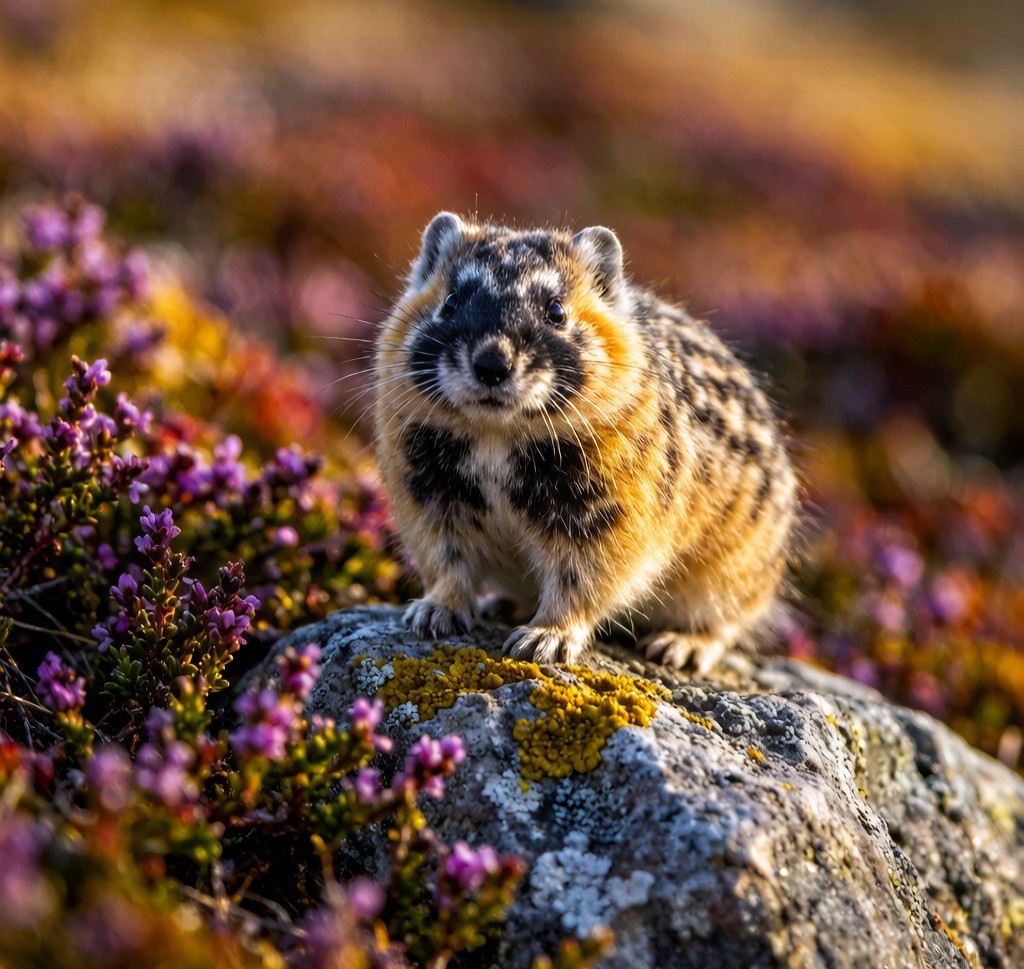
A Norwegian Lemming (Lemmus lemmus) standing on a lichen-covered rock in the Scandinavian tundra, showing its distinctive yellow-brown and black markings
Overview
The Norwegian Lemming (Lemmus lemmus) is a small, brilliantly colored rodent native to the tundra and alpine regions of Scandinavia and the northwestern Russian Federation. Famous for its dramatic population cycles, which see numbers fluctuate by up to 100-fold in 3 to 5-year cycles, the Norwegian Lemming is one of the few Arctic mammals whose population dynamics are visible even to the naked eye. Its extraordinary vivid coloration – bright yellow-ochre, bold black patches, and distinctive black face mask – makes it one of the most striking small mammals in the Arctic.
Adult Norwegian Lemmings measure 12 to 17 centimeters in body length with a tail of only 1 to 2 centimeters, and weigh 40 to 110 grams. Despite their small size, they are remarkably bold and aggressive for their body weight – individuals will defend their territories fiercely against intruders of any size. The lemming’s fur is its most distinctive feature: a complex mosaic of bright golden-yellow, rich ochre, and bold black patches, with a diagnostic black band across the face that gives them a masked appearance.
Habitat and Distribution
Norwegian Lemmings are found in the alpine and subarctic tundra zones of the Scandinavian Peninsula (Norway, Sweden, and Finland), as well as the Kola Peninsula and parts of the Russian Federation. Their preferred habitat is the moss and lichen-dominated tundra heaths above the treeline, typically at elevations of 800 to 1,500 meters in Scandinavia. They inhabit areas with a mosaic of moisture conditions – wet moss and lichen beds, drier heath patches, and rocky outcrops that provide cover from avian predators.
The lemming’s habitat is shaped by the dramatic seasonality of the Scandinavian high Arctic. Summers bring brief but intense plant growth, while winters are long, dark, and bitterly cold, with lemmings remaining active beneath the snow rather than hibernating. During winter, they create intricate tunnel systems within the snowpack, which provides insulation from the extreme cold and protection from predators.
Population Cycles
The Norwegian Lemming’s most famous characteristic is its dramatic population cycle – one of the most pronounced and predictable population oscillations in the animal kingdom. Lemming numbers can increase by up to 100-fold during peak years, when the tundra literally teems with lemmings. These peaks are followed by rapid crashes, sometimes within a single season, which reduce populations to extremely low levels within weeks.
The cause of these cycles involves a combination of factors including predator-prey dynamics and the quality of the winter snowpack. In years with deep, stable snow cover, lemmings survive better in winter, leading to higher spring populations and subsequent overgrazing of their food plants. In years with poor snow cover, lemmings suffer high winter mortality, leading to low spring populations and allowing food plants to recover.
Behavior and Adaptations
Norwegian Lemmings are remarkable for their diurnal activity pattern and bold, aggressive behavior – unlike many small prey species that are primarily nocturnal, lemmings are active day and night. Their vivid coloration is linked to aposematic (warning) signaling – the yellow and black patterning warns potential predators that they are unprofitable prey. Lemmings are herbivorous, feeding on tundra plants including grasses, sedges, mosses, and dwarf willows.
During peak population years, Norwegian Lemmings engage in dramatic mass migrations as local populations exceed habitat carrying capacity. These migrations are an evolved dispersal strategy that allows lemmings to colonize new areas. Lemmings also serve as a critical prey base for Arctic predators, including Arctic Fox, Red Fox, Snowy Owl, Rough-legged Buzzard, and Long-tailed Skua.
Conservation
The Norwegian Lemming is currently listed as Least Concern on the IUCN Red List, as its large range and population mean it is not at immediate risk of extinction. However, long-term climate change poses a significant threat to the species – warmer winters with more frequent freeze-thaw cycles degrade the stable snowpack conditions that lemmings depend on for winter survival. Climate change also threatens the cold, moist tundra habitats that lemmings require. Research suggests that Norwegian Lemming populations may shift northward and upward in elevation as temperatures rise.
[…] Classified within the subfamily Caprinae, the muskox shares evolutionary ties with the Norwegian Lemming and other Arctic herbivores. Fossil records show that muskoxen once ranged across the northern […]