 By st20113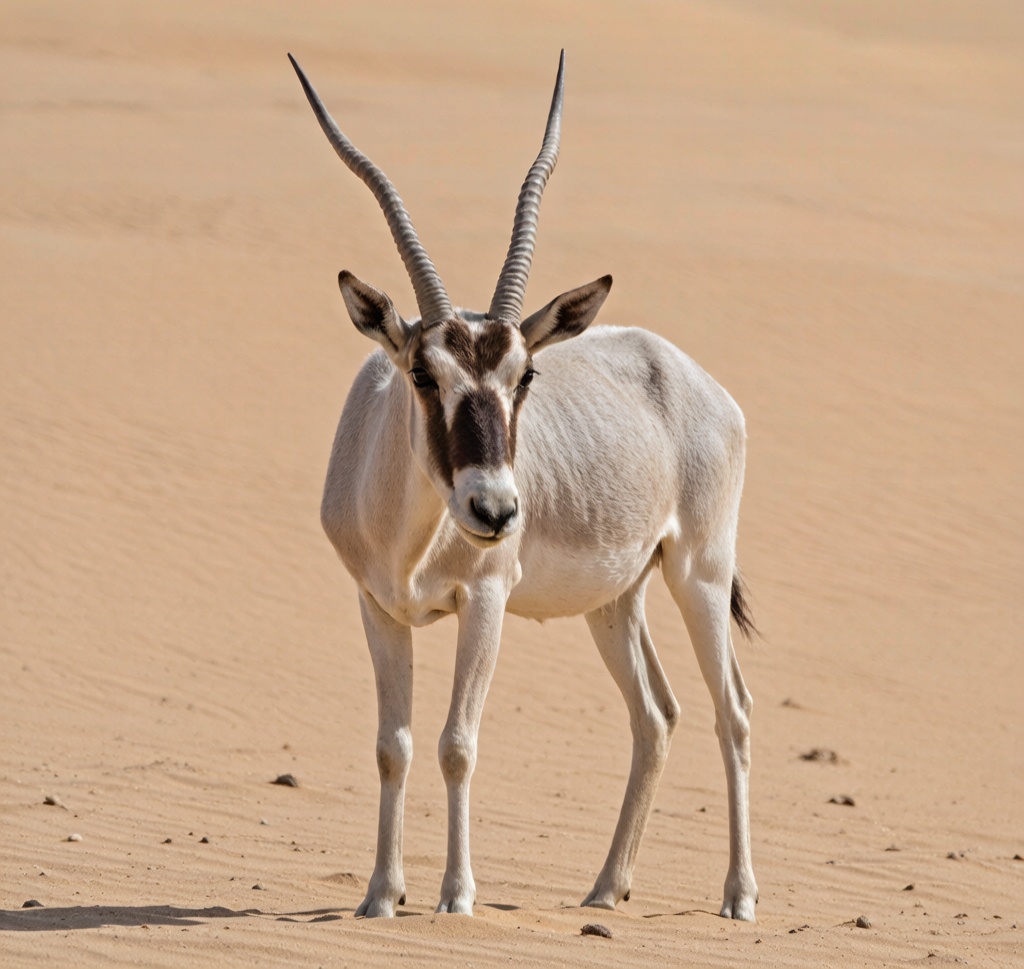
Introduction
The addax (Addax nasomaculatus) is one of the world’s rarest large mammals, an antelope so perfectly adapted to the Sahara Desert that it rarely needs to drink water at all. Also known as the white antelope or Sahara antelope, the addax inhabits arid rocky plateaus, sandy valleys, and gravel plains of the Sahel and Sahara across Mauritania, Niger, Chad, Sudan, and Libya. Standing roughly 1.1 meters at the shoulder and weighing 60 to 135 kilograms, the addax carries a dramatic pair of long, corkscrew-twisted horns reaching up to 120 centimeters on both sexes. With fewer than 100 to 300 mature individuals surviving in the wild, the addax is classified as Critically Endangered and faces a real risk of extinction within coming decades.
Taxonomy
The addax belongs to the family Bovidae and is the sole living member of the genus Addax—a unique evolutionary lineage with no close living relatives. Its scientific name Addax nasomaculatus translates as “nose-spotted,” referencing the distinctive dark facial markings running from the horn base down the bridge of the nose. The addax was first formally described by de Blainville in 1816 based on specimens from West Africa. Within Bovidae, the addax belongs to the tribe Hippotragini alongside the scimitar-horned oryx and Arabian oryx, both of which have also suffered severe population declines.
Physical Characteristics
The addax’s coat undergoes a dramatic seasonal transformation. During the hot dry season, the coat is short and almost white, reflecting the desert sun. As temperatures drop, the coat grows longer and turns grayish-brown with a dark face mask. Like the Arctic Fox, which also undergoes seasonal coat changes for camouflage, the addax transforms completely with the seasons. Both sexes carry spirally twisted horns up to 120 centimeters long—present in both males and females—making the addax one of the most visually distinctive antelopes in Africa. A beard-like throat tuft gives the addax its unique silhouette against the desert horizon.
Habitat
The addax inhabits the Sahara and Sahel, an environment of extreme temperatures and very little rainfall—typically under 100 millimeters per year. It is found on rocky plateaus, gravel plains, and hard-packed desert floors, always near some vegetation. The addax is most active during cooler early morning and late afternoon hours, resting in shade during midday when surface temperatures can exceed 50 degrees Celsius. It is a nomadic wanderer, following seasonal rains to find fresh plant growth, rather than maintaining a fixed territory. Its broad, splayed hooves prevent sinking in sand, allowing it to traverse dune fields that few other large mammals can cross.
Diet
The addax is primarily a grazer, feeding on tough desert grasses and the leaves of drought-resistant shrubs. Its digestive system processes coarse, fibrous material that many other grazers cannot tolerate, and it obtains sufficient moisture from food to survive without drinking free water. During the dry season, it relies more heavily on succulent shrub leaves for both nutrition and hydration. This extraordinary water economy is one of the key adaptations allowing the addax to survive where most large mammals cannot persist year-round. The Saiga Antelope employs similar strategies in the Eurasian steppes, though it occupies a very different habitat.
Reproduction
Addax do not have a fixed breeding season. After a long gestation of approximately 257 to 264 days—one of the longest of any antelope—a single calf is born, typically during the dry season when predators are fewer. Calves are born with a pale coat and can stand and follow their mother within hours. Like the African Elephant, which also gives birth to single calves after a long gestation, addax mothers move their calves frequently to avoid detection by predators. Young addax remain with their maternal group for an extended period, learning the routes and feeding strategies essential for desert survival.
Conservation
The addax is classified as Critically Endangered by the IUCN, with only 100 to 300 mature individuals remaining in the wild—a decline of over 80 percent in the past two decades. The primary threats are uncontrolled hunting for meat and horns, habitat degradation from pastoral livestock, and increasingly severe droughts linked to climate change. The species has been hunted from vehicles with modern weapons across its range. Enforcement of anti-hunting laws is minimal in remote Saharan border regions. Conservation priorities include strengthening anti-poaching efforts, protecting key habitat areas, and supporting international cooperation to save this unique antelope.
Fun Facts
The addax’s pale coat is so effective in the desert that early European explorers in Africa sometimes struggled to spot them against the sun-bleached terrain. The Black Rhinoceros faces similarly acute threats from poaching and represents another of Africa’s most critically endangered large mammals. The addax’s corkscrew horns, present in both sexes and reaching 120 centimeters, are among the most distinctive in the animal kingdom. Ancient Egyptians are believed to have kept addax in captivity as early as 2500 BCE, and the species appears in ancient Egyptian art, suggesting it was valued for its imposing appearance and large horns.