 By st20113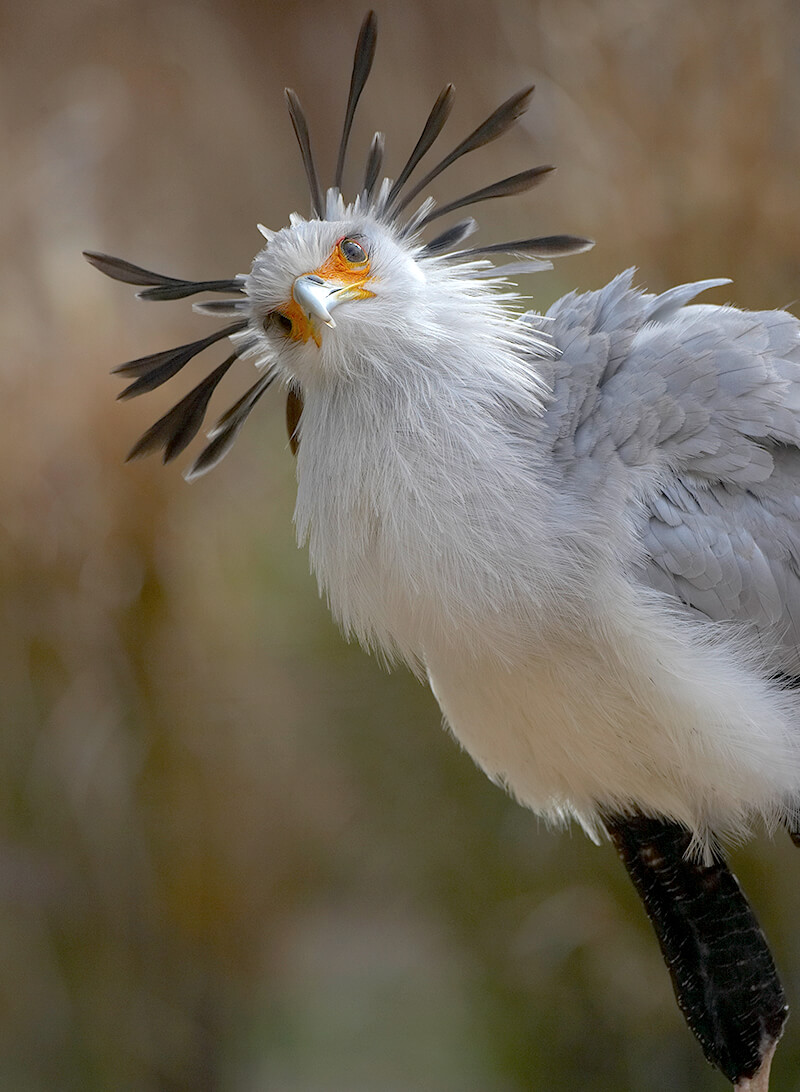
Introduction
The secretary bird (Sagittarius serpentarius) is one of Africa’s most distinctive raptors — a large, long-legged bird of prey that hunts on foot across the open grasslands and savannas of sub-Saharan Africa. Unlike any other bird of prey, the secretary bird is almost entirely terrestrial, spending most of its time walking through tall grass in pursuit of prey rather than soaring. Standing up to 1.4 meters tall with a wingspan of over two meters, it is unmistakable. Its eagle-like body and head, adorned with elongated black crest feathers, sit atop extraordinarily long legs, giving it an almost crane-like silhouette. The species is a national symbol of Sudan and appears on the coat of arms of South Africa.
Taxonomy
The secretary bird occupies a unique taxonomic position as the sole member of the family Sagittariidae and the genus Sagittarius. For many years, its affinities were debated — some taxonomists placed it near hawks and eagles while others suggested a relationship with storks. Modern genetic analysis has confirmed that its closest relatives are the osprey and accipitrid hawks and eagles. The species name serpentarius — meaning serpent-bearer — reflects its legendary ability to kill and consume snakes, including highly venomous species. Two subspecies are recognized, separated geographically across the African continent.
Physical Characteristics
The secretary bird’s most remarkable feature is its extraordinarily long legs, covered in scale-like plumage resembling pantaloons. The lower legs are bare and colored orange-red, ending in short, powerful toes equipped with blunt, talon-like claws. The body is eagle-like with a grayish-white head, a black crest of elongated feathers that curves forward, and a black bib on the upper chest. The wings are broad and rounded, predominantly gray with black flight feathers. Secretary birds have extremely powerful legs — capable of delivering a kick with a force equivalent to five times their own body weight — which they use to dispatch prey with a single blow.
Habitat
Secretary birds inhabit the open grasslands, savannas, and semi-desert scrublands of sub-Saharan Africa, from the southern edge of the Sahara southward through East Africa to South Africa. They are most commonly found in areas of medium-to-tall grass where their terrestrial hunting strategy is most effective. Secretary birds require large, unfragmented territories — a breeding pair may need up to 50 square kilometers of suitable habitat — and avoid dense forests, wetlands, and areas with intensive agriculture. They are typically observed in pairs or family groups, walking purposefully through the grass with a distinctive gait, covering up to 30 kilometers per day in search of food.
Diet
The secretary bird is a formidable predator of the African grasslands, feeding on large insects, small mammals, birds, and reptiles. Locusts, beetles, and scorpions form a significant portion of its non-breeding diet, while during breeding it actively hunts rodents, hares, and small antelopes. Its most celebrated prey is snakes — including puff adders, cobras, and black mambas — which it dispatches with swift, powerful kicks that can kill a snake instantly. Secretary birds swallow prey whole or in large pieces, with the head swallowed first to avoid the risk of a venomous bite.
Reproduction
Secretary birds are monogamous and form long-term pair bonds within the same territory year after year. They breed during the local dry season. Both sexes participate in elaborate courtship displays involving calling, bowing, and wing-spreading. The pair builds a large, flat stick nest in the crown of an acacia tree, typically 2 to 7 meters above the ground, which is reused and added to over successive seasons. The female lays 1 to 3 white eggs (usually 2), incubated for approximately 42 to 46 days. Both parents feed the chicks for up to three months after hatching, and young birds remain dependent for several more months before dispersing.
Conservation
The secretary bird is listed as Endangered on the IUCN Red List, with declining populations across much of its range. Primary threats are habitat degradation from agricultural expansion and overgrazing by livestock. Pesticides and rodenticides poison both prey and the birds themselves. Grassland fires — both natural and human-set — destroy nesting trees and reduce prey availability. Conservation efforts focus on protecting key grassland habitats, reducing pesticide use, and monitoring populations through satellite tracking of tagged individuals.
Fun Facts
The secretary bird gets its name from an unusual source: 19th-century naturalist clerks who carried quill pens behind their ears, resembling the bird’s distinctive crest feathers. Secretary birds are the only raptor that hunts primarily on foot, capable of covering up to 30 kilometers in a single day. When cornered at the nest, they strike at predators with their powerful legs while flapping their wings for balance — earning them the nickname ground eagle. They are capable of killing snakes far larger than themselves, and have been observed flushing antelopes and other small mammals from hiding among the grass.