 By st20113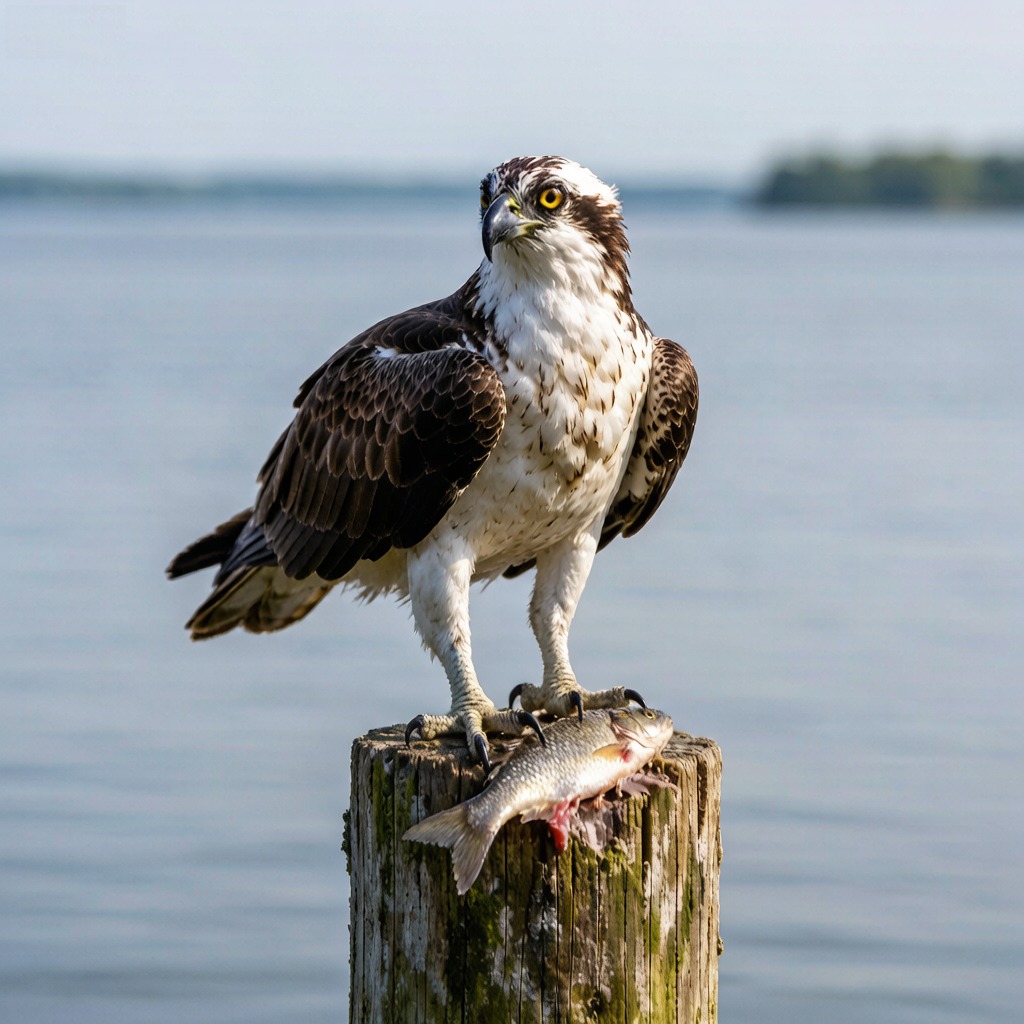
Introduction
The osprey (Pandion haliaetus), commonly known as the sea hawk, fish hawk, or river hawk, is a medium-large raptor that is cosmopolitan — found on every continent except Antarctica. Unlike most hawks, the osprey is almost entirely dependent on fish for its diet, making it one of the most specialized fish-eating birds in the world. Its unique ability to dive feet-first into water to snatch fish has made it a remarkable example of evolutionary adaptation in the avian kingdom.
Taxonomy and Classification
The osprey was long placed in the family Accipitridae alongside hawks, eagles, and kites. However, modern genetic analysis has revealed that it is sufficiently distinct to warrant its own family — Pandionidae. Two to four subspecies are recognized, with P. h. haliaetus found across Europe, Asia, and Africa, and P. h. carolinensis found in North America. The osprey’s lineage diverged from other diurnal birds of prey approximately 30 to 40 million years ago.
Physical Characteristics
Ospreys are 54 to 58 cm (21 to 23 inches) in body length with a wingspan of 150 to 180 cm (4.9 to 5.9 feet). They weigh 1.4 to 2.1 kg (3.1 to 4.6 lbs). Their plumage is dark brown above and white below, with a distinctive dark eye stripe extending from the bill to the nape. The osprey’s most remarkable feature is its reversible outer toe — it can grasp prey with two toes in front and two behind, an adaptation unique among diurnal raptors that allows it to carry fish securely during flight.
Distribution and Habitat
Ospreys have one of the widest distributions of any raptor species, breeding on every continent except Antarctica. They migrate between temperate breeding grounds and tropical wintering areas. Ospreys are strongly associated with aquatic environments — coastal areas, lakes, rivers, reservoirs, and wetlands — requiring clear water where fish are visible near the surface.
Hunting Behavior
The osprey is an expert aerial fisher. It hunts by flying over water at heights of 10 to 40 meters, hovering briefly, then diving steeply with feet extended forward. Upon impact, it may submerge completely before emerging with a fish gripped in its reversible talons. The osprey carries its prey head-first to reduce air resistance. Studies suggest ospreys catch fish in 10 to 30 percent of dives, with regional variation depending on prey availability.
Reproduction
Ospreys are monogamous and often return to the same nest site year after year. They build large stick nests on elevated structures such as dead trees, cliffs, utility poles, or purpose-built platforms. A typical clutch contains 2 to 4 eggs, which are incubated for approximately 38 to 43 days. Both parents participate in incubation and feeding.
Conservation Status
The osprey is listed as a species of Least Concern by the IUCN. Following bans on DDT and other organochlorine pesticides in the 1970s, osprey populations in North America and Europe recovered dramatically. Today, they benefit from the availability of artificial nesting platforms near water bodies.
[…] relationship with storks. Modern genetic analysis has confirmed that its closest relatives are the osprey and accipitrid hawks and eagles. The species name serpentarius — meaning serpent-bearer — […]
[…] includes many swift species worldwide, all sharing the same mastery of sustained flight. Unlike the osprey, which hunts fish from above water, the swift catches tiny insects high in the sky, illustrating […]