 By st20113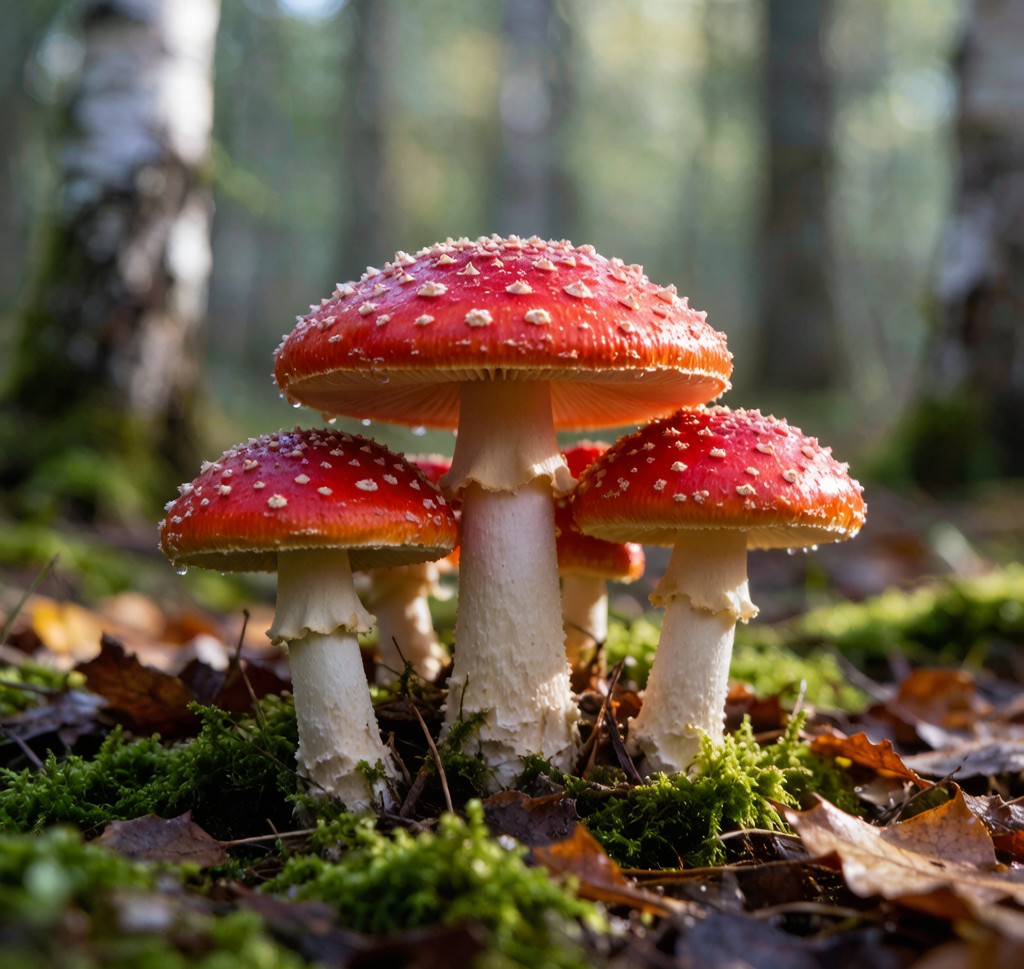
The fly agaric (Amanita muscaria) — instantly recognisable from its vivid scarlet cap speckled with white warts — is one of the most iconic, widespread, and culturally significant fungi on Earth, a species that has woven itself into the mythology, art, and spiritual traditions of virtually every culture across its circumpolar range. Found in temperate and boreal forests throughout the Northern Hemisphere — from Iceland and Scandinavia to Japan, and from Alaska to the Appalachian Mountains — the fly agaric is one of the most familiar toadstools in the world, its image familiar from fairy tale illustrations, video games, and Christmas decorations. Despite its reputation as a deadly poison mushroom, the fly agaric is not typically lethal to humans, though it produces a complex cocktail of psychoactive and toxic compounds including ibotenic acid and muscimol that can cause vivid hallucinations, delirium, vomiting, and loss of muscular coordination. The species forms mycorrhizal associations with birch, pine, and spruce trees, linking individual trees in underground fungal networks through which carbon, nitrogen, and phosphorus are exchanged, making the fly agaric a critical component of the ecological web of the boreal forest.
## Physical Characteristics
The fly agaric is a large, striking mushroom that passes through distinct colour and morphological stages as it matures. Young specimens emerge from the soil as white, egg-shaped buttons partially covered by a membranous universal veil, then expand into a convex cap measuring 8 to 20 centimetres in diameter that is a brilliant, blood-red to scarlet red colour overlaid with numerous white to cream wart-like spots — the remnants of the universal veil that ruptures as the cap expands. As the mushroom matures, the cap flattens and may fade to orange-yellow, and the warts may wash off in heavy rain. The gills beneath the cap are white and free of the stalk. The stipe (stem) is white, 10 to 20 centimetres tall, and bears a large, floppy white ring (the annulus) and a cup-like structure at the base (the volva) that is covered in concentric rings of white scales. The spores are white, smooth, and elliptical, and the flesh is white throughout. The distinctive red-and-white appearance is mimicked by several other harmless mushroom species — a phenomenon known as Batesian mimicry — and by the highly toxic scarlet coloured brackets of the oakMazegill fungus.
## Habitat and Distribution
The fly agaric is one of the most widely distributed of all larger fungi, found throughout the temperate and boreal zones of the Northern Hemisphere from the British Isles to Japan and from Scandinavia to the Mediterranean and North Africa in the south of its range. It is particularly abundant in birch and birch-pine forests in northern Europe and Asia, where it can occur in enormous numbers during the autumn fruiting season. The species has been introduced to many parts of the Southern Hemisphere, including South America (particularly Chile, Argentina, and Brazil), southern Australia, New Zealand, and South Africa, almost certainly through the importation of northern hemisphere pine seedlings with soil containing the fungus or its spores. In its introduced ranges, the fly agaric has formed associations with introduced pine and birch trees and in some areas has become more abundant than in parts of its native range. The fly agaric is a strict mycorrhizal symbiont and cannot grow without its host trees; it is typically found at the edges of forest clearings, along roadsides, and in open woodland where young birch and pine trees are establishing.
## Ecology
The fly agaric plays a critical ecological role as a mycorrhizal symbiont of birch, pine, spruce, fir, and cedar trees, forming a dense sheath of fungal tissue around the fine roots of its host plants and extending far into the surrounding soil through a network of microscopic filaments called hyphae. Through this network, the fungus transports water and mineral nutrients — particularly phosphorus and nitrogen — to the tree in exchange for carbon compounds produced by the tree through photosynthesis. This underground mycorrhizal network can link multiple trees of different species together, allowing the transfer of carbon and nutrients from larger, older trees (the mother trees) to young seedlings establishing in the understory, a phenomenon sometimes described as the wood wide web. Several compounds produced by the fly agaric, including ibotenic acid and muscimol, are neuroactive in mammals and insects alike: the fly agaric is a significant component of the diet of the Siberian reindeer, which actively seek out and consume the mushrooms and exhibit signs of intoxication after feeding.
## Conservation and Cultural Significance
The fly agaric is not considered threatened and is widespread and abundant throughout its native range. The species has a rich cultural history spanning multiple continents: it features prominently in the shamanic traditions of the indigenous peoples of Siberia, where it was used as an entheogen in religious ceremonies; it appears in Scandinavian folklore as the dwelling place of圣诞精灵; it is associated with the winter solstice and Christmas traditions throughout northern Europe; and it features prominently in the iconography of the Smurfs and other popular culture franchises. The active compounds of the fly agaric have been the subject of considerable scientific and pharmacological interest, and recent research has suggested that the mushroom may have played a role in ancient Vedic religious traditions in India, in Norse mythology, and in the origins of the Christmas traditions of northern Europe.
[…] of the shop mushroom and of the fairy-ring champignon, and it shares the fungal way of life with Amanita muscaria: both are fungi that absorb their food rather than make it by […]
[…] the poisonous fly agaric (Amanita muscaria), described in our article on Amanita muscaria (Fly Agaric), the chanterelle is a safe and sought-after wild mushroom; both are fungi, but where the fly agaric […]
[…] the famously poisonous fly agaric, described in our article on Amanita muscaria (Fly Agaric), which belongs to a different family and must be avoided, the button mushroom is thoroughly safe […]
[…] a sac fungus, and like other larger fungi it lives by breaking down organic matter rather than by Amanita muscaria and the toadstools of the gilled families, occupying a different part of the fungal […]
[…] Like its relatives it is a woodland toadstool of autumn, and it belongs to the same gilled group as Amanita muscaria, the fly agaric, though it is far less […]
[…] by their exuding latex, and it sits alongside the gilled fungi rather than the sac fungi, unlike Amanita muscaria, though both are woodland toadstools of […]
[…] allies, and it shares the mycorrhizal lifestyle with many forest fungi — in the same way that the fly agaric forms associations with tree roots, R. emetica exchanges sugars for minerals with birch. Within […]
[…] strongly violet overall hue. Like other forest fungi it is mycorrhizal, and in the same manner that the fly agaric partners with trees, the violet webcap exchanges soil minerals for tree sugars through root […]
[…] it has abandoned gills entirely in favour of spines that carry the spore-producing surface. Like the fly agaric and other conspicuous woodland fungi, it is a product of the rich fungal community that recycles […]