 By st20113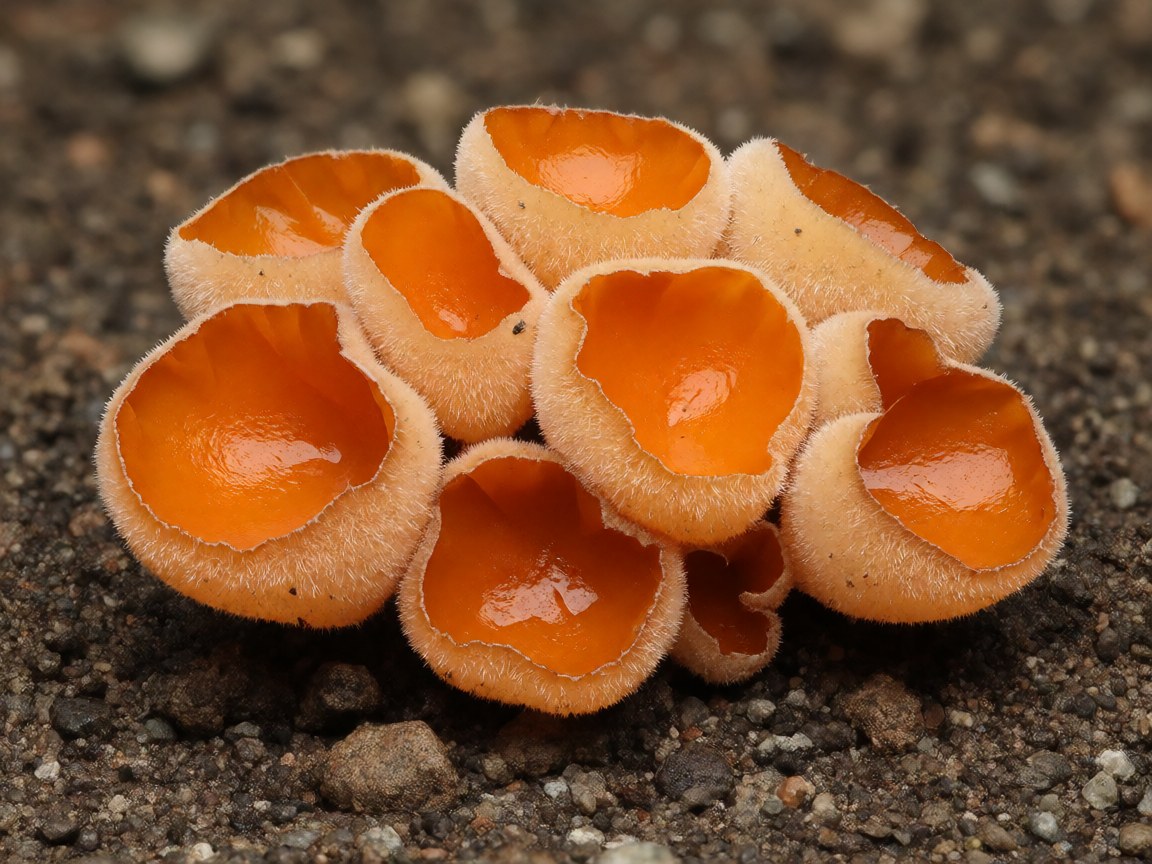
Aleuria aurantia | Orange Peel Fungus
Introduction
The orange peel fungus (Aleuria aurantia) is one of the most conspicuous and easily named fungi of autumn, a bright orange cup that appears on bare soil and looks, exactly as its name suggests, like a piece of orange peel tossed aside. The cups are usually found in groups, clusters, or scattered troops on disturbed ground — path edges, lawns, gravel drives, muddy banks, and the bare margin of a flower bed — in places where nothing else of that colour grows. Because the colour is so unmistakable and the habitat so ordinary, it is often the fungus that turns a casual walker into someone who notices fungi at all. It is a cup fungus, an ascomycete, and that explains both its shape and its way of life: the spores are produced inside microscopic sacs lining the inner surface of the cup rather than on gills or in pores. It is usually listed as edible, but the flesh is thin and the flavour negligible, and its real value is as one of the most reliable and cheerful signs that the fungal season is properly under way.
Taxonomy
Aleuria aurantia belongs to the phylum Ascomycota, the sac fungi, and is placed in the order Pezizales and the family Pyronemataceae, a large and difficult group of mostly small, brightly coloured cup fungi. Its relatives include the scarlet elf cup (Sarcoscypha coccinea), the brown ear cups of Otidea, the dung-loving Cheilymenia, and the big brown cups of Peziza. The genus Aleuria is small, and the species epithet aurantia is simply Latin for orange. It differs fundamentally from the familiar mushrooms such as Amanita muscaria, which is a basidiomycete and forms its spores externally on the surface of club-shaped cells called basidia; in Aleuria the spores are formed inside elongated cells called asci, typically eight per ascus, and are liberated only when the ascus is mature. This distinction — spores inside versus spores outside — is one of the deepest divides in the fungal kingdom, and the cup fungi sit firmly on the “inside” side of it.
Physical Characteristics
The fruit body is a cup, initially rounded and deep, then opening out into a shallow saucer and finally becoming irregularly flattened, wavy, and often split down one side, two to ten centimetres across. The inner, fertile surface is smooth, slightly glossy, and brilliant orange to orange-red, sometimes with a paler yellow-orange margin. The outer surface is visibly different: paler, whitish to buff or pale orange, and finely downy with a dense covering of short, curved, septate hairs that are easy to see with a hand lens and are one of the characters used to separate it from similar species. There is no stem, or at most a short, rooting base buried in the soil. The flesh is thin, brittle, and pale orange, and the whole thing is fragile enough that the cups often tear when handled. Microscopically the spores are elliptical, hyaline, and ornamented with a fine network of ridges, usually containing one or two oil droplets, measuring about seventeen to twenty-four micrometres long; the asci are cylindrical and their tips do not turn blue in iodine, which helps distinguish the genus from Peziza. Several other orange cups exist and need microscopy to separate: species of Melastiza, Sphaerosporella, and Cheilymenia are all much smaller, while the scarlet elf cup is deep red rather than orange and grows on dead wood rather than bare soil.
Habitat
It is a saprotroph of bare or sparsely vegetated mineral soil, and it is strongly associated with disturbance: roadside verges, gravel drives, garden paths, lawns, riverbanks, spoil heaps, woodland rides, recently dug soil, and even the thin soils of sand dunes. It prefers damp, open ground with little competing vegetation, often on clay or gravel, and it appears most often after rain in autumn. The species is widespread across Europe and North America and has been recorded in Asia, parts of South America, and Australia; it is common throughout Britain and Ireland. Fruiting runs from late summer into early winter, with a peak in September and October, though cups can appear in mild spells in December and occasionally in spring. Because it fruits on ground that is too disturbed, too dry, or too sun-baked for most fungi, it often dominates exactly the places where people are most likely to walk past it.
Diet
The fungus feeds as a saprotroph, breaking down dead organic matter in and on the soil: fragments of leaf litter, dead root material, thatch, and other plant debris. It releases enzymes into the soil and absorbs the soluble products, and in doing so it helps make carbon and nitrogen available again to plants and other organisms. It is one of the earlier colonisers of bare mineral ground, and it appears to have no mycorrhizal relationship with living plants. Its tolerance of conditions that exclude most fungi — compaction, exposure, periodic drying, and full sun — is a large part of its success: it does not have to compete with turf or with a dense fungal community, because few others can use the same ground. This is why ploughing, path-cutting, and general disturbance tend to produce more orange peel fungus rather than less.
Reproduction
Spores develop inside the asci that line the fertile inner surface of the cup. When the ascus is mature, turgor pressure inside it rises, a small hinged lid at the tip — the operculum, which gives the order Pezizales its common name of “operculate cup fungi” — flips open, and the eight spores are shot out in a fraction of a second. The discharge happens across the whole surface at once if the cup is disturbed, breathed on, or warmed by the sun, and on a still day with low sunlight a mature troop can be seen releasing a fine, visible puff of spores. The spores are then carried away by air currents, and those that land on suitable damp soil germinate into a mycelium that grows through the substrate year-round. Fruiting is triggered by autumn rain following a dry period, and the same mycelium can produce cups in the same place for several years in succession.
Conservation
The species is common and widespread and is not considered threatened; it has not been formally assessed on the global level, but its abundance and tolerance of disturbance make it one of the least conservation-dependent fungi. If anything, it benefits from human activity, since mown grass, worn paths, and turned soil all create the open ground it needs. Local threats are the intensive management of amenity grassland with herbicides, fungicides, and heavy nitrogen fertiliser, the sealing of soil under paving and tarmac, and the fashion for replacing natural soil with sterile mulch. Recording is straightforward because the fungus is so recognisable, and it is a good species for citizen-science surveys, though recorders are warned that several small orange cups require microscopic confirmation and that photographs alone can be misleading.
Fun Facts
- The bright orange, irregularly flattened cups really do look like discarded pieces of orange peel.
- It fires its spores from a hinged lid; a disturbed cup can release a visible puff of spores.
- Unlike a typical mushroom, it makes its spores inside microscopic sacs, eight to a sac.
- It thrives on disturbed ground such as path edges, gravel drives, and lawns.
- It is technically edible, but the flesh is thin and tasteless and it is generally not considered worth eating.