 By st20113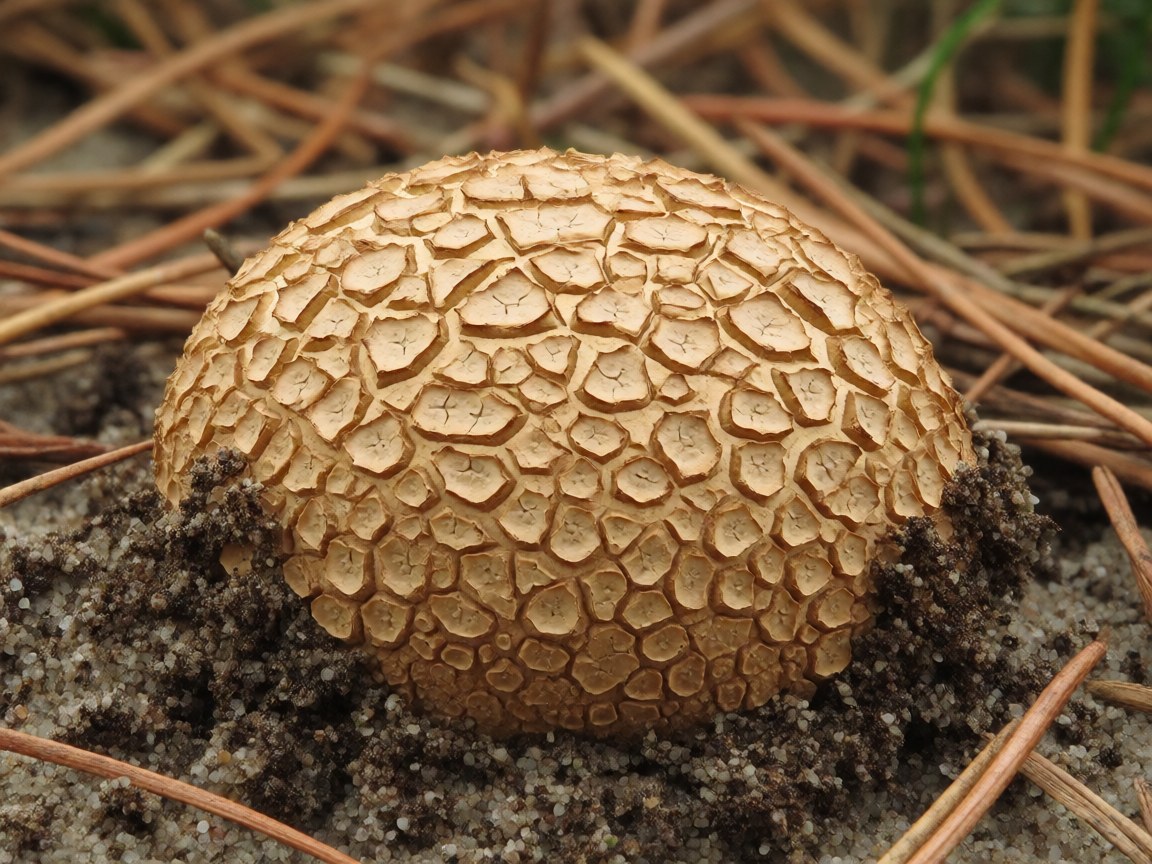
Scleroderma citrinum | Common Earthball
Introduction
The common earthball (Scleroderma citrinum) is a squat, lumpy, yellowish-brown ball that sits half-buried in sandy soil and woodland litter and looks, to most people, exactly like a puffball that has gone off. It is firm and heavy where a puffball is light, its skin is thick, tough, and patterned with cracks and small scales rather than smooth, and when it is cut open the inside is not the pure white flesh of a young puffball but a mass of grey-violet, marbled tissue that darkens as it matures. That marbled interior is the diagnostic feature and the reason for one of its old names, and the whole structure eventually turns to a dry powder of spores that escapes through an irregular split in the top. It is common on poor, acidic, sandy ground throughout the northern hemisphere, and it is one of the first “puffballs” a beginner learns to distinguish — largely because it is mildly poisonous and tastes appalling.
Taxonomy
Scleroderma citrinum is a gasteroid basidiomycete: a member of the gilled fungi whose ancestors lost the mechanism for shooting their spores and instead enclosed them within the fruit body, an arrangement that has evolved independently many times and which produces the puffball, earthball, earthstar, and stinkhorn body forms. It is placed in the family Sclerodermataceae within the order Boletales, which makes it a relative of the boletes rather than of the true puffballs, a relationship confirmed by molecular work and reflected in details of its spores and tissues. The genus Scleroderma, whose name means “hard skin”, contains a number of tough-skinned earthballs worldwide. Like the familiar Amanita muscaria, it is a basidiomycete producing spores on club-shaped cells, but the basidia are borne on the internal surfaces of irregular chambers inside the closed fruit body rather than exposed to the open air on gills.
Physical Characteristics
The fruit body is roughly spherical to flattened and often slightly irregular or lobed, typically three to ten centimetres across, and it usually sits partly buried with the lower part narrowed into a short, thick, rooting base of whitish mycelial cords. The outer skin, or peridium, is thick, tough, and almost leathery, one to three millimetres thick, and its surface is pale yellow to ochre or dull brown, covered with a pattern of small, flattened, closely packed warts and scales that become more cracked and areolate with age — the citrine, or lemon-yellow, tint of fresh young material gives the species its name. There is no stem and no opening at the base. When cut in half, the interior is the key feature: the spore mass, or gleba, is at first firm and whitish, soon becoming marbled grey-violet and purple-black, and finally turning into a dry, dark, powdery mass of spores mixed with threads. The spores are large, dark brown, and strongly ornamented with a network of ridges and spines, and the smell of mature material is unpleasant and metallic.
Habitat
It grows on the ground in woodland, on heathland, in sand dunes, on roadside banks, and in rough grassland and parkland, nearly always on poor, dry, acidic, sandy or gravelly soil, and it is tolerant of disturbance and of full sun as well as shade. It is particularly characteristic of birch and pine woodland on sandy soils, of heathland margins, and of the acidic banks along paths and tracks. It is found across Europe, Asia, and North America and has been introduced elsewhere, and it is common throughout Britain and Ireland. Fruiting is from late summer into autumn, occasionally in winter, and the tough, persistent fruit bodies can remain in place for months, gradually weathering to a dark, hollow shell. It is often found in groups or small troops rather than singly.
Diet
The common earthball is an ectomycorrhizal fungus, forming a mutualistic partnership with the roots of trees rather than feeding on dead matter. Its mycelium sheathes the fine root tips of its hosts — birch, pine, oak, beech, and various other trees and shrubs are all recorded — and the fungus receives sugars from the tree in exchange for water and mineral nutrients, especially nitrogen and phosphorus, which its far-reaching mycelium is much better at extracting from poor, acidic soil than the roots alone would be. This is why the species is so strongly associated with nutrient-poor ground: on such soils the partnership is most valuable to the tree. The fungus does not decay wood or litter to any significant extent, and the fruit bodies appear only when the mycelium has accumulated enough resources from its hosts, which is why a good season for earthballs often follows a good growing season for the trees themselves.
Reproduction
Because the spores are enclosed, they cannot be shot away from a basidium as they are in a mushroom. Instead, the spores develop inside the chambers of the gleba, and when they are ripe the mass dries to a powder and the thick outer skin splits irregularly across the top. The spores are then puffed out by the impact of raindrops and by the pressure of animals stepping on or brushing past the fruit body — the same bellows mechanism used by the true puffballs. They are dispersed by wind and water, and probably also by small invertebrates and by animals that disturb the soil. The spores germinate to produce a mycelium that must encounter a compatible root tip of a suitable host tree to establish the mycorrhiza, and it is this requirement that ties the fungus so tightly to particular woodland and heathland habitats. The mycelium and its partnership with the tree persist for years, and fruit bodies may appear in the same place repeatedly.
Conservation
The species is common, widespread, and not threatened, and it is arguably one of the most successful ectomycorrhizal fungi in disturbed and degraded habitats, since it tolerates acidic, nutrient-poor, and compacted ground that excludes many of its relatives. Its conservation interest is as an indicator of the mycorrhizal health of poor soils and of the continuity of woodland and heath on sandy ground, and it is a frequent component of fungal surveys for that reason. Local losses follow the loss of heathland to agriculture, development, and scrub invasion, and the conversion of birch and pine woodland to plantation forestry, but the species is resilient and quick to colonise suitable ground. Its main significance to people is as a lookalike: it is mildly poisonous, causing nausea, vomiting, and abdominal pain, and the chief risk is that it may be gathered in mistake for an edible puffball.
Fun Facts
- The marbled grey-violet interior is the quickest way to tell it from a true puffball.
- The tough skin cracks into a pattern of small scales, and the spore powder puffs out through the split top.
- It is related to the boletes rather than to the true puffballs.
- It is ectomycorrhizal, partnering with the roots of birch, pine, and other trees on poor soil.
- It is mildly poisonous and has a thoroughly unpleasant taste, so it is rarely eaten twice.
[…] fungus shares the family with the Common Earthball. That fungus has a smooth warty skin. It grows in woodland on acid soil. Our fungus is more scaly […]