 By st20113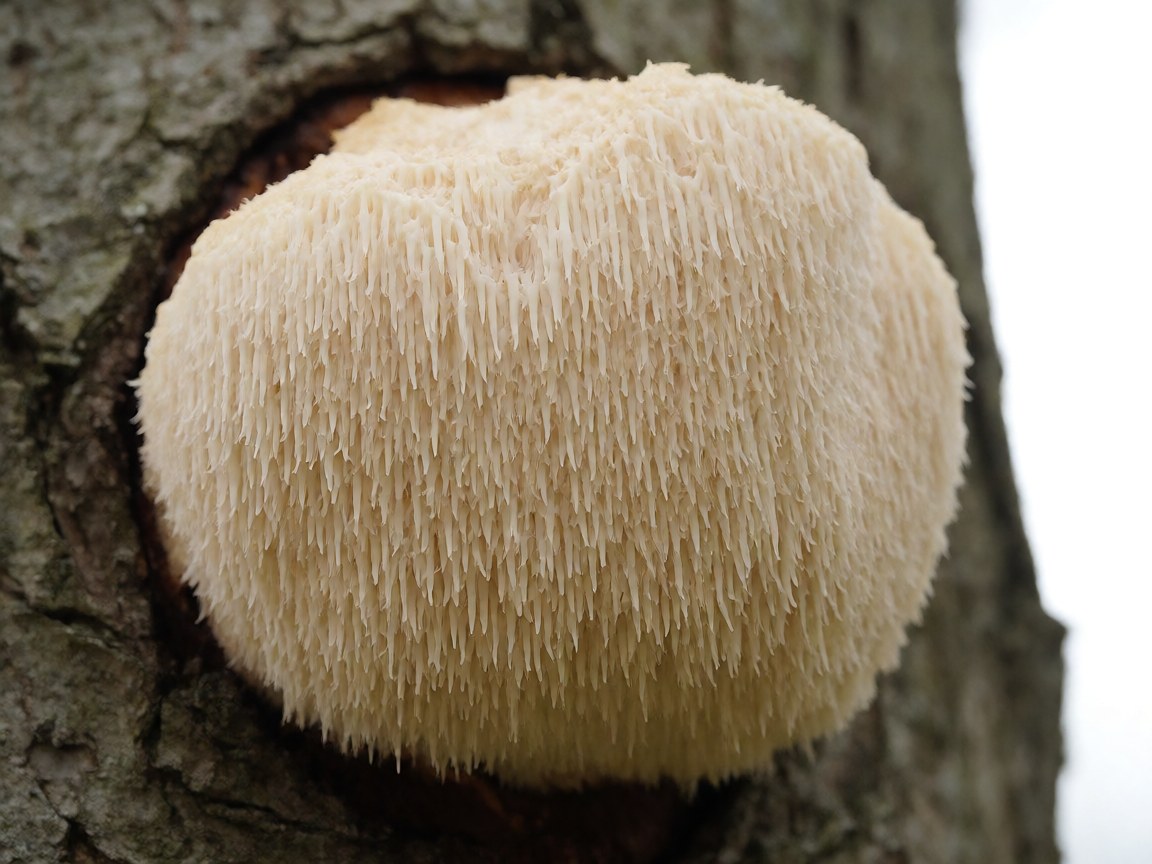
Hericium erinaceus | Lion’s Mane
Introduction
Lion’s mane (Hericium erinaceus) is one of the most unmistakable fungi in the world: a soft, rounded, creamy-white mass covered in a shaggy curtain of long, dangling, tooth-like spines that hang down like icicles or, in the imagination that gave it its name, like the mane of a lion. It grows on the trunks of broadleaf trees, usually from a wound or a broken branch high above the ground, and it is large, pale, and soft enough to be visible from some distance. It is a tooth fungus, which means the spines are the spore-bearing surface — the underside of the structure is made of thousands of tiny, downward-pointing teeth rather than gills or pores. It has a long history of use as food and as medicine in East Asia, it is now cultivated commercially and sold as a dietary supplement, and it is a protected or red-listed species in much of Europe, where it remains genuinely scarce.
Taxonomy
Hericium erinaceus is a basidiomycete in the order Russulales and the family Hericiaceae, a small group of tooth fungi whose members produce their spores on pendant spines. Its relatives include the coral tooth Hericium coralloides, the bear’s head Hericium americanum, and the northern tooth Climacodon septentrionalis, all of which share the same spiny, pendulous habit. The genus name comes from the Latin for a hedgehog, a reference to the spines, and the specific epithet erinaceus means much the same thing. Like the familiar Amanita muscaria, it produces its spores externally on club-shaped basidia, but whereas the fly agaric hangs those basidia from the flat vertical faces of gills, lion’s mane covers the surface of thousands of individual teeth, each of which is a separate, downward-hanging spike of fertile tissue. The spines give it an enormous surface area in a small volume, and this is the whole point of the design.
Physical Characteristics
The fruit body is a single, unbranched, roughly rounded or cushion-shaped mass, sometimes lobed or flattened on one side, typically ten to twenty-five centimetres across but occasionally much larger and weighing a kilogram or more. It is attached to the tree by a very short, thick, lateral base, or directly by one side, and it has no stem. From the underside and edges hang the spines: soft, slender, cylindrical, tapering to a point, normally two to five centimetres long, packed closely together and hanging vertically. Both the body and the spines are white or creamy-white when young and fresh, becoming cream, pale yellow, buff, or pale brownish with age, and the spines are brittle and break away easily. The flesh is white, soft, juicy, and rather watery, with a mild, pleasant smell and taste that has been compared to crab or lobster. The spores are small, smooth, almost spherical, and amyloid, and the spore print is white.
Habitat
It grows on the wood of broadleaf trees, most often from wounds, branch stubs, cracks, and broken limbs on living trunks, and it also fruits on dead standing trees, fallen logs, and large stumps. Beech and oak are the commonest hosts in Europe, with maple, walnut, elm, and others recorded elsewhere; in North America it is found on a similar range of hardwoods. Most often it appears well above head height on a large, old, living tree, which is one reason it is so rarely collected and so easily overlooked by people who do not look up. It is widely distributed across the temperate northern hemisphere, including Europe, Asia, and North America, but it is nowhere common; in Britain it is a rare and much-recorded species, protected by law, and most British records come from old beech woodland in the south. It fruits from late summer into autumn, and occasionally in winter during mild spells.
Diet
Lion’s mane is a white-rot fungus and a wound parasite of living trees. It colonises the heartwood exposed by a wound, a snapped branch, or a frost crack, and it is capable of decomposing both the cellulose and the lignin of the wood, which is what distinguishes white rot from brown rot; attacked wood becomes pale, soft, stringy, and eventually spongy. Because the fungus is working largely on dead heartwood inside a living tree, a vigorous host can compartmentalise the decay and go on living for decades with the fungus fruiting from the same wound year after year, and a single tree may support the same individual for a very long time. This combination — a parasite that mostly consumes already-dead tissue and that can persist inside one tree — is why the species is tied so closely to old, large, damaged broadleaf trees and why it disappears when they are felled.
Reproduction
The spores are produced over the surface of the hanging spines, an arrangement that vastly increases the fertile area available in a fruit body of a given size and, because the spines hang down into still air beneath the fungus, allows the spores to be released and simply fall clear rather than having to be actively discharged into a confined space. Spores are carried away by air currents; those that land on exposed heartwood of a suitable host germinate, and the resulting mycelium must meet a compatible partner before it can produce fruit bodies. Infection generally requires a wound, since intact bark is an effective barrier. Once established, the mycelium persists within the wood and fruits whenever conditions are right, most often after warm, humid weather in late summer and autumn. Commercial cultivation on sawdust, logs, and supplemented substrates is now well established, particularly in East Asia, and this has made the fungus far more available than wild collection ever could.
Conservation
The status of the species differs sharply between continents. In Asia and increasingly in North America it is widely cultivated and is not a conservation concern. In Europe it is a different matter: lion’s mane is red-listed in several countries and is legally protected in Britain, where it is one of the fungi listed under the Wildlife and Countryside Act, making it an offence to pick or damage it without permission. Its rarity is a direct consequence of its dependence on large, old, wounded broadleaf trees — exactly the trees that have been removed most thoroughly from European woodland. The loss of old beech and oak, the removal of dead and dying timber, and the tidy management of parks and avenues all reduce what little habitat remains. Conservation is therefore about retaining veteran trees, allowing them to keep their dead limbs and wounds, and resisting the urge to make woodland safe and neat.
Fun Facts
- The long dangling spines are the spore-bearing surface, not decoration.
- It is a white-rot fungus, able to break down both cellulose and lignin in wood.
- It usually fruits high on the trunk of a living tree, from an old wound or broken branch.
- It is legally protected in Britain and must not be picked.
- It is cultivated commercially and sold as a food and as a dietary supplement, and is said to taste like crab.