 By st20113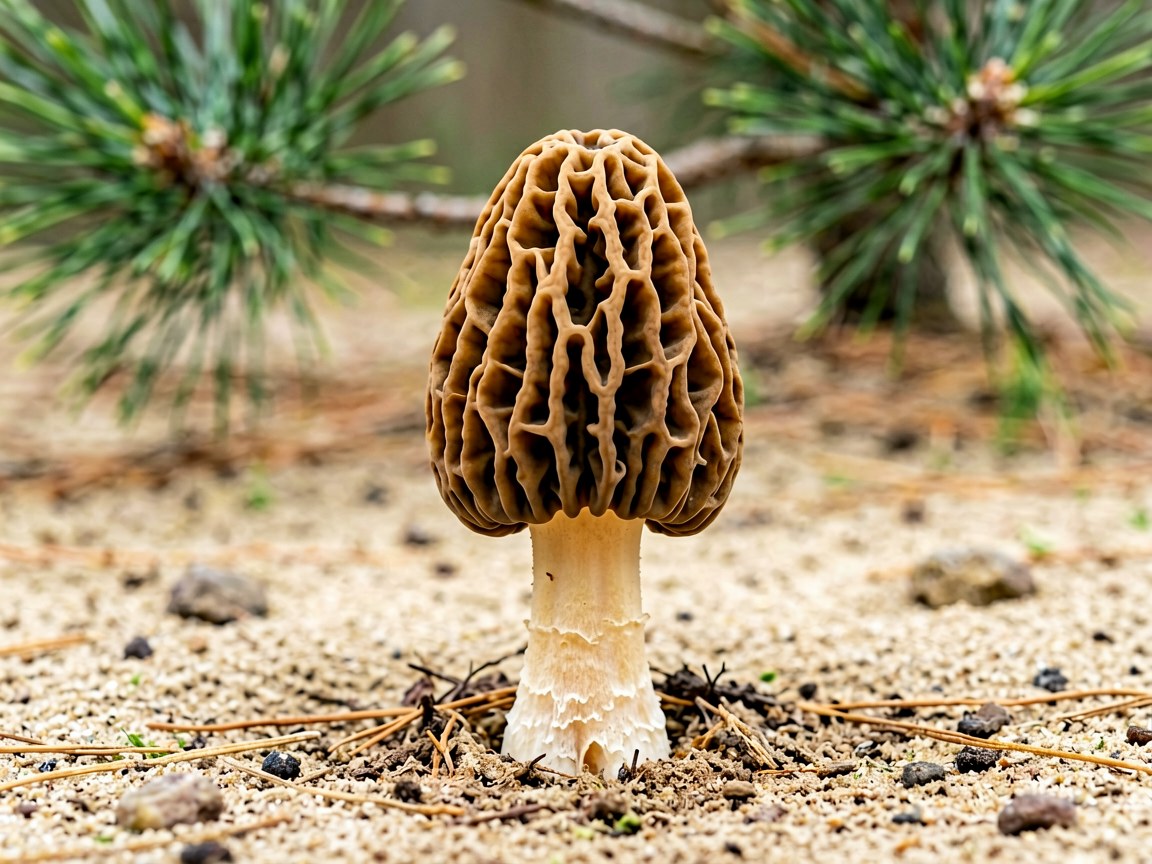
Gyromitra esculenta | False Morel
Introduction
Gyromitra esculenta, the false morel, is one of the most confusing and dangerous edible mushrooms of the northern woods, a brain-like, saddled or lobed brown fungus that appears in spring on sandy soil under conifers and in disturbed ground. It is sought by some as a delicacy, yet it contains a toxin that can be fatal if eaten without careful preparation, and it is easily mistaken for the true morels it superficially resembles. The cap is a rounded, irregular, deeply folded and wrinkled mass, chestnut to reddish-brown, sitting on a pale, fluted, often hollow stem, and it looks rather like a walnut or a brain that has been pressed into shape. It fruits early, often before the trees are fully in leaf, and it is a characteristic fungus of pine woods, plantations and burned or cleared ground across Europe, Asia and North America. Because it is both prized and poisonous, it demands respect and positive identification. It is a sac fungus, and like other larger fungi it lives by breaking down organic matter rather than by Amanita muscaria and the toadstools of the gilled families, occupying a different part of the fungal world.
Taxonomy
The false morel is a member of the Ascomycota, the sac fungi, and belongs to the genus Gyromitra in the family Gyromitraceae, a group of morel-like and saddle-shaped fungi quite separate from the true morels of the genus Morchella. The name Gyromitra means “twisted hat,” an allusion to the convoluted cap, and the specific epithet esculenta means “edible,” a name that reflects the tradition in some countries of eating the fungus after drying and thorough cooking, but which is now understood to be dangerous advice. The genus includes several spring species with lobed or saddle-shaped caps, some of them equally toxic; the most similar is Gyromitra gigas, the giant false morel, which is larger and paler. True morels of the genus Morchella are distinguished by their honeycomb of pits and ridges and by a cap that is attached to the stem only at the top, whereas the false morel’s cap is attached at several points and is merely wrinkled rather than pitted. The false morel’s placement among the ascomycetes means its spores are produced in microscopic sacs called asci, in contrast to the basidia of the gilled mushrooms, a technical difference that matters to the mycologist but not to the forager, who must rely on shape, season and habitat.
Physical Characteristics
The fruit body consists of a cap and a stem. The cap is irregularly rounded, lobed and deeply folded into a brain-like or saddle-like mass, three to ten centimetres across, coloured chestnut, reddish-brown or dark brown, with a smooth but wrinkled and convoluted surface and no true gills or pores underneath. The stem is pale, whitish to buff, three to eight centimetres tall and one to two centimetres thick, distinctly fluted, chambered and hollow, and often wider and more robust than that of a true morel. The flesh is brittle and waxy, and the whole fungus is lighter than it looks. The spores are produced in the asci that line the convoluted upper surface and are elliptical, smooth and pale, and the spore print is creamy white to yellowish. The colour, the hollow fluted stem and the brain-like cap are the key field marks, and the fact that the cap is attached to the stem over much of its lower surface, not just at the apex, is the single most useful feature separating it from the true morel. Size and colour vary with age and habitat, older specimens dulling to a darker brown.
Habitat
The false morel is a fungus of spring, fruiting from late winter into late spring, earlier than most other large mushrooms and often while the ground is still cool. It grows on the ground, favouring sandy and peaty soils, and it is especially associated with conifers, particularly pine, where it appears in woods, plantations and on heathland; it is also common on disturbed ground, in burns, on roadside verges and on sites that have been cleared or scorched, and it is sometimes abundant in the year or two after a fire. It ranges across temperate and boreal Europe, Asia and North America and is absent from the true tropics. In some regions it is a mushroom of mountains and northern forests, in others a lowland species of sandy heaths. It is often found in the same early-season window as the true morels, which is precisely why confusion between the two is so dangerous, and foragers who specialise in morels learn the habitat and timing as carefully as the shape. It is a saprotroph, drawing its food from dead organic matter in the soil and leaf litter rather than from living trees, with a clear preference for the needle beds and acid grounds of conifer country.
Diet
The false morel is a saprotrophic decomposer, feeding on dead plant material in the soil and breaking it down with enzymes, returning carbon and minerals to the woodland floor. It forms no close partnership with living trees and is not a parasite, though it is frequently found among conifers simply because the acid, sandy conditions under pines suit it. Its role in the ecosystem is that of a recycler of organic debris in spring soils. As food for animals, the false morel is not known to be eaten by mammals or insects in any quantity, and its toxicity presumably deters most would-be grazers; slugs and a few fungus-eating insects may nibble it, but it is largely left alone. For people the picture is more complicated: the fresh fungus contains gyromitrin, a compound that the body converts to the toxin monomethylhydrazine, the same family of chemical used in rocket fuel, and which can cause severe poisoning and death. In some culinary traditions the mushroom is dried and boiled with the water discarded, processes that drive off or remove much of the toxin, and it is then eaten as a delicacy, but the margin of safety is narrow and opinions among mycologists are firmly against eating it at all.
Reproduction
As an ascomycete, the false morel produces its spores in asci that line the convoluted upper surface of the cap. When mature, the spores are released and carried by the wind to the soil, where they germinate under suitable cool, moist spring conditions. Compatible mating types must meet for the fungus to fruit, and once a mycelium is established in the ground it can produce the distinctive caps year after year in the same locality, often in loosely scattered groups rather than in dense troops. Because it fruits in spring, its reproductive window is early and brief, and the caps shrivel and decay as the weather warms and dries. The mushroom’s fruiting is abundant and localised, appearing in numbers on a site cleared the previous year and thinly after. Spore dispersal is entirely by air, and its early appearance lets it complete its reproductive phase before the leaf canopy closes and the spring flush of competing fungi begins.
Conservation
The false morel is widespread and common across its northern range and is not considered threatened; in many places it is one of the more conspicuous fungi of early spring and a regular record in forays and surveys. Its populations are stable and, if anything, it benefits from disturbance such as clearing, burning and the creation of sandy, open ground, so it is resilient to the kinds of habitat change that would harm shadier, more specialised fungi. It is not legally protected anywhere, and there is no conservation concern attached to it; the only “management” issue is public safety, since its toxicity means it should be treated with caution wherever people gather wild mushrooms. It is a useful teaching fungus, illustrating both the ascomycete body plan and the practical dangers of relying on a superficial resemblance to an edible look-alike. For foragers, the safe rule is to leave it alone or, where local tradition allows its use, to follow the strict drying and cooking steps that reduce but do not remove its hazard.
Fun Facts
- It contains gyromitrin, which the body turns into monomethylhydrazine, a toxin related to rocket fuel.
- In some countries it is considered a delicacy after drying and repeated boiling, but many experts advise never eating it.
- It fruits in spring, often before the leaves appear, in the same window as the true morel it mimics.
- Its cap is merely wrinkled and brain-like, not pitted like a true morel, and it is attached to the stem at several points.
- The hollow, fluted stem and early spring season make it one of the easiest toxic fungi to recognise once you know what to look for.