 By st20113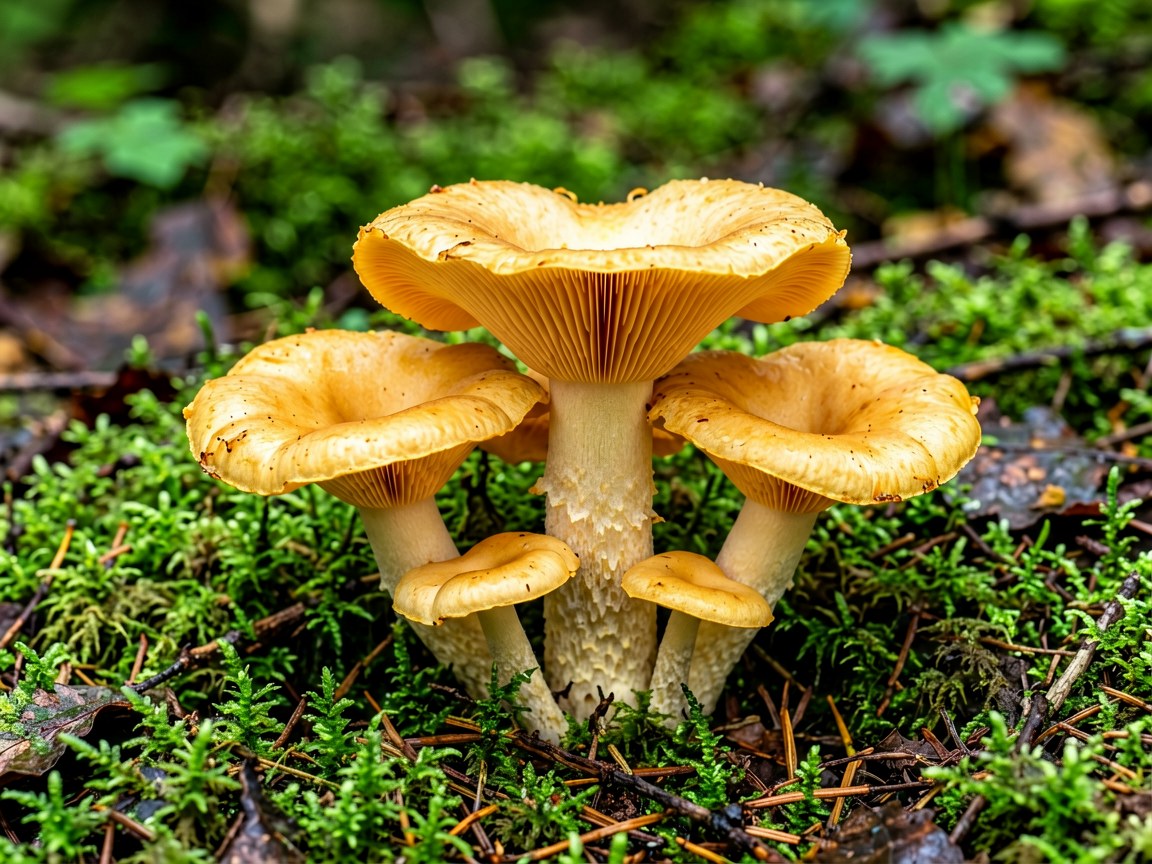
Cantharellus cibarius | Chanterelle
Introduction
The Chanterelle (Cantharellus cibarius) is one of the most prized and best-loved wild mushrooms of the northern forests—a golden, funnel-shaped fungus with a delicate apricot scent that has been gathered for the table since medieval times. Found in mossy glades from late summer into autumn, it is the reward of patient foraging and a centrepiece of European mushroom cuisine.
Unlike the showy bracket fungi or the familiar capped mushrooms, the chanterelle is subtle and elegant: egg-yellow from cap to stem, with blunt ridges in place of true gills. It is also a model of a mutually helpful relationship with trees, and a useful lesson in telling a safe, delicious wild fungus from its dangerous look-alikes.
Taxonomy
Cantharellus cibarius was named by the mycologist Elias Magnus Fries in 1821; the genus name Cantharellus is a little drinking-cup, and cibarius means “fit for food.” It belongs to the family Cantharellaceae, within the order Cantharales, a group of fungi quite separate from the true gilled mushrooms.
Unlike the poisonous fly agaric (Amanita muscaria), described in our article on Amanita muscaria (Fly Agaric), the chanterelle is a safe and sought-after wild mushroom; both are fungi, but where the fly agaric is a notorious toxin, the chanterelle is a culinary treasure. Within its group it is the type species that gives the whole genus its good name.
Physical Characteristics
The chanterelle’s cap is 3–10 cm across, convex at first and then funnel-shaped, in shades of egg-yellow to apricot, with a smooth, slightly velvety surface and an irregular, wavy edge. Instead of separate gills it bears blunt, forked ridges (false gills) that run down the stem, a key mark that separates it from many look-alikes.
The flesh is pale, firm, and faintly fragrant—often described as apricot or peach. The stem is the same yellow, smooth, and solid, and there is no ring or cup. Collected young, the caps are firm and hold their colour; older ones fade and the edges become ragged, but the yellow tones and blunt ridges remain diagnostic.
Habitat
The chanterelle is mycorrhizal, forming a partnership with the roots of trees—especially birch, beech, oak, and conifers—and favouring mossy, acidic, well-drained forest floors and heathland with light shade. It appears in summer and autumn across Europe, North America, and parts of Asia, often in the same spots year after year.
Because it depends on living trees, the chanterelle is a creature of healthy, mature woodland rather than of open fields or decaying wood. Its fruiting is weather-sensitive, peaking in warm, damp seasons after rain, and a good “chanterelle year” is a signal of favourable conditions in the forest.
Diet
The chanterelle is not a rotter of dead wood but a mycorrhizal partner: its underground threads (mycelium) weave around tree roots and exchange sugars the fungus receives from the tree for improved access to water and soil minerals. This makes it a connector rather than a decomposer, and explains why it only appears among living trees.
Above ground the fruiting body is short-lived, but the mycelium below may persist for years, fruiting whenever conditions allow. The fungus therefore lives mostly out of sight, and the golden mushroom we gather is merely its brief, reproductive emergence.
Reproduction
The chanterelle reproduces by spores, produced on its false gills and released to drift on the air. A single cap releases millions of spores, but successful establishment depends on meeting the right tree root to pair with—a chancy business that is why wild chanterelles cannot simply be “farmed” like the button mushroom.
Underground, the fungus spreads by extending its mycelium and by the spores that occasionally found new partnerships. Because the partnership with trees is essential, chanterelles are gathered from the wild rather than cultivated, and sustainable picking means taking caps but leaving the mycelium and enough for regrowth.
Conservation
The chanterelle is widespread and of least concern globally, but it is sensitive to the loss and fragmentation of the mature, mossy woodland it needs, and to the acidification and pollution of forest soils. In places it is protected, and over-collection by commercial foragers can deplete local populations.
Because it cannot be cultivated, the species depends entirely on healthy wild forest, so its conservation is really the conservation of mycorrhizal woodland. Sensible harvesting—cutting rather than uprooting, and leaving plenty behind—keeps both the fungus and its tree partners thriving, and many regions restrict commercial picking to protect the resource.
Fun Facts
- Its apricot-like scent is so distinctive that foragers use it, with the blunt ridges, as a primary identification cue.
- It forms a partnership with tree roots rather than rotting wood, which is why it can never be farmed like a supermarket mushroom.
- The chanterelle has been eaten in Europe for centuries and was a favourite of Renaissance and medieval cooks.
- Its yellow colour comes from natural carotenoid pigments, the same family as those in carrots.
- Several similar “chanterelle” species exist worldwide, and telling them from the poisonous false chanterelle is a classic foraging skill.
[…] The fruit bodies of the genus are all thin and hollow. Our species shares its family with the Chanterelle, the golden mushroom that is one of the best known edible fungi of Europe. The chanterelle has a […]