 By st20113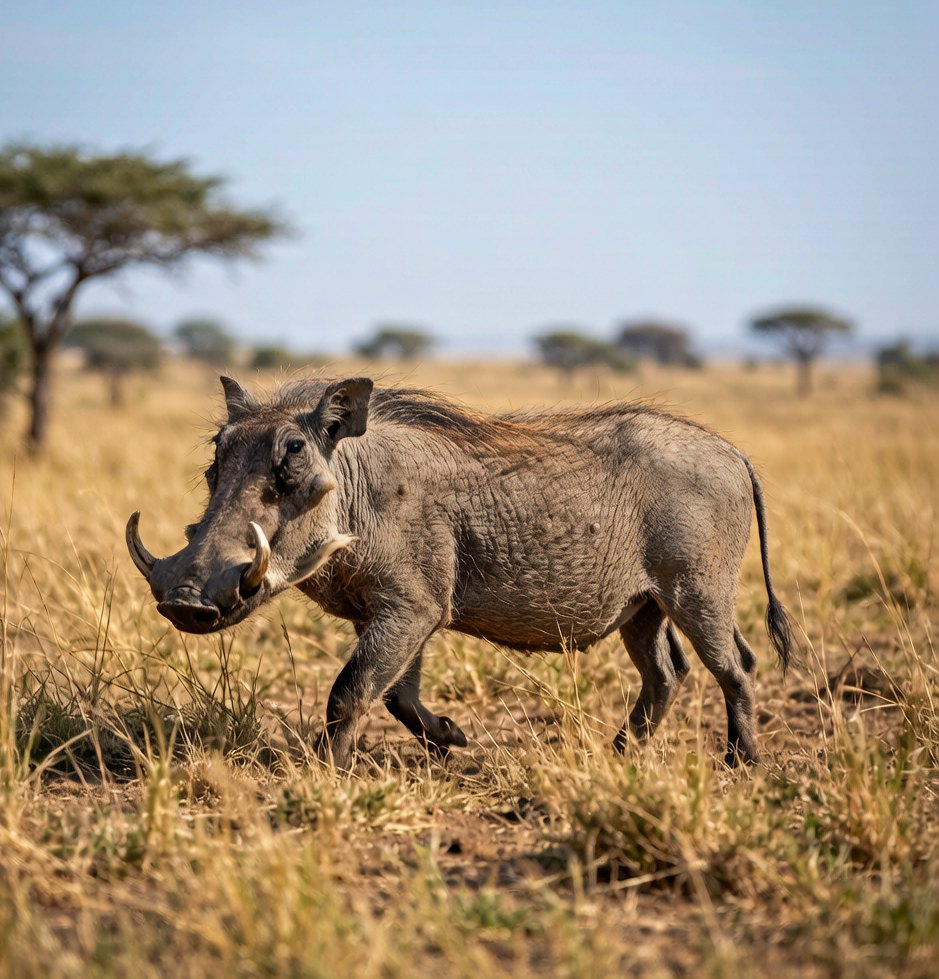
Introduction
The Common Warthog is a wild pig of the open grasslands and woodlands of sub-Saharan Africa, instantly recognizable by the two pairs of upward-curving tusks and the wart-like bumps on its face. Despite its fierce look, the warthog is a mostly peaceable grazer that flees danger at a trot, often with its tail held stiffly upright. Popularized by cartoons, the real animal is a tough, adaptable survivor of the African savanna, equally at home in heat, drought and the company of larger beasts.
Taxonomy
Phacochoerus africanus belongs to the family Suidae, the pigs, the same broad group that includes domestic swine and the African elephant (which is not a pig but a fellow African mammal of the open plains). The genus Phacochoerus contains the common warthog and the desert warthog of the Horn of Africa. Closely related to bushpigs and forest hogs, warthogs are among the most specialized of the pigs, built for a life of grazing rather than rooting in dense forest.
Physical Characteristics
Warthogs are bulky animals standing about 65 to 85 centimetres at the shoulder and weighing 50 to 150 kilograms. The coat is sparse and bristly, usually grey or brown, with a mane of longer hair along the back and tufts at the ends of the ears and tail. The head is large, with two pairs of tusks—the upper ones curving upward and the lower ones sharper—used in fights and defence. The facial “warts” are actually thickened pads of skin that protect the face during clashes between males. Their slender legs and padded knees let them kneel to graze close to the ground.
Habitat
Warthogs inhabit savanna, grassland, open woodland and semi-desert across sub-Saharan Africa, avoiding dense rainforest and true desert. They are closely tied to the availability of water and short grasses, and they shelter from heat and predators in burrows, often taking over the abandoned diggings of aardvarks. During the hottest part of the day they rest in shade or in these cool underground refuges, emerging to feed in the cooler mornings and late afternoons across the open plains.
Diet
Warthogs are primarily grazers, using their broad, disk-like snouts to crop grasses close to the ground, and they often kneel on their front legs to reach short shoots. In the dry season they switch to roots, bulbs, fruits, berries and bark, and they will dig for rhizomes with their snouts and tusks. They are opportunistic and will occasionally eat carrion or invertebrates. By grazing short grass they help maintain the open habitats favored by many other savanna animals, linking them into the wider food web of the plains.
Reproduction
After a gestation of about five to six months, the female gives birth to a litter of two to four piglets in a secure burrow. The young are born with soft, reddish coats and remain in the den for several weeks before following the sounder, a group of related females and offspring, out to feed. Males are mostly solitary, joining groups only to mate. The family group stays close, and the piglets learn to run with their tails erect, a signal that helps the group keep together when alarmed and dashing for cover.
Conservation
The Common Warthog is listed as Least Concern and remains widespread and common across its range, though local numbers fall where hunting is heavy or habitat is converted to agriculture. It tolerates human-altered landscapes better than many large mammals and often persists on ranches and reserves alike. Continued abundance depends on retaining open grassland and limited persecution, ensuring that these charismatic pigs continue to roam the African savanna in healthy numbers.
Fun Facts
Warthogs often back into a burrow to sleep, facing outward so they can dash out if threatened. They kneel on their front legs to graze short grass. Their tusks are actually elongated teeth, the upper pair curving up past the snout. When running, a warthog holds its tail straight up like an antenna. Despite the fierce look, adults usually flee rather than fight, relying on speed and wariness to survive.