 By Iris
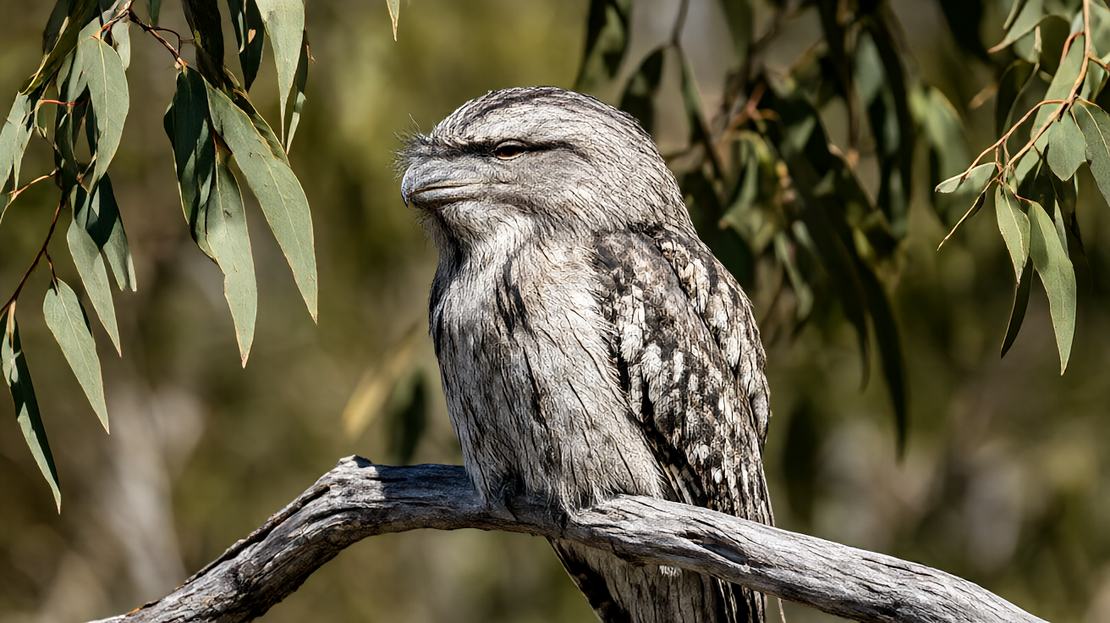
Podargus strigoides | Tawny Frogmouth
Species Profile · Podargidae
Tawny Frogmouth
A bird freezes on a dead branch and lets its outline disappear into the bark.
Least Concern
Length
Weight
Clutch
Incubation
Fledge
Rating
The Tawny Frogmouth
A bird that pretends to be a branch
A bird sits on a dead branch with its bill pointed at the sky. Grey feathers match the bark, and nothing moves. People walk under the tree and never look up twice.
That stillness is the whole defence. A frogmouth is not an owl, although the yellow eyes suggest one. Owls hunt with talons, while this bird catches prey in a wide soft bill.
Most of its hunting happens on the ground, well after dark. Because the disguise works so well, gardeners often find one only after a branch falls.
Family tree
Podargidae, the frogmouths
Its proper name is Podargus strigoides, one of three frogmouths in Australia. The family also holds the potoos of the New World tropics, and older books grouped frogmouths with owls for decades. Feather structure and foot anatomy place them elsewhere, closer to nightjars and swifts.
Three subspecies are accepted, and they differ mainly in size and shade. Birds of the dry interior run paler, while coastal birds look darker overall. Because the birds sit still, differences between the races are hard to see in the field.
Bill and bristles
How to tell one
Adults measure 34 to 53 cm from bill to tail. Weight falls between 200 and 600 g, with males often the heavier sex. The bill is broad and flat, and bristles stand around its base. A wide gape lets the bird take large prey in one movement.
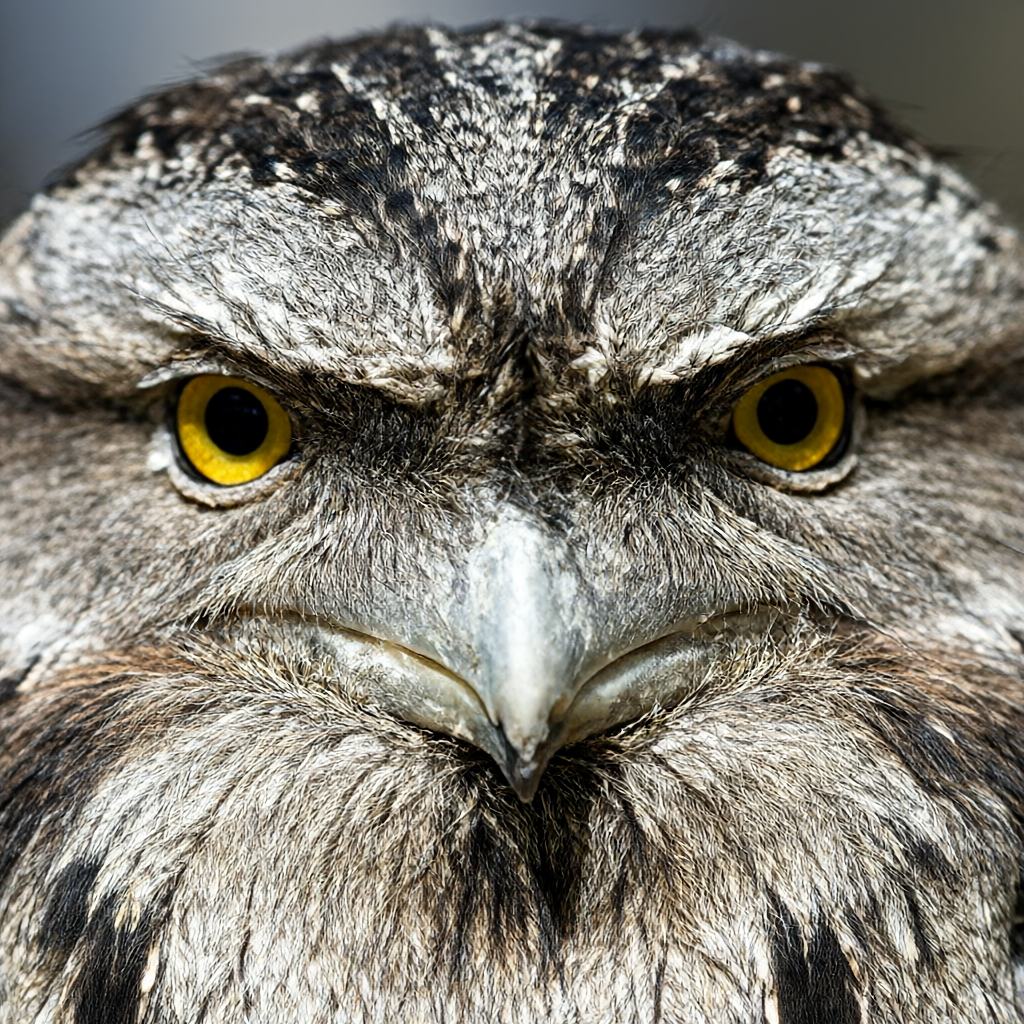
Eyes run big and yellow, and they face forward. Soft grey plumage carries fine black streaks and pale silver patches. That pattern copies the bark of a eucalypt almost exactly. Short legs carry strong feet, though the claws are weak compared with an owl’s, and the bird cannot grip hard.
A long tail helps the bird balance on a thin perch. Feathers stay loose and soft, so a bird can sit for hours without a sound. Because the mouth looks like a frog’s, the common name explains itself.
1
2
3
Open woodland
Where it lives
Eucalypt woodland suits it best, and so does open forest. Parks, farms and gardens hold birds wherever old trees survive. Daytime cover matters more than food supply, since the bird needs a good perch. Because a dead branch is easy to find, towns often support pairs.
Dense rainforest holds few birds, since the canopy blocks out the light. In the north of the continent the range stops short of the wet tropics. A chameleon uses the same trick in a warmer forest, sitting still until the eye gives up.
Beetles and mice
What it eats
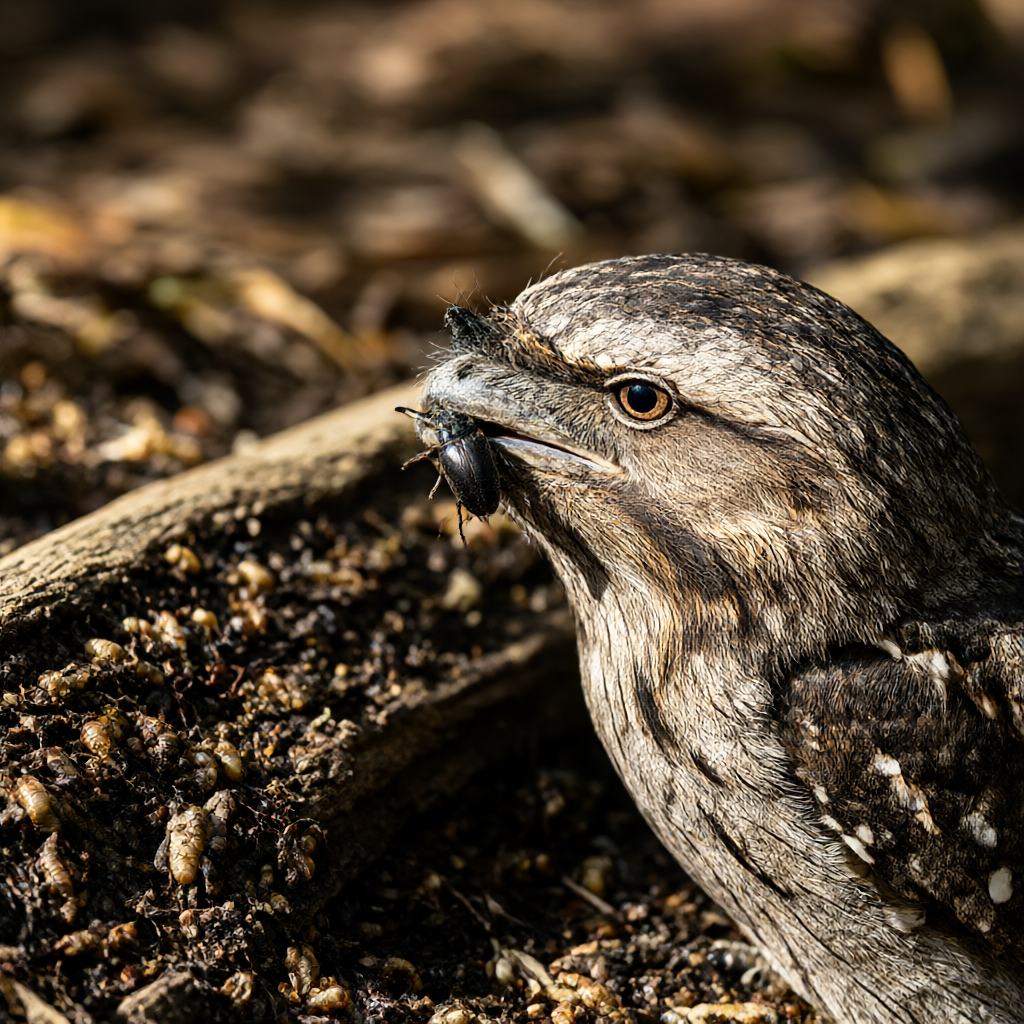
Insects make up most of the diet. Beetles, moths, grasshoppers and cockroaches all get eaten, and so do worms and slugs. The bird drops from a low perch and takes prey from the ground.
Prey is swallowed whole, and the bill holds it easily. Small mammals and frogs get taken when the chance comes. Bones and hard wing cases are coughed up later as pellets.
Because the bird hunts in the dark, hearing does most of the work, and hard wing cases get coughed up later as pellets. A crocodile takes larger prey from the same waterholes, though it hunts by ambush rather than by ear.
A platform of sticks
The breeding cycle
A pair holds one territory for years. The nest is a rough platform of sticks that looks ready to fall apart, and two or three white eggs are laid in the fork. Both birds incubate for about 30 days. Chicks hatch with white down, and they stay in the nest for a month.
Young birds then drop to the ground before they can fly properly. Parents feed them for several weeks afterwards. Because the pair stays together, the same site gets used again next spring.
Cars, cats and windows
Conservation
The Red List calls the species Least Concern. Numbers look stable across most of Australia. Cars kill many birds, since a frozen frogmouth ignores a headlight, and cats take young birds that land on the ground.
Because the bird relies on old trees, clearing removes nest sites. Pesticides cut the insect supply in farmland. Nothing suggests a rapid decline yet, and the species remains common in towns.
Side by side
How It Compares
| Trait | Tawny Frogmouth | Chameleon |
|---|---|---|
| Family | Podargidae | Chamaeleonidae |
| Length | 34-53 cm | 17-35 cm |
| Prey | beetles, mice and frogs | insects taken by tongue |
| Disguise | freezes with the bill raised | changes colour and body shape |
| Nest | rough platform of sticks | buried in warm soil |
| Rating | Least Concern | Least Concern |
Common misreadings
What People Get Wrong
- Not an owl. The big yellow eyes belong to a separate family entirely. Its feet cannot grip prey the way an owl’s do, so the bird takes what it can swallow in one movement.
- No chosen pose. The bird freezes wherever it happens to be sitting. Plumage does the rest, and a bird on a eucalypt branch shows no outline that a predator can pick out at dusk.
- Barely a nest. Two or three eggs sit in a rough fork of sticks. Nothing gets added after laying, and the platform often looks ready to collapse under the weight of the sitting bird.
Going further
Sources and Further Reading
Quick hits
Five things to remember
- It is not an owl at all.
- It sits with its bill pointed upward.
- It coughs up pellets of bone and shell.
- Pairs keep the same tree for years.
- Chicks leave the nest before they can fly.