 By st20113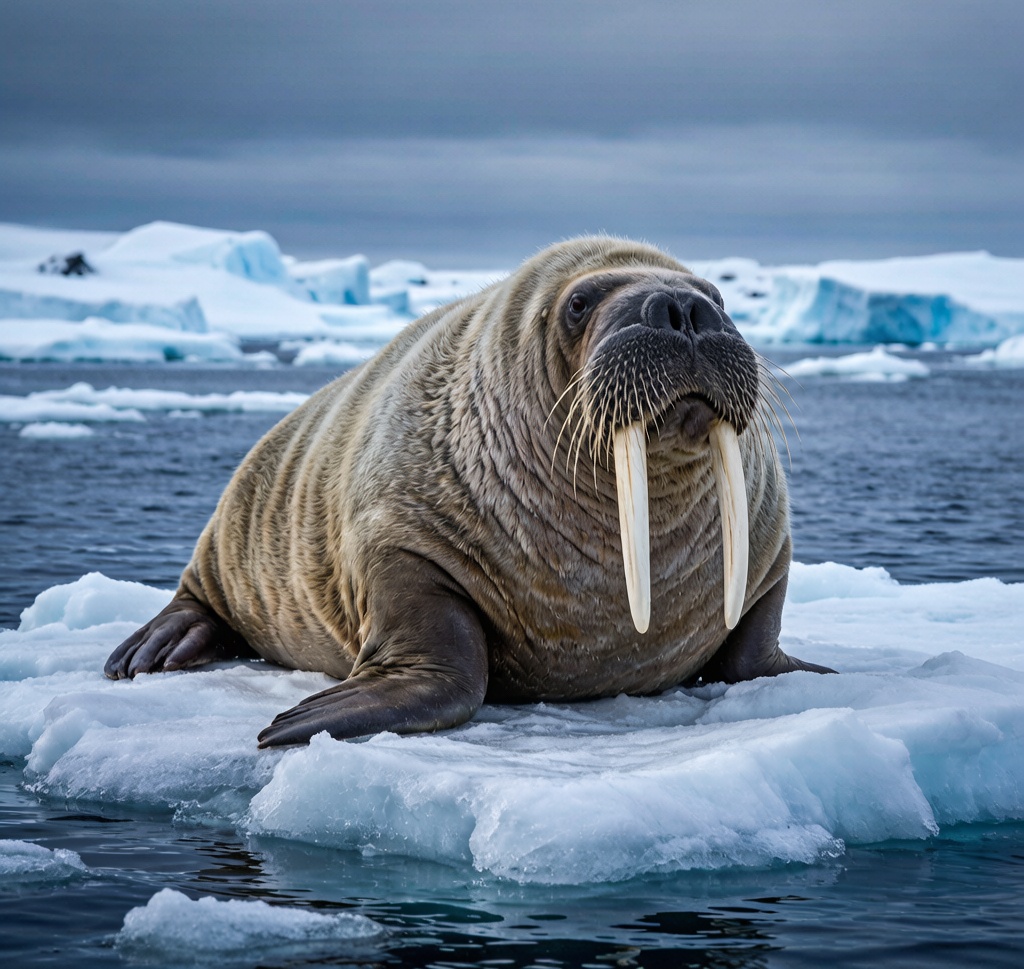
The walrus (Odobenus rosmarus) is one of the largest pinnipeds — fin-footed marine mammals — inhabiting the Arctic and sub-Arctic waters of the Northern Hemisphere. Recognized instantly by its enormous size, blubbery body, and the magnificent long ivory tusks that distinguish it from all other seal relatives, the walrus is a keystone species of the cold northern seas. There are two recognized subspecies: the Atlantic walrus (Odobenus rosmarus rosmarus) found in the Arctic Atlantic, and the Pacific walrus (Odobenus rosmarus divergens) found in the Bering, Chukchi, and Beaufort seas. Walruses are highly social animals, forming massive haul-outs on ice floes and beaches that can number in the thousands of individuals.
## Physical Characteristics
The walrus is immediately identifiable by its massive bulk — adult males can weigh over 1,700 kilograms and measure more than 3.5 meters in length. Its skin is thick and leathery, ranging from pale brown to reddish-brown, covered with a sparse layer of short, coarse hair that becomes sparser with age. The walrus’s most famous feature is its long, continuously growing ivory tusks — actually elongated canine teeth — which can reach lengths of one meter in males and females alike. These tusks serve multiple functions: maintaining footing on ice, breaking breathing holes through ice from below, and establishing social hierarchies through ritualized combat. Beneath the skin lies a thick layer of blubber, sometimes exceeding 15 centimeters deep, providing insulation against the frigid Arctic waters and serving as an energy reserve.
## Habitat and Distribution
Walruses are circumpolar in distribution, found throughout the Arctic Ocean and adjacent seas. Pacific walruses undertake vast seasonal migrations, summering in the Chukchi Sea and wintering in the Bering Sea. They prefer ice-covered waters for resting and pupping, hauling out onto stable sea ice or ice floes. When sea ice is absent, they gather on rocky coastlines and sandy beaches, sometimes in enormous colonies. The Atlantic walrus occupies the Canadian Arctic, Greenland, Svalbard, and the western Russian Arctic.
## Behavior and Diet
Walruses are benthic feeders, diving to the ocean floor to search for prey. Their diet consists primarily of bivalve mollusks such as clams, which they locate using their sensitive whiskers — stiff vibrissae — and extract from shells using powerful suction. They also consume various invertebrates including worms, shrimp, crabs, and sea cucumbers, and occasionally hunt fish and even seals when prey is scarce. A single walrus may consume thousands of clams per day. The distinctive tracks left by walrus foraging in seafloor sediments are an important ecological disturbance, influencing benthic community structure in Arctic marine ecosystems.
## Reproduction and Lifespan
Mating occurs in the water during winter. After a prolonged gestation of 15 to 16 months — including delayed implantation — females give birth to a single calf on sea ice in spring. Newborns weigh approximately 45 to 75 kilograms and are capable of swimming within hours. Mothers nurse their calves for over two years, and young walruses remain dependent on their mothers for several years. Sexual maturity is reached at around seven to ten years, but dominant males do not successfully breed until they are much older. Wild walruses can live for over 40 years.
## Conservation
Walruses face significant threats from climate change, particularly the loss of sea ice habitat. They are also affected by hunting, shipping traffic, and oil spills. The Pacific walrus was listed as a candidate for Endangered Species Act protection in 2011 due to population concerns linked to diminishing sea ice.