 By st20113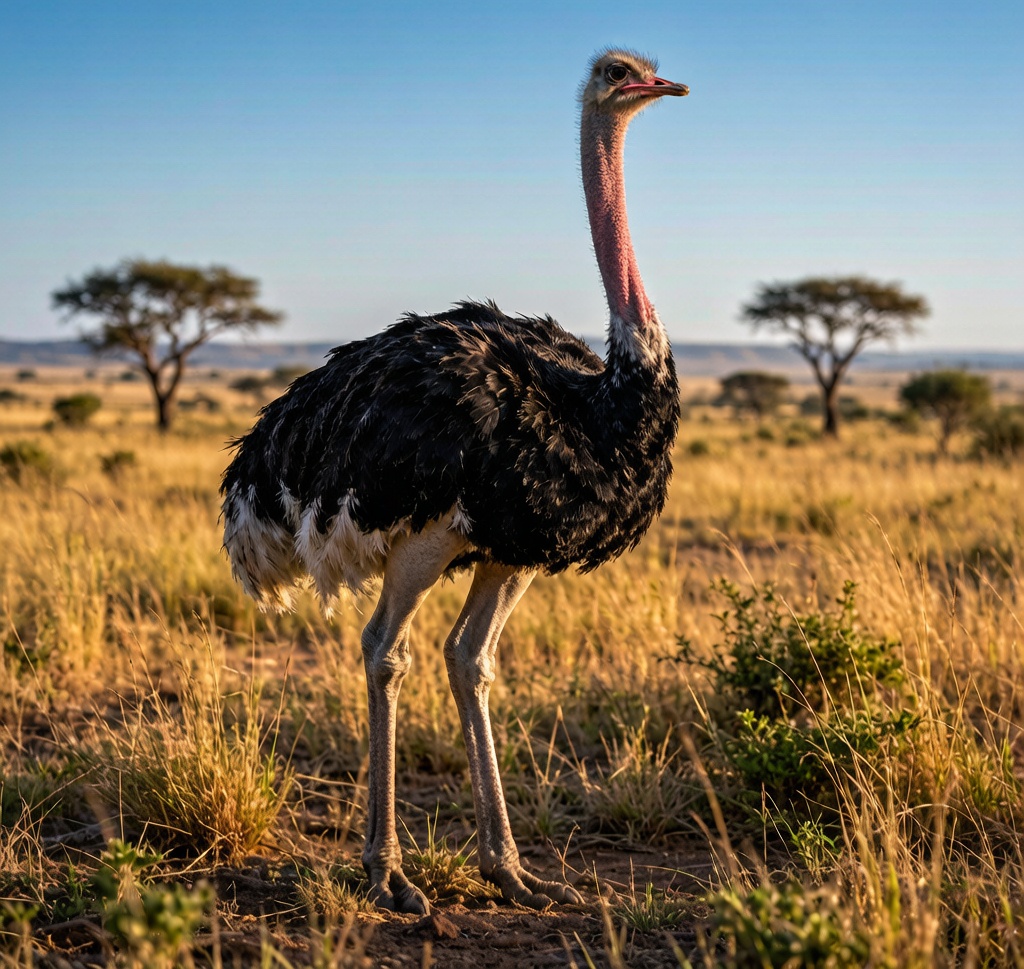
The common ostrich (Struthio camelus) is the world’s largest living bird and the fastest land bird on Earth. Standing up to 2.8 meters tall and weighing as much as 156 kilograms, this remarkable flightless bird is native to the open savannas and semi-arid plains of sub-Saharan Africa. Despite its inability to fly, the ostrich has evolved into a supremely adapted running animal, capable of sustained speeds exceeding 60 kilometers per hour and sprinting at over 70 kilometers per hour. Its enormous eyes — the largest of any land vertebrate — provide exceptional vision across the open landscape, compensating for its flightless nature.
## Physical Characteristics
The ostrich exhibits striking sexual dimorphism. Males develop striking black-and-white plumage: their body is covered in soft, shaggy black feathers, while their wings and tail display prominent white plumes. The neck and upper thighs are bare, revealing pinkish-red to grey skin that becomes more vivid during the breeding season. Females and juveniles display a duller greyish-brown plumage with whitish markings. The ostrich’s long, powerful legs are among the strongest of any bird, ending in feet equipped with only two toes — a unique trait among birds — each bearing a large, sharp claw. The large eye measures approximately 50 millimeters in diameter, protected by a long black eyelash-like fringe of feathers.
## Habitat and Distribution
The common ostrich inhabits Africa’s savanna biome, ranging from Senegal in the west across to Ethiopia in the east, and southward to Tanzania and northern South Africa. It prefers open, flat grasslands with scattered acacia trees and thorny scrub, typically avoiding dense vegetation, deserts, and humid forests. Ostriches are nomadic, moving seasonally in response to rainfall patterns and food availability, and they can survive in areas where water is scarce by obtaining moisture from the plants they eat.
## Behavior and Diet
Ostriches are primarily herbivorous, consuming seeds, grasses, shrubs, and occasionally flowers and fruits. They also opportunistically eat insects such as locusts and small vertebrates when available. Feeding occurs during the cooler parts of the day, with flocks of five to 50 birds often associating with grazing mammals such as zebras and antelopes, benefiting from the flushing of insects. The ostrich’s digestive system is highly efficient, capable of extracting maximum nutrients from fibrous plant material. It swallows small stones and pebbles — known as gastroliths — which accumulate in a muscular gizzard to grind food mechanically.
## Social Structure and Reproduction
Ostriches live in loose social groups. During the breeding season, dominant males establish territories and mate with a primary female, the “major” hen, while other females may also lay eggs in the same nest. The nest is a simple scrape in the ground, scratched out by the male and shared by several females. The dominant pair incubate the eggs — each egg weighs approximately 1.4 kilograms and is the largest egg of any living bird. Both parents share incubation duties, with males typically incubating at night due to their darker, less conspicuous plumage. Chicks are precocial, able to run within hours of hatching, and are guarded by both parents for several months. Ostriches can live for over 40 years in the wild.
## Conservation
The common ostrich is listed as Vulnerable, with population declines driven primarily by habitat loss, hunting for meat and feathers, and collection of eggs. However, the species has been successfully farmed in many countries, reducing pressure on wild populations. Conservation efforts in Africa focus on protected area management and community-based conservation programs.
[…] Australia, and C. c. johnsonii in northern New Guinea. Its closest relatives include the ostrich and the emu, with which it shares the ratite group — birds that lack a keel on their breastbone, […]
and the family Dromaiidae, making it a close relative of the southern cassowary and the ostrich. Genetic evidence has revealed that the extinct Tasmanian emu and King Island emu were genetically
[…] eagle captures mammals and birds with spectacular stoops from great height. Unlike the flightless ostrich of the African savanna, which relies on running to escape danger, the eagle commands the skies as […]
[…] horned owl occupies deserts, swamps, grasslands, and city parks alike. Unlike the ground-dwelling ostrich of Africa, this owl rules the night sky as a silent, lethal […]
[…] to 1.9 metres tall and weighing as much as 60 kilograms, it is the second-heaviest bird after the ostrich. Native to the tropical forests of northeastern Australia, New Guinea, and surrounding islands, […]