 By st20113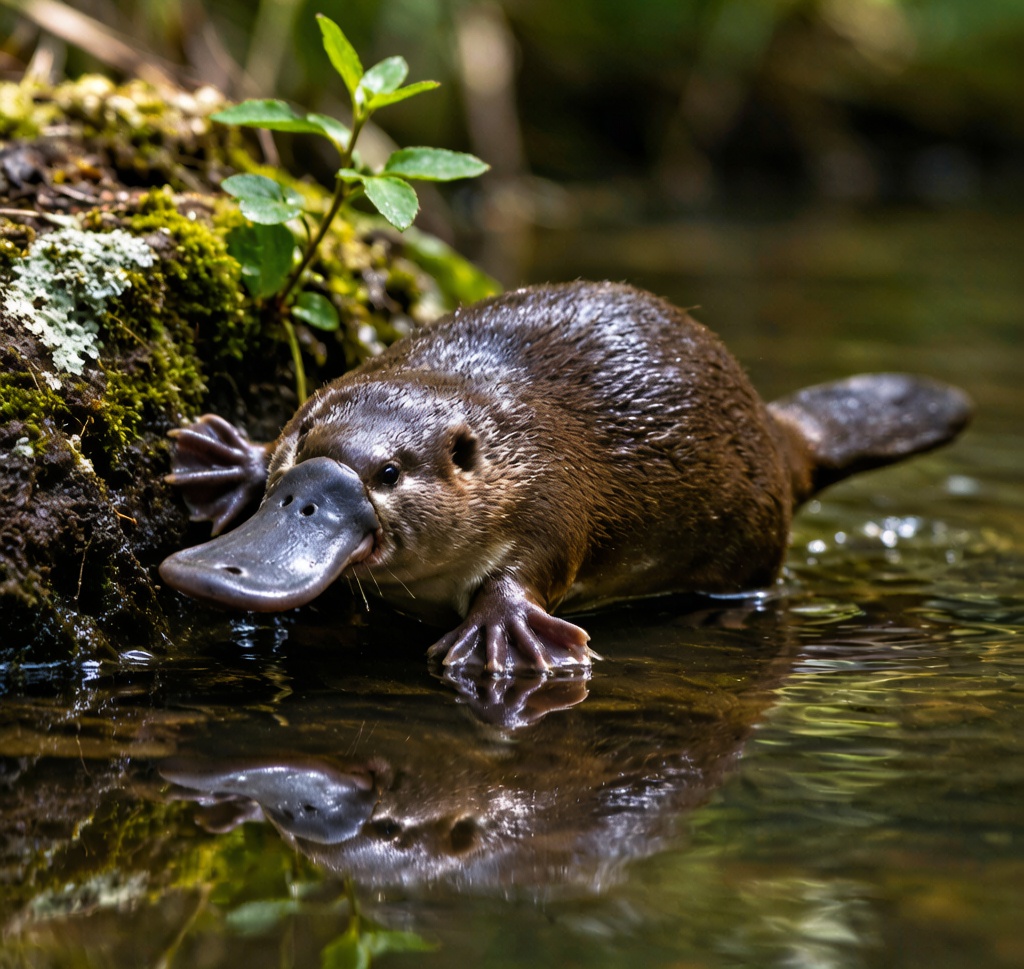
The duck-billed platypus (Ornithorhynchus anatinus) is one of the most remarkable creatures in the animal kingdom. As one of only five surviving species of monotremes — mammals that lay eggs instead of giving birth to live young — the platypus represents an extraordinary evolutionary blend of mammalian and reptilian characteristics. Native to the freshwater streams and rivers of eastern Australia, this semi-aquatic mammal has fascinated scientists and naturalists since European naturalists first encountered it in the late 18th century.
## Physical Characteristics
The platypus possesses one of the most unusual anatomies in the natural world. Its most distinctive feature is its duck-like bill — a soft, rubbery, electro-receptive organ used to detect prey underwater. The bill is covered in thousands of sensory receptors that can detect the weak electric fields generated by the muscle movements of invertebrates and small vertebrates. The platypus has a streamlined body covered in dense, waterproof fur that is dark brown on the dorsal surface and lighter greyish-brown on the underside, providing excellent insulation in cold river water. Its tail is broad, flat, and paddle-shaped, resembling that of a beaver, and serves as a fat storage organ. Males are equipped with a venomous spur on each hind leg, capable of delivering a painful toxin that is primarily used during territorial disputes.
## Habitat and Distribution
The platypus inhabits permanent freshwater systems, including rivers, streams, and artificial ponds across its range. It requires clear, slow-moving water with suitable burrowing sites in the banks. The species is endemic to Australia, found along the east coast from Queensland to Tasmania, and into South Australia. Individuals establish home ranges along several hundred meters of waterway, with males typically occupying larger territories than females.
## Behavior and Diet
The platypus is a carnivorous ambush predator, feeding primarily on aquatic invertebrates such as insect larvae, freshwater shrimps, crayfish, and worms. It hunts entirely underwater, closing its eyes, ears, and nose while using its electro-receptive bill to locate prey. Prey is captured by scooping it up from the riverbed or by surface feeding. After feeding, the platypus retreats to its burrow, which is typically dug into the riverbank above the waterline. Despite being a proficient swimmer, the platypus does not spend extended periods submerged, surfacing every two to five minutes to breathe.
## Reproduction
As a monotreme, the platypus reproduces by laying eggs. Females lay one to three leathery eggs after a gestation period of about 21 days, incubating them against their body and tail for approximately ten days. The young hatch in an undeveloped state and are nursed by the mother, who produces milk through mammary glands without nipples — the milk simply oozes from the skin into the nursing groove. Juveniles remain in the burrow for several months before emerging to feed independently. Sexual maturity is reached at around two years of age.
## Conservation Status
The platypus is currently classified as Near Threatened on the IUCN Red List. Major threats include habitat destruction, water pollution, entanglement in fishing gear, predation by introduced species such as foxes and dogs, and prolonged drought linked to climate change. Conservation efforts focus on habitat protection, river restoration, and the establishment of protected areas throughout its range.