 By st20113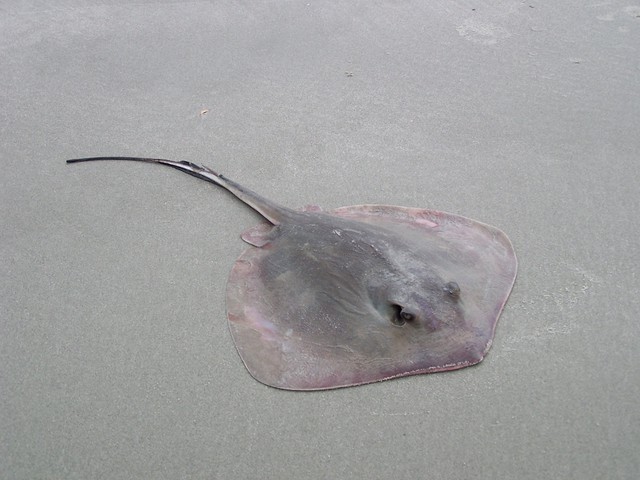
Introduction
The Common Stingray (Dasyatis pastinaca) is one of the most widely recognised rays in European waters. Found across the Eastern Atlantic from the British Isles to West Africa, including the Mediterranean and Black Sea, this bottom-dwelling elasmobranch inhabits coastal seas where it rests on sandy and muddy substrates. It is characterised by a flattened kite-shaped disc and a long whip-like tail armed with a serrated venomous spine used for defence. Though often overshadowed by larger shark species, the Common Stingray plays an important ecological role as a mesopredator in shallow marine food webs, and its presence serves as an indicator of coastal ecosystem health.
Taxonomy
Dasyatis pastinaca belongs to the order Myliobatiformes, within the family Dasyatidae, characterised by round to diamond-shaped discs and venomous tail spines. The full taxonomic hierarchy places the species within the class Chondrichthyes, encompassing all cartilaginous fish. The genus Dasyatis historically contained dozens of species worldwide, though ongoing systematic revisions have reorganised many into separate genera. The species epithet “pastinaca” derives from the Latin word for parsnip, likely referencing the root-like shape of the tail spine. No recognised subspecies exist, though regional populations show variation in body size and reproductive timing.
Physical Characteristics
The Common Stingray possesses a broad diamond-shaped disc reaching up to 140 centimetres in width, with females generally growing larger than males. The body is heavily cartilaginous and covered in placoid scales giving the skin a rough texture. Dorsal coloration is typically olive-grey to brownish-red, transitioning to pale white on the underside. The tail is distinctly longer than the disc and bears one or two serrated venomous spines positioned roughly one-third from the base. The jaws, on the ventral surface, contain flattened teeth for crushing benthic invertebrate shells.
Habitat
This species inhabits temperate and subtropical marine waters across the Eastern Atlantic, ranging from the British Isles southward to the Canary Islands and Cape Verde. It is common throughout the Mediterranean and Black Sea, thriving in shallow coastal zones with sandy, muddy, or gravel substrates at depths typically from the intertidal zone down to fifty metres. Seasonal movements are observed, with individuals moving into deeper waters during winter and returning to shallower zones in spring and summer.
Diet
The diet consists primarily of benthic invertebrates and small demersal fish. Crabs, shrimps, and amphipods form the staple in most locations, while small fish including gobies and flatfish are consumed opportunistically. Molluscs with thin shells are crushed with the powerful jaws. Prey is located using electroreception through the ampullae of Lorenzini, chemosensory cues, and visual detection. The stingray is primarily nocturnal, foraging across the seafloor while remaining partially buried in sand or mud during the day to avoid predators including the great white shark.
Reproduction
The Common Stingray is ovoviviparous, with embryos developing inside the mother’s uterus without a placental connection. Gestation lasts approximately four to nine months, varying by region. Litter sizes range from four to ten live pups, each born fully formed and capable of immediate independent survival. The tail spine is soft at birth but hardens within days. Females give birth in shallow protected nursery areas. Sexual maturity is reached at approximately four to six years of age, with longevity estimated at fifteen to twenty years in the wild.
Conservation
The Common Stingray is classified as Vulnerable by the IUCN, with populations declining due to bycatch mortality in demersal fisheries, coastal development, and habitat degradation. Trawling and seine net fisheries capture significant numbers as non-target catch. The species is slow to mature and produces relatively small litters, making it particularly susceptible to overexploitation. Some range states have implemented minimum landing size regulations and seasonal closures in nursery areas. Conservation efforts focus on improving fishing gear selectivity and establishing marine protected areas.
Fun Facts
Despite their fearsome reputation, Common Stingrays are considered docile and only use their tail spine defensively when stepped on or handled. Their electroreceptive ampullae of Lorenzini are so sensitive they can detect the tiny electrical fields produced by the heartbeats of buried prey beneath sand. Some populations rest in stacked arrangements, with multiple individuals lying atop one another on the seafloor.
[…] fish shares the family with the Common Stingray. That family holds about 90 species. All of them have a whip like […]