 By st20113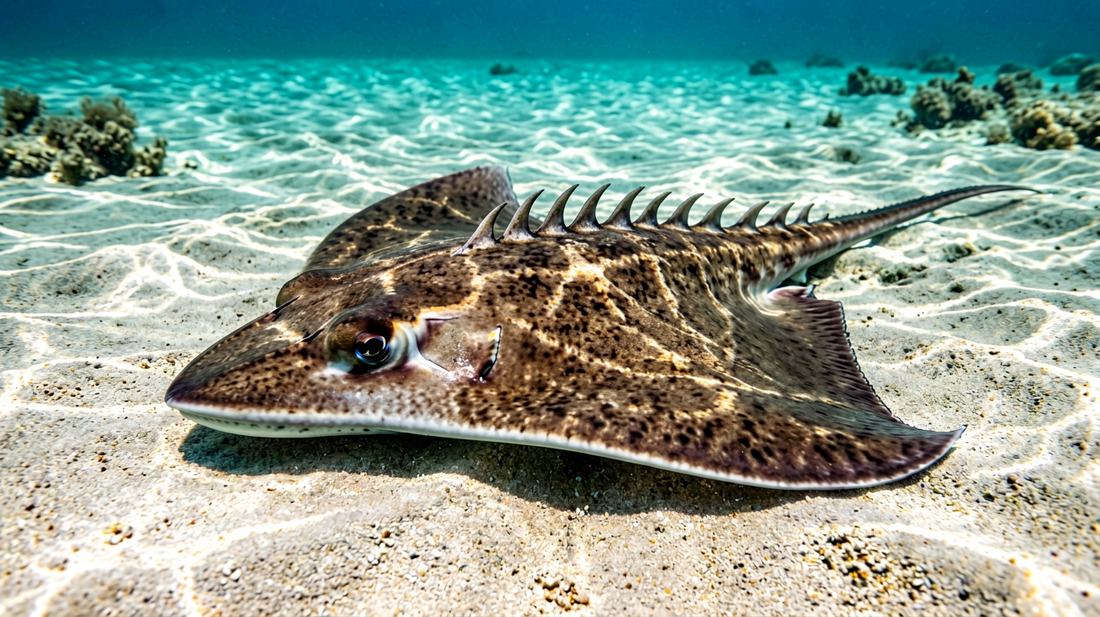
Raja clavata | Thornback Ray
Species Profile · Rajidae
Thornback Ray
The commonest skate of the north-east Atlantic, now Near Threatened after a fall of more than 90 per cent on some grounds.
IUCN: Near Threatened
Range
Disc width
Weight
Capsules
Maturity
Mermaid’s purses on the beach
The thornback ray
The thornback ray is the commonest skate of the north-east Atlantic and the Mediterranean. It is also the most widespread. It is one of the few gristle-fish still many enough to be met often. Anglers, divers and inshore trawler crews all meet it on the sandy grounds of the shelf. It is a medium-sized skate. Its disc is broad and diamond-shaped. The top side carries a grim array of curved spines.
A row of them runs along the midline of the back and the tail. More are scattered over the shoulders, the wing-like side fins and the skin around the eyes. This armour gives the fish its common name. Its skin is also mottled brown and buff. Many rays carry bold dark blotches on the disc. The species lays eggs, like all skates. The eggs sit in hard, box-like cases with stiff horns at the corners.
These are among the best known objects washed up on European beaches. Most people call them mermaid’s purses. The ray matures late and its eggs take months to hatch. It rears few young in a lifetime. That makes it very open to harm from fishing. It has fallen badly across much of its range.
Family tree
Raja, the type species
The thornback ray is in the family Rajidae, the skates. With about 160 species this is the largest family of rays. It is also the largest family of gristle-fish apart from the catsharks. Skates live the world over, from the Arctic to the Antarctic. They differ from the stingrays, among which the common stingray is the best known in Europe. Stingrays have a saw-toothed spine on the tail. Skates do not. Skates also keep the habit of laying eggs. Stingrays do not. Within the family the species sits in the genus Raja.
That genus holds about 30 species of the north-east Atlantic and the Mediterranean. The thornback ray is its type species. That means the name Raja is always tied to it by the rules of naming. The name Raja is the Latin word for a skate or ray. It comes at first from the Greek. The species name clavata is the Latin word for fitted with clubs or nails. It points clearly to the big curved thorns on the back. The naming of the genus has been much changed on gene evidence over 20 years. The genus Raja is now cut to about 25 to 30 species of the north-east Atlantic and the Mediterranean. The rest have been moved to genera such as Dipturus, Leucoraja, Rostroraja and Amblyraja.
The thornback ray stays in Raja in the narrow sense. That fits both its shape and its range. Some local variation has been named. It shows in the number of thorns on the midline, in the size reached and in the dark blotches. The change is smooth rather than sharp. No subspecies are usually named. The fossil record of the genus goes back at least to the Palaeocene. Most fossil species are known only from skin prickles and stray teeth. The thornback ray turns up in Pleistocene and postglacial beds of the North Sea and the British Isles. Those old remains cannot be told from the modern ray.
Thorns and a diamond disc
How to identify one
The thornback ray has a broad, diamond-shaped disc. The disc is a little wider than it is long. The front edges are nearly straight or very slightly bowed. The side fins form the corners of the diamond. The outer angles are broadly rounded. The snout is fairly long and rather sharply pointed. Its tip juts clearly past the front edges. The tail is stout and much shorter than the disc. It is about half the disc width. It ends in a pair of small back fins set close together near the tip. The tail fin is cut down and of little use. In smaller rays it is barely a fold. In the largest it is gone. The top disc width on record is about 105 cm.
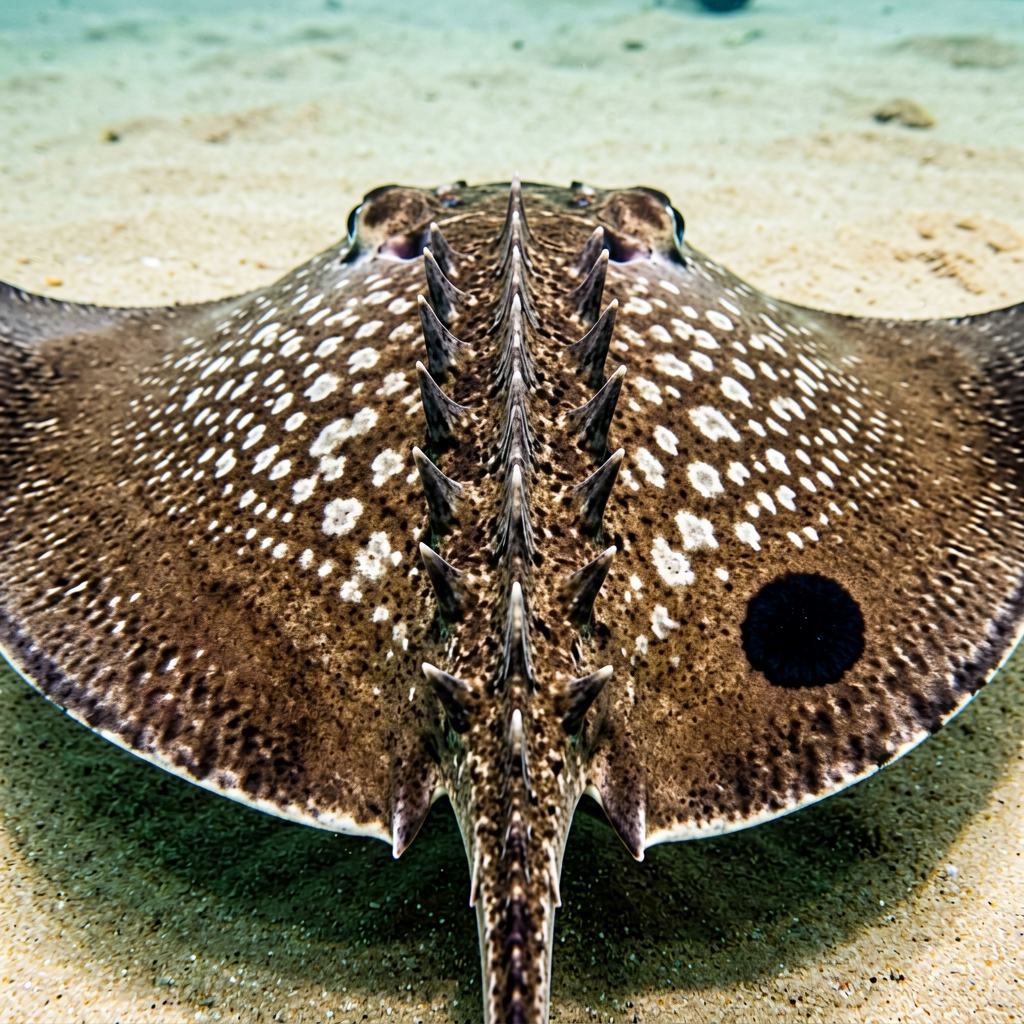
That means a total length of nearly 1.5 metres and a weight of perhaps 18 kilograms. Most rays met are much smaller. The common disc width is 40 to 80 cm. That means a weight of 2 to 5 kilograms. Females grow much larger than males. Males seldom pass 70 cm in disc width. The top side is mottled in brown, grey-brown, olive and buff. Darker patches and bands are spread about. In some rays the dark spots form a more or less fixed pattern. That has sometimes been read as breaking up the outline. The under side is a plain pale grey or white. In some fish the disc edges are darker. The armour of the skin is the clearest mark of the species. A row of 20 to 30 big, curved, flattened thorns runs along the midline of the back and tail.
The largest sit in the middle of the row. Another row, often almost as strong, runs along each side of the tail. The shoulders carry a patch of small spines. In adult females and large males, loose spines called bucklers appear on the outer parts of the side fins. A clear group of spines sits around and behind the eye and the spiracle. Young rays are nearly smooth. The full armour grows only at adulthood. So the bucklers on the wings and shoulders are sex marks. The mouth is on the under side. Its teeth form a broad plate of small, blunt cusps in several rows. The nostrils and the ampullae of Lorenzini sit under the snout. These are the organs with which the ray senses weak electric fields.
1
2
3
Sand, gravel and seasonal moves
Where it lives
The thornback ray lives along the whole north-east Atlantic coast. Its range runs from Norway and the western Baltic southwards. It covers the North Sea, the Irish Sea, the English Channel and the Bay of Biscay. It reaches the coasts of Morocco and the Sahara. It also turns up, though less often, off west and south Africa as far as Namibia. It is common across the Mediterranean and is present in the Black Sea. It is one of very few skates still found in shallow coastal water in most of western Europe. The species lives from the shore down to about 300 metres. There are odd records much deeper. It is most common between about 10 and 60 metres.
It favours sand, muddy sand, gravel and mixed ground. It is uncommon over rock and over the softest mud. It likes ground that mixes open sand with nearby patches of coarser stuff. The open sand is for resting and for sensing prey. The coarser patches hold the spineless prey. The species makes a marked seasonal move over most of its range. It comes inshore into shallow water in spring and summer. Then it may be found in as little as 2 or 3 metres. Shore anglers take it from open beaches. In autumn and winter it moves offshore into deeper water.
It is then taken at 60 to 100 metres or more. The moves follow the yearly cycle of water heat. They are thought to be a way of keeping warm. The rays seek the warmest water in summer. That helps digestion and the growth of the eggs. In winter they seek the more even heat of deeper water. The species bears slightly brackish water. It is often recorded from estuaries and coastal lagoons. It does not swim up rivers in the manner of the flounder.
Crushing crabs
What it eats
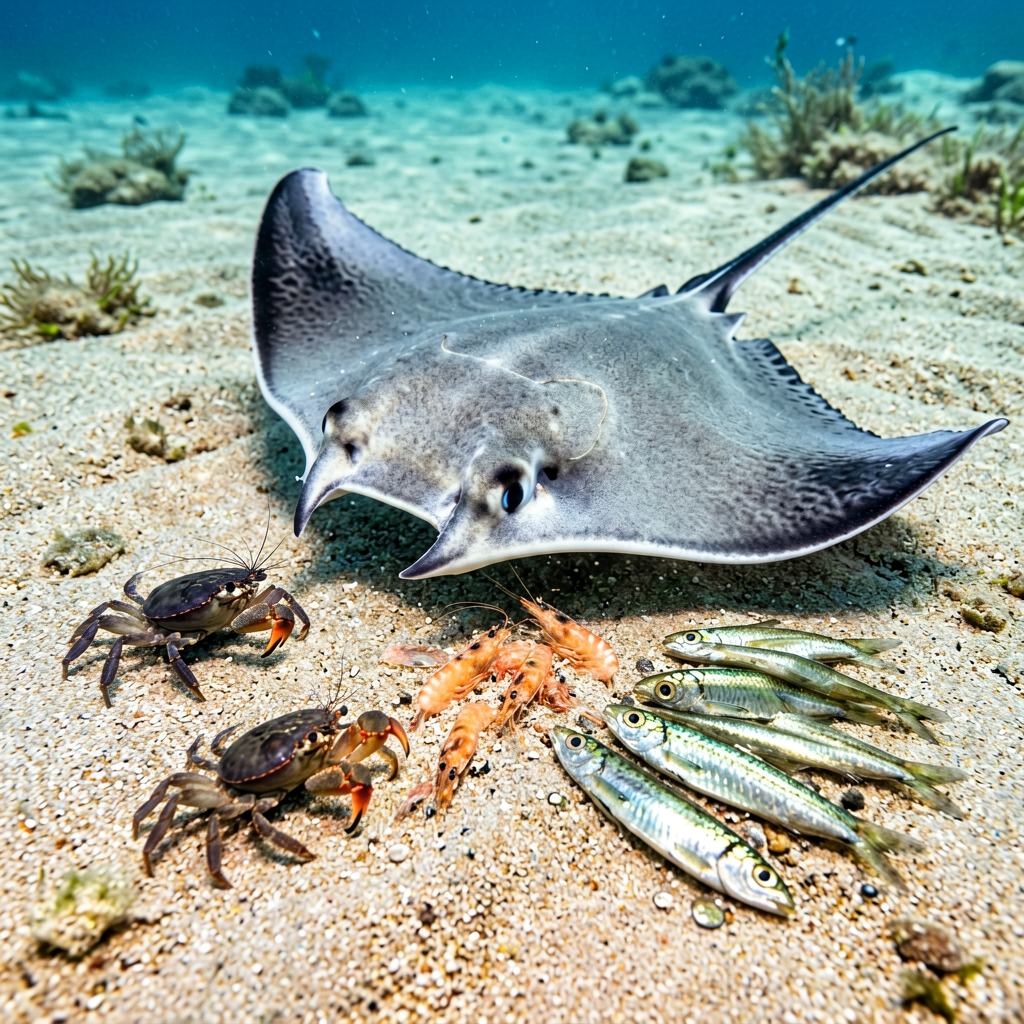
The thornback ray is a bottom hunter. It takes prey with fairly hard shells. Crabs and shrimps matter more in its diet than in any other European skate. Swimming crabs, small shore crabs, hermit crabs, prawns and mantis shrimps all feature. Its crushing teeth reflect this. The teeth form a broad plate of small, flat, blunt cusps. They sit packed in close rows. That is well suited to breaking crab shell. It is no use at all for seizing a slippery fish or cutting flesh. Fish are still taken when the chance comes.
Small bottom-living kinds appear often in the diet. These include the sandeel, the goby, the dragonet and the young of flatfish and cod. Squid and cuttlefish are eaten too, often the young. Big bristle worms are also taken. The species eats some shellfish and small sea snails. Shell bits in the stomachs of large rays show that the biggest thornbacks can deal with well-armoured prey. Prey is found mainly by smell and by the electric sense rather than by sight. Buried crabs and worms give off small electric fields. The ampullae of Lorenzini can pick these up a few centimetres away. That lets the ray find prey hidden well below the sand.
Once found, the ray uses the front edges of its disc to dig the prey out. The prey is then steered towards the mouth by the movement of the disc. It is crushed between the tooth plates before it is swallowed. The species feeds mainly at night and in the early morning. It is much busier then. Through the middle of the day it lies buried in the sand. Only the eyes and the spiracles show. This pattern has been shown in tanks and in the stomachs of fish taken at different times.
One egg case at a time
The breeding cycle
The thornback ray lays eggs. It puts down one egg case at a time. The eggs are fertilised inside the body. Each is then shut in a hard, box-like, horny capsule. The capsule passes out through the oviduct. It is laid on the sea bed a few days after it forms. The capsule is about 9 to 13 cm long with the horns. It is a little bowed on both faces. It carries a stiff, tapering horn at each corner. The two rear horns are longer than the front pair. They curve or hook. That holds the capsule clear of the sand.
The surface has a felt of fine threads. This traps grains of sand. It gives the case a feel and colour much like the sand and gravel around it. It is buff-brown when fresh and darkens with age. The female makes about 40 to 140 capsules in a season. She puts them out every few days. In the British Isles this runs from about February to September. In the Mediterranean it is gathered in spring. The capsules may be held on the sea bed for a few days before they are laid. The female often pushes out several and then lays them together. Growth inside the case takes 4 to 5 months at the heat of European coastal water. It may take much longer in the colder north.
The young come out through the front end of the case. They are small copies of the adult, with the disc fully formed and the armour not yet grown. They come out at a disc width of 11 to 13 cm. There is no care of the young. They are on their own at once. They settle on the same grounds as the adults. They stay in the shallowest and most sheltered water for the first year or two. Males mature at a disc width of about 48 to 55 cm and an age of 6 or 7 years. Females mature at about 62 to 78 cm and 8 to 11 years. The species lives to a top age of about 15 years. For a gristle-fish of this size that is fair rather than odd. It is still far longer than the life of any bony fish around it.
Down by more than 90 per cent
Near Threatened
The thornback ray is classed as Near Threatened. The trend behind that class is due only to fishing. The species is taken in vast numbers along with the catch of bottom trawls. This happens across the north-east Atlantic and the Mediterranean. The fish are kept for sale. Its way of life leaves it very ill-suited to bear a high toll. It matures late. The time it takes to replace itself has been put at 11 to 14 years. Its egg output is fairly low. The largest females, which make the most eggs, are just the ones the market wants.
So the stock is in itself very open to harm when adults are taken out. The old records leave no doubt about the result. In the southern North Sea the species was named in the 19th century as one of the commonest fishes of the region. It was taken in such amounts that it was said to be spread on the land as manure. It was also food for the poor. It has since fallen by more than 90 per cent on some grounds. The survivors have pulled back in depth as well. They now gather in water deeper than the trawlers work. They also hold on in patches of sea bed too rough for the gear. Recovery is possible.
Skates answer the lifting of fishing with a rise in numbers. Such rises have been recorded in several areas after fisheries closed. The answer is slow because of the ray’s long life. Recovery of the North Sea stock, if it comes at all, will take several decades. Steps taken so far include areas closed to bottom trawling. Some countries ban the landing of certain skate species. Top landing sizes are used to shield breeding females. Sorting grids and changes to the gear aim to cut the toll on young fish. The species is also watched through sampling of the fishery. The fish thrown back from the trawls are the main way of judging the stock.
Quick hits
Five things to remember
- The thornback ray is the type species of the genus Raja, which means its name is always tied to the genus by the rules of zoological naming.
- Its egg cases are the stiff, four-horned capsules found on beaches the world over, and the name mermaid’s purse is used for the egg cases of every skate, not just this one.
- Along the midline of the back runs a row of 20 to 30 big curved thorns, and the bucklers that grow on the wings of adult fish are sex marks found mainly in females and large males.
- Thornbacks can sense the weak electric fields made by the muscles of buried crabs and worms, which lets them find prey hidden well below the surface of the sand.
- The young are known as maiden rays, and they are told from the adults by their almost wholly smooth skins, the armour growing only at adulthood.