 By st20113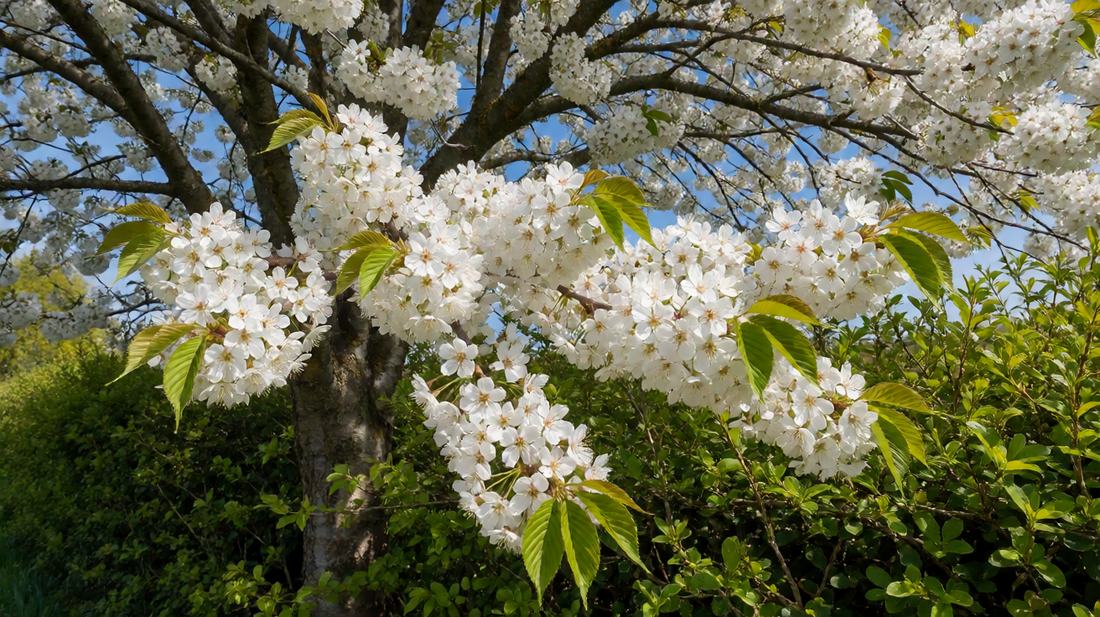
Prunus avium | Wild Cherry
Species Profile · Rosaceae
Wild Cherry
The tallest of the European cherries and the ancestor of every sweet cherry in a shop — Prunus avium means the plum of the birds.
IUCN: Least Concern
Range
Height
Leaves
Blossom
Fruit
The plum of the birds
The tallest of the European cherries
The wild cherry is the tallest of the European cherries. It is also the ancestor of every sweet cherry sold in a shop. In early spring it stands out in a hedgerow. It carries clusters of pure white blossom on bare branches. Most other trees have not opened their leaves yet. By midsummer it hangs with small dark fruit.
Blackbirds, thrushes and mice strip it within days. The Latin name explains the deal exactly. Prunus avium means the plum of the birds. The tree is native to Europe, North Africa and western Asia. It grows from the British Isles south to Morocco and east to the Caucasus and northern Iran. People have planted it so widely that the true limits of its native range are hard to fix.
Its timber is one of the best hardwoods in Europe: reddish-brown, close-grained and easy to work. Furniture, panelling and musical instruments have used it for centuries. Wild cherry is also a tree of old woodland and ancient hedges. A wood with several large cherries in it has usually been wooded for a very long time.
Family tree
Prunus, a genus of about 430
The wild cherry belongs to the family Rosaceae and to the genus Prunus. That genus holds plums, cherries, peaches, apricots and almonds, about 430 species in all. Within the genus the wild cherry sits in the subgenus Cerasus, the cherries. Members of that group carry their flowers in small clusters. Their fruit holds a smooth stone. Linnaeus described the tree, though not at once under the name used today. In the first edition of Species Plantarum in 1753 he made it a variety of the sour cherry.
Only in 1755, in the second edition of his Flora Suecica, did it become a species in its own right. Wild cherry has 16 chromosomes, so it is diploid. That matters to fruit growers. The sweet cherries grown for sale belong to this species. Most of them cannot fertilise their own flowers. An orchard therefore needs a second, compatible variety nearby. The wild cherry of northern and western Europe is not the only plant with that English name.
In North America the name usually means Prunus serotina, a different tree that flowers much later. Wild cherry is a close relative of the blackthorn, a spiny shrub of the same genus. Blackthorn flowers even earlier and bears the sloe. The two often grow a few metres apart in the same hedge. Their habit, their thorns and their fruit tell them apart.
White blossom, red glands
How to identify one
The wild cherry is a deciduous tree that grows to between 15 and 32 m. The trunk can reach 1.5 m across. Young trees show strong apical dominance. They make a straight leading shoot and a neat, cone-shaped crown. Old trees become rounded and uneven, with heavy, wide limbs. The bark is one of the easiest features to learn. On young trunks it is smooth and purplish-brown, with clear grey-brown lenticels across it. As the tree ages the bark grows thick, dark and cracked, and it peels in thin strips. The leaves are alternate and simple, 7 to 14 cm long and 4 to 7 cm wide.
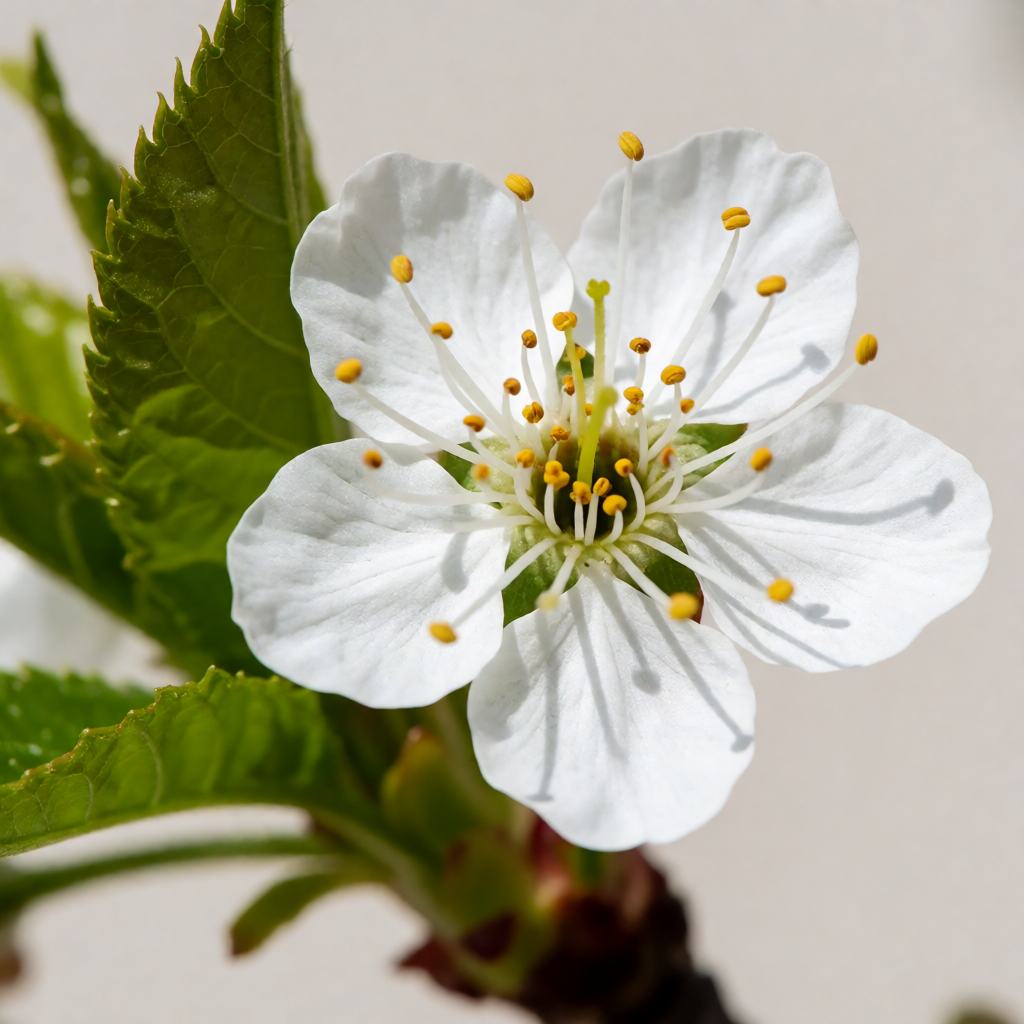
They are oval with a drawn-out tip and a fine saw edge. They are dark matt green above and paler beneath. The leaf stalk is 2 to 3.5 cm long and carries 2 to 5 small red glands. More red glands sit at the tips of the leaf teeth. These glands are a neat trick. They leak a sugary liquid that draws ants. The ants then see off caterpillars, so the tree hires bodyguards. The flowers open in early spring, at the same time as the new leaves, in clusters of 2 to 6 on a shared stalk. Each flower is 2.5 to 3.5 cm across.
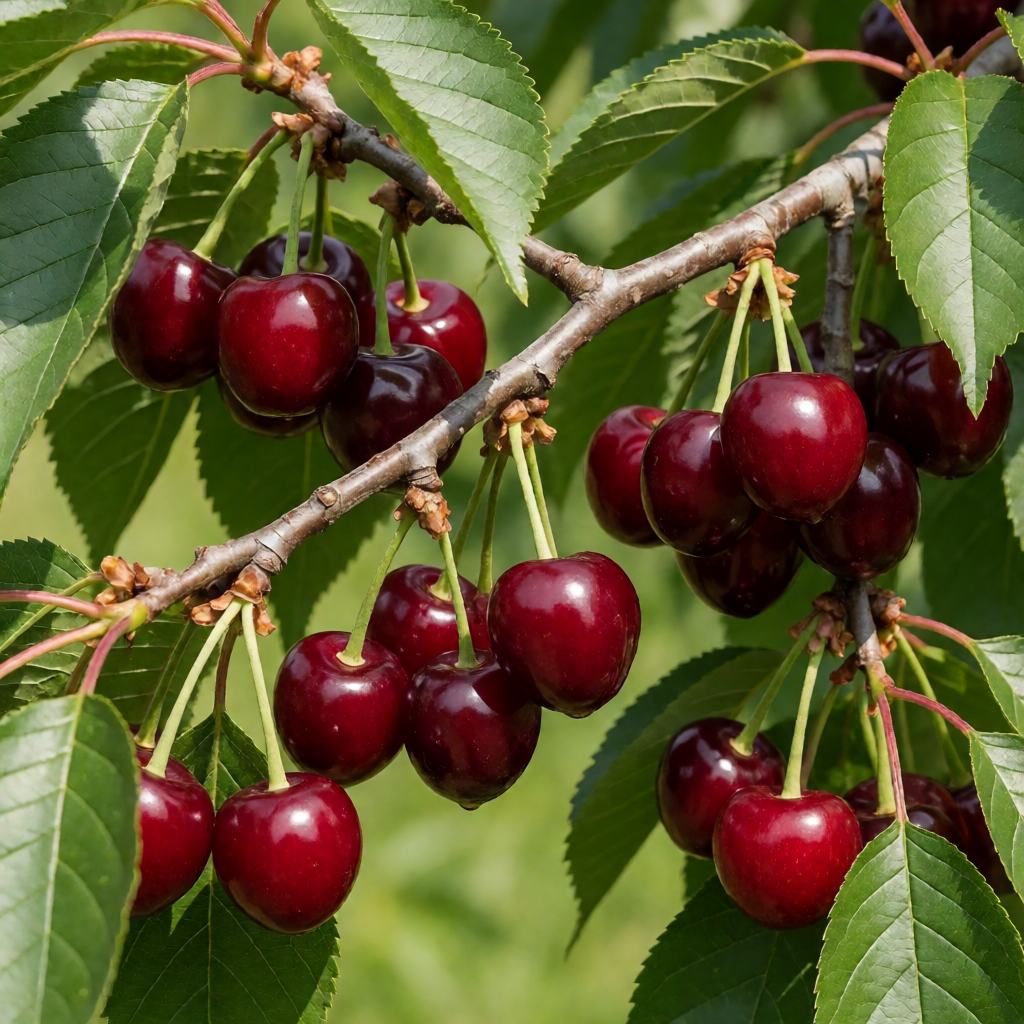
It has 5 pure white petals and about 30 stamens with yellow anthers. In autumn the leaves turn orange, pink and red. The fruit is a drupe 1 to 2.5 cm across. It starts bright red and turns dark purple to almost black when ripe. Inside sits 1 hard stone 8 to 12 mm long, grooved along one edge. The flesh is about 82 per cent water. The dry matter is almost half sugar and starch, with only about 2 per cent fat. That is the parcel a bird needs in autumn.
1
2
3
Ancient woodland and old hedge
Where it lives
Wild cherry grows in mixed deciduous woodland, on wood edges, in hedges, along roads and in scrub. It wants fertile soil, not poor ground. It does best on deep, well-drained, slightly acid loam. It copes with a wide range of soils, as long as the site is not waterlogged. It needs light. Seedlings settle in gaps and at wood edges, not under a closed canopy. A mature tree in shade stops fruiting and in time dies.
The species is native across most of Europe. It grows from the British Isles south to Morocco and Tunisia and east through Anatolia and the Caucasus to northern Iran. One small, isolated group lives in the western Himalaya. It grows from sea level to about 1800 m in the mountains of its southern range. In Britain it is a typical tree of ancient woodland and old hedges. It is often the first large tree to flower on a wood edge. Birds and mammals eat the fruit: blackbirds, song thrushes, redwings, fieldfares, wood mice, dormice, badgers and foxes.
The stones usually pass through intact, so the tree spreads steadily through the countryside. People also grow wild cherry as an ornamental and as a rootstock. Many cherries in parks and gardens sit on wild cherry roots. That habit has a price. Trees grown from stock that came from elsewhere cross with native trees. In Britain the genetic purity of truly native wild cherry is now a concern in its own right.
It makes its own food
What it eats
Wild cherry makes its own food. It has no diet in the animal sense, but the way it feeds shapes everything about the tree. It is a deciduous broadleaf that builds its crown in early spring. It uses energy stored in its roots and trunk to open leaves and flowers at almost the same time. It then runs on sunlight through the summer and banks the spare as starch. That store fuels the next spring’s growth.
The early flowers draw on last year’s sugar, not on the current season. So a tree that loses its leaves to caterpillars or drought in one summer gives a poor show of blossom the next spring. A shallow, wide root system pulls minerals from the soil. Wild cherry also teams up with fungi on its roots. Those fungi reach further than the roots can and help the tree take up phosphorus. The red glands on the leaf stalks do a different job.
They leak nectar outside the flower, which draws ants, wasps and other insects. The ants patrol the leaves and remove small caterpillars. The tree pays a little sugar and gets protection. The leaves themselves feed a long list of moth caterpillars, including the orchard ermine, the leopard moth and the lesser spotted pinion. The blossom gives pollen and nectar to bees, hoverflies and beetles at a time of year when little else is open. The fruit then feeds the birds and mammals that carry the seed away.
Blossom on bare branches
The breeding cycle
Wild cherry is a hermaphrodite. Each flower carries both male and female parts. Yet most trees cannot fertilise themselves. The flowers open in March and April, before most other trees are in leaf. Bees do almost all the work of pollination. They come for the nectar at the base of the flower and for the pollen. A tree in full blossom can draw hundreds of bees an hour. Cherry blossom is one of the best early nectar sources in northern Europe.
Once a flower is pollinated, the ovary swells into a drupe. The other flower parts wither and drop. The fruit ripens from June to August, depending on latitude and variety. Dispersal depends entirely on animals that eat the flesh and then drop or pass the stone. That is why a woodland crop vanishes within a few days of ripening. A cherry stone does not germinate easily. It has a hard coat, and the embryo inside needs warm, wet weather followed by cold. So seed in the wild often comes up in the second spring after it was shed.
Only a small share of stones ever makes a seedling. A young tree grows fast in its first decades. In the open it can flower at about 10 years old. Wild cherries live a fair while for a broadleaf, often 60 to 100 years and sometimes much longer. Old trees show cracked bark, hollow trunks and heavy, broken limbs. All of that makes good homes for bats, beetles and fungi.
Common, but losing its veterans
Conservation
The wild cherry is listed as Least Concern on the global Red List, with a stable trend. It is one of the most widespread hardwoods in Europe. That verdict rests on the size of the range, which covers most of a continent and reaches into western Asia and North Africa, and on the tree’s habit of seeding freely wherever birds carry its stones. Local pressures are still real. In Morocco the tree is classed as near threatened. In Tunisia it sits on the national list of rare and threatened plants, because the southern edge of its range has shrunk through clearance, grazing and drought.
Across Europe, 3 problems stand out. The first is the loss of old trees. Mature wild cherries are valuable timber and are often felled before they become veterans. Planting schemes have not replaced them. The second is the loss of ancient woodland and hedges, which breaks the network of good sites. The third is genetic.
Wild cherry is the standard rootstock for farmed cherries. Large numbers of trees from elsewhere have been planted in hedges, roadsides and new woods. They cross with native stock, which slowly dilutes the local genetic character of the species. Conservation bodies now try to manage this by insisting on planting material drawn from the same area. Heavy deer grazing is a further problem. Deer love seedling cherries, and few survive to become saplings where deer are numerous.
Quick hits
Five things to remember
- The Latin name Prunus avium means plum of the birds, a nod to the way birds spread the stones.
- The red glands on the leaf stalk leak nectar that draws ants, which then chase off caterpillars.
- Every part of the tree except the ripe fruit flesh holds cyanide compounds, including the stone and the leaves.
- The wild cherry is the ancestor of the farmed sweet cherry, and most orchard trees cannot fertilise their own flowers.
- The blossom opens before the leaves, which makes the tree one of the best early nectar sources for bees.