 By st20113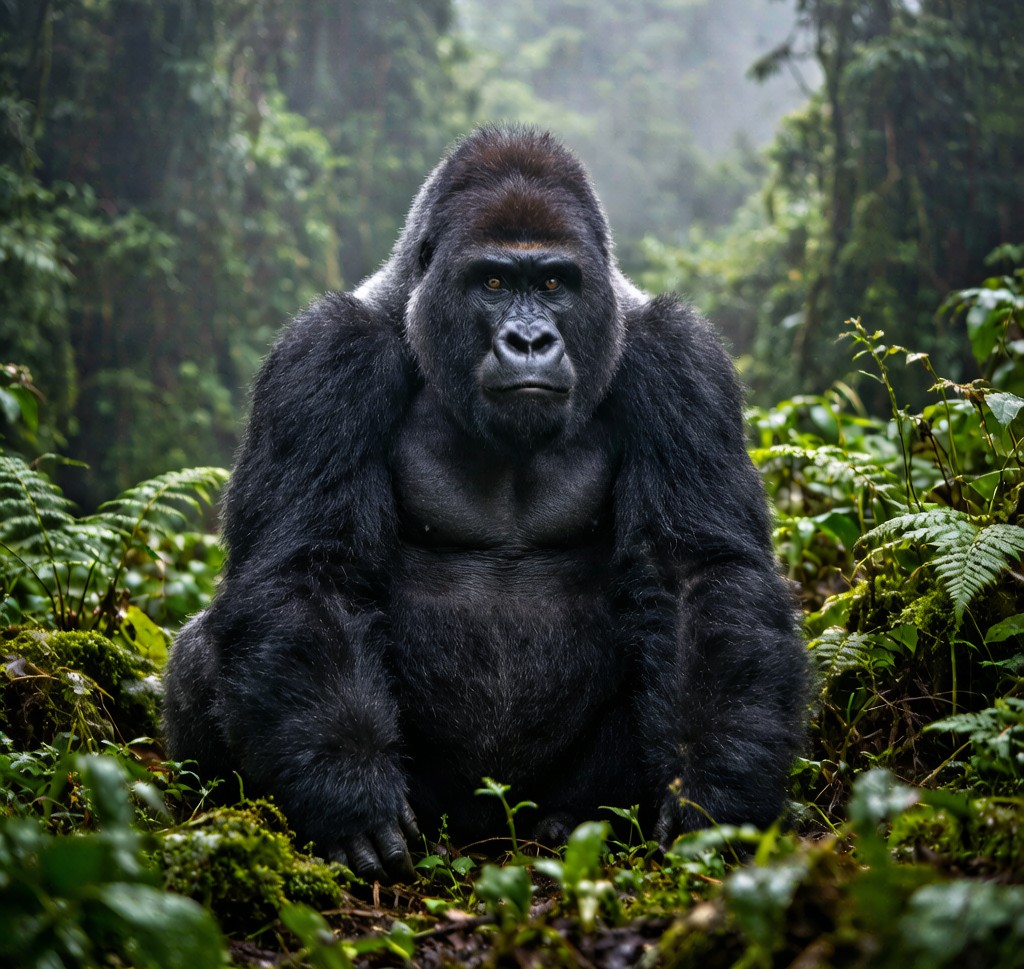
A Mountain Gorilla (Gorilla beringei beringei) silverback male in the misty montane forest of the Virunga Mountains
Overview
The Mountain Gorilla (Gorilla beringei beringei) is one of the most closely observed and emotionally compelling wild animals on Earth. Inhabiting the high-altitude forests of the Virunga volcanic mountains of Central Africa and in Uganda’s Bwindi Impenetrable National Park, the mountain gorilla is a subspecies of the eastern gorilla that has captured the world’s imagination through the groundbreaking research of Dian Fossey and the rise of gorilla tourism in Rwanda, Uganda, and DR Congo. With fewer than 1,100 individuals surviving in the wild, the mountain gorilla is one of the most endangered primates on Earth – yet it is also one of the few great apes for which the conservation story is one of hope rather than despair.
Mountain gorillas are large, powerfully built great apes. Adult males, called silverbacks due to the silvery-silver hair that develops on their backs and hips at sexual maturity (approximately 15 years), weigh 160 to 220 kilograms and stand approximately 150 to 170 centimeters tall when upright. Females are considerably smaller, typically weighing 70 to 120 kilograms. They have longer, thicker, and darker hair than other gorilla subspecies – an adaptation to their cooler, high-altitude habitat where temperatures can drop below freezing at night.
Habitat and Distribution
Mountain gorillas are found in two isolated populations within the forests of the Albertine Rift region of Central Africa. The largest population inhabits the Virunga Massif – a chain of dormant and active volcanoes spanning the borders of Rwanda, Uganda, and DR Congo – at elevations of 2,200 to 4,300 meters. The second population lives in Uganda’s Bwindi Impenetrable National Park, at somewhat lower elevations of 1,160 to 2,600 meters. Some researchers suggest that the Bwindi population may be sufficiently distinct to warrant subspecies status in the future.
The mountain gorilla’s habitat consists of montane and bamboo forest, characterized by dense vegetation, frequent mist, and dramatic altitudinal gradients. The forest provides all of their essential resources: food (primarily vegetation), construction materials for sleeping nests, and cover from predators. Seasonal shifts in food availability drive vertical migration – gorillas descend to lower elevations during dry seasons when fruit is more abundant and ascend to higher elevations during wet seasons to feed on new growth in the bamboo zones.
Diet and Daily Life
Mountain gorillas are primarily herbivorous folivores – over 85% of their diet consists of leaves, shoots, stems, bark, roots, and flowers from approximately 142 plant species. Their most important food plants belong to the genus Galium (a type of bedstraw), as well as thistles, nettles, celery, and bamboo. Fruit makes up only a small portion of the diet, though it is highly sought after when available. Occasional consumption of insects (primarily ants and termites) provides protein supplementation, and gorillas have been observed eating dung on occasion to maximize nutrient absorption.
Gorillas spend approximately 30% of their day feeding, 30% resting, and the remainder engaged in social activities and locomotion. They construct a fresh sleeping nest each night – a bowl of bent vegetation constructed on the ground or in trees – with infants sharing their mother’s nest. Their daily range varies from 0.5 to 2 kilometers per day, with males patrolling and defending the group boundary and females and juveniles foraging across the group’s home range of 15 to 25 square kilometers.
Social Structure and Intelligence
Mountain gorilla groups are typically led by a single dominant silverback male, with one to several adult females and their offspring forming the core of the group. The silverback is the central decision-maker, directing the group’s daily movements, mediating conflicts, protecting the group from predators and rival males, and maintaining social cohesion. The bond between the silverback and his females is a central feature of gorilla society – unlike the multi-male systems of chimpanzees, gorilla groups are remarkably stable and peaceful.
Mountain gorillas are among the most cognitively advanced animals on Earth. They use tools in the wild, modify their communication signals in response to the social context, demonstrate long-term memory for individual relationships, and display empathy and self-awareness. They communicate through a rich repertoire of at least 25 distinct vocalizations, 24 facial expressions, and various body postures and displays. The silverback’s chest-beating display – created by cupping his large, fleshy hands and rapidly striking his chest – can be heard over a kilometer away and communicates size, strength, and dominance to rival males.
Conservation and Hope
The mountain gorilla is listed as Endangered on the IUCN Red List, but it stands as one of the most inspiring conservation success stories in modern history. In the 1980s, the species was on the brink of extinction, with populations devastated by habitat loss, hunting, and political instability in DR Congo. Since then, intensive conservation efforts – including anti-poaching patrols, community-based conservation programs, veterinary interventions, and the establishment of well-managed national parks – have led to a remarkable population recovery, with numbers doubling over the past three decades.
Gorilla tourism has played a crucial role in this recovery, generating millions of dollars in revenue for local communities and creating powerful economic incentives to protect gorilla habitat. In Rwanda, gorilla tourism is the single largest source of foreign exchange after coffee and tea. The development of highly regulated, low-impact gorilla tourism protocols – limiting group sizes, keeping minimum distances, and requiring masks to prevent disease transmission – has created a model for great ape tourism worldwide that balances conservation with human development.