 By st20113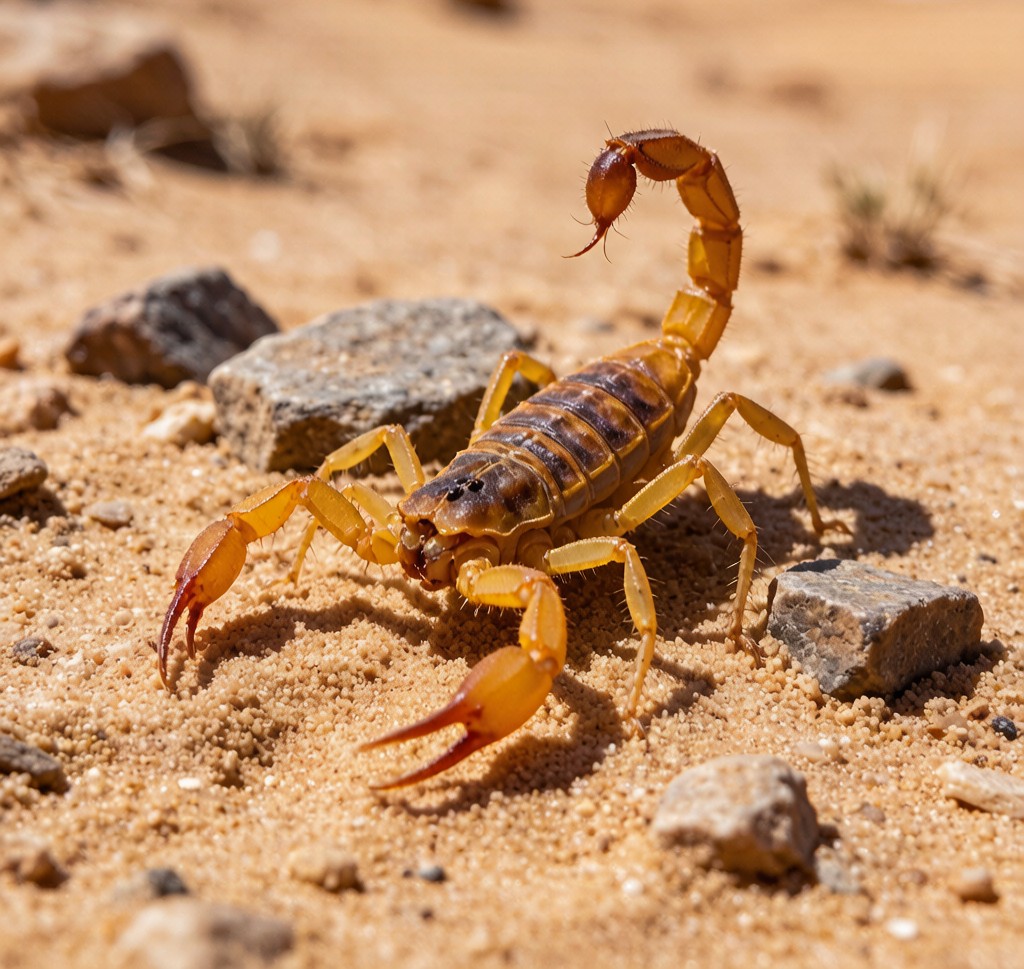
A Deathstalker Scorpion (Leiurus quinquestriatus) on sandy desert ground, showing its pale yellow coloration and powerful curved stinger
Overview
The Deathstalker (Leiurus quinquestriatus) is widely regarded as one of the most dangerous scorpion species in the world. Despite its relatively modest size – typically 8 to 10 centimeters in length – the Deathstalker’s venom is extraordinarily potent, containing a cocktail of neurotoxins that can be lethal to humans, particularly children, the elderly, and those with compromised health. Found across the arid and semi-arid regions of North Africa and the Middle East, this scorpion thrives in some of the harshest environments on Earth.
The Deathstalker is characterized by its slender build, relatively large pinchers (pedipalps), and distinctive yellow to yellowish-brown coloration, often with darker stripes or bands along the mesosoma (the middle body segment). The tail (metasoma) is long and thin, ending in a notably swollen, bulbous telson that contains the venom glands. Its appearance is deceptively delicate, belying the extreme potency of its venom.
Habitat and Distribution
The Deathstalker is native to the Saharan and Sahelian regions of North Africa, ranging from Morocco and Mauritania in the west through Algeria, Tunisia, Libya, Egypt, Sudan, Ethiopia, Eritrea, Somalia, Kenya, and Tanzania. Its distribution extends eastward into the Arabian Peninsula (Saudi Arabia, Yemen, Oman, Jordan, Israel, and Lebanon) and through parts of the Middle East. This vast range reflects the species’ remarkable adaptation to extreme aridity and temperature variability.
Deathstalkers inhabit dry deserts, semi-arid scrublands, rock outcrops, and the margins of agricultural fields. They are crevice-dwellers, sheltering during the extreme heat of the day in natural crevices, under rocks, within crumbling walls, and in abandoned burrows of other animals. At night, they emerge to hunt, using the infrared-sensing organs on their pectines (comb-like sensory structures on the underside) to detect vibrations of approaching prey on the sand.
Venom and Medical Significance
The Deathstalker’s venom is one of the most medically significant scorpion venoms in the world. Its primary active components are neurotoxins – specifically chlorotoxins and leiurotoxins – that work by overstimulating the nervous system, causing an massive release of neurotransmitters that can lead to seizures, paralysis, cardiac dysfunction, and potentially death. The venom also contains cardiotoxins, nephrotoxins, and other components that affect multiple organ systems.
In humans, a sting typically causes immediate severe pain at the site of injection, followed by localized swelling, numbness, and tingling. In severe cases, systemic effects include muscle twitching, involuntary jerking movements, profuse sweating, hypertension, cardiac arrhythmias, and respiratory failure. Children, who are most at risk due to their lower body mass, account for the majority of fatalities. The venom has also attracted significant scientific interest for its potential applications in cancer research – chlorotoxin derived from Deathstalker venom has shown promise in targeting and imaging brain tumor cells.
Ecology and Behavior
Despite their fearsome reputation to humans, Deathstalkers play an essential role as apex invertebrate predators in desert ecosystems. Their diet consists primarily of insects including beetles, grasshoppers, crickets, and moths, as well as spiders, centipedes, and other scorpions. They are ambush and active hunters, capable of pursuing prey across sand with remarkable speed.
Mating in Deathstalkers involves an elaborate courtship dance called the promenade à deux, in which the male and female lock pinchers and the male guides the female across the ground while depositing a spermatophore on the substrate. The female then positions herself over it to take it up. Unlike many scorpion species, Deathstalkers are viviparous – females give birth to live young, typically 20 to 30 nymphs, which immediately climb onto the mother’s back and remain there through their first instar. The mother may assist the young through their first molt, regurgitating prey for them to feed on.