 By st20113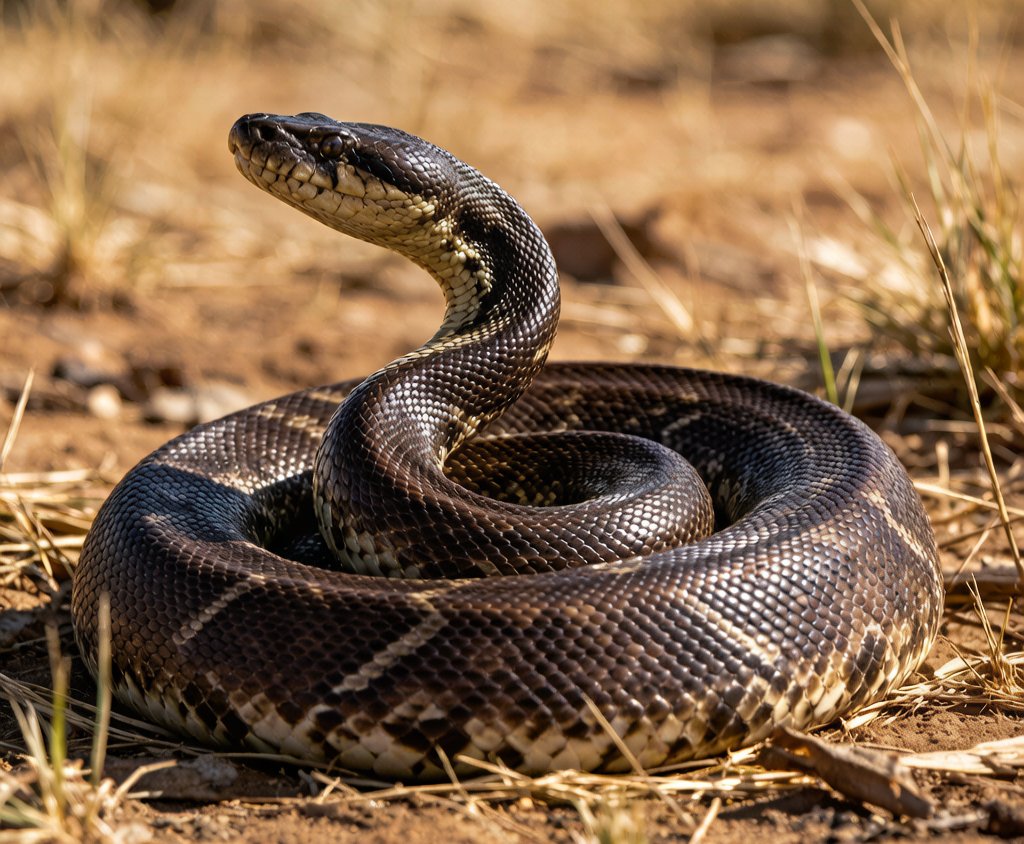
Introduction
The African rock python is the largest snake native to Africa, a powerful constrictor that inhabits a wide range of habitats south of the Sahara. Growing to lengths of more than five metres, it is a formidable predator capable of subduing prey as large as antelope and crocodiles. Despite its size, it is generally shy and avoids humans when possible. Like other reptiles such as the crocodile, it is a patient ambush hunter that relies on stealth and strength rather than speed.
Taxonomy
The African rock python is classified as Python sebae within the family Pythonidae, the true pythons. Historically, the northern and southern populations were considered a single species, but some authorities now split them, with the southern form called Python natalensis. Pythons are primitive snakes that retain remnants of hind limbs in the form of small spurs near the cloaca. They are non-venomous, killing prey by constriction rather than venom injection, a trait they share with the unrelated boas.
Physical Characteristics
This python has a bulky body marked with a striking pattern of brown, olive, and tan blotches edged in black, providing excellent camouflage among rocks and vegetation. The head is broad with a distinctive triangular marking, and heat-sensing pits line the upper and lower lips, helping it detect warm-blooded prey in darkness. Adults commonly reach 3 to 5 metres, though exceptional individuals exceed 6 metres. The muscular body is built for both swimming and climbing, and the scales are smooth and iridescent in sunlight. Compared with the slender lizard, the python is vastly heavier and slower on land.
Habitat
African rock pythons occupy savannas, grasslands, forests, and rocky hillsides, but they show a strong preference for areas near permanent water such as rivers, lakes, and swamps. They are strong swimmers and often bask on riverbanks. They use burrows, rock crevices, and hollow logs as shelter during the day’s heat. Their adaptability to farmland and human-modified landscapes has allowed them to persist across much of sub-Saharan Africa, though conflict with people sometimes arises.
Diet
These pythons are opportunistic carnivores with a diet that grows with their size. Young snakes eat rodents, birds, and small mammals, while adults take monkeys, warthogs, antelope, and even crocodiles and domestic livestock. They strike swiftly, coil around the prey, and tighten with each exhaled breath until the animal suffocates. The python then swallows its meal whole, aided by loosely hinged jaws, and may fast for weeks or months afterward. They often hunt near water where animals come to drink.
Reproduction
Breeding typically occurs in the dry season, with females laying clutches of 20 to 100 leathery eggs in a sheltered burrow or termite mound. The mother incubates the eggs by coiling around them and shivering her muscles to generate warmth, a rare form of parental care among reptiles. After about two to three months, the eggs hatch, and the independent young disperse to fend for themselves. Hatchlings are vulnerable to predators including birds and mammals until they grow large enough to defend themselves.
Conservation
The African rock python is listed as a species of least concern overall, though local populations face pressure from hunting for skin and meat, persecution by farmers, and habitat loss. In some regions it is respected or feared in local folklore. The pet trade also removes animals from the wild. Conservation focuses on education and protected areas, since the species plays a valuable role in controlling rodent and pest populations. Unlike the declining turtle populations in some oceans, the python remains widespread, but monitoring is important.
Fun Facts
The African rock python can go many months without eating after a large meal. It can sense the body heat of a mouse from several centimetres away using lip pits. Females guard their eggs fiercely and are among the few snakes that actively warm their clutch. A large python can swallow prey several times the width of its own head thanks to stretchy ligaments. Despite myths, these snakes do not crush bones but suffocate prey by preventing it from breathing.
[…] Python in the family Pythonidae, the Old World constricting snakes. It is a close relative of the Python sebae (African Rock Python) and shares the python hallmark of heat-sensing pits along the lips and the retention of a pelvic […]