 By st20113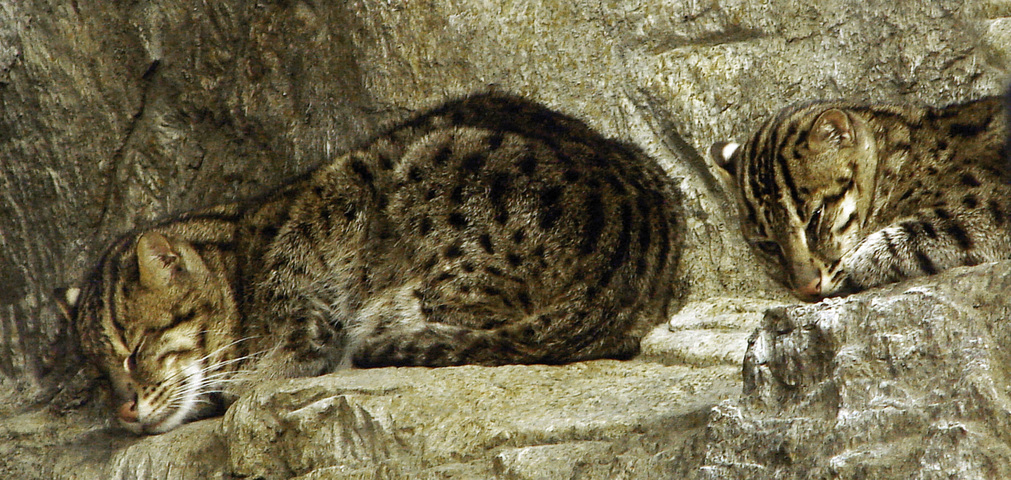
Introduction
The fishing cat (Prionailurus viverrinus) is a medium-sized wild cat of South and Southeast Asia whose biology and behaviour challenge many assumptions about what a cat can be. Unlike virtually all other felids, it is a proficient swimmer that dives for fish, stalks frogs in rice paddies, and raises its young in the dense cover of wetlands rather than in dry terrain. Found in marshes, mangroves, and riverine grasslands across an arc of countries from the Indus Valley to Java, the fishing cat plays the role of apex predator in one of the world’s most threatened ecosystems — the Asian wetland.
Taxonomy
The fishing cat is classified within the genus Prionailurus, a group of small to medium-sized wild cats native to Asia. Within this genus, it is considered one of the most basal — or evolutionarily ancient — species, suggesting it diverged early from the common ancestor of the group. Its closest relatives are the leopard cat (P. bengalensis) and the rusty-spotted cat (P. rubiginosus). Molecular studies confirm its taxonomic placement within Prionailurus, while morphological analysis of its skull and dentition supports its classification as a distinct species rather than a subspecies of leopard cat.
Physical Characteristics
Adult fishing cats weigh between 8 and 14 kilograms and stand approximately 38 to 40 centimetres at the shoulder, making them roughly twice the size of a domestic cat. Their elongated, muscular body is covered in a coat of olive-grey to tawny-brown fur with distinctive elongated dark spots arranged in longitudinal rows along the torso. The most remarkable physical adaptations are found in the paws: the toes are partially webbed, with extra skin extending well beyond the claw tips, and the claws are fully retractable but unusually long. Their fur consists of two layers — a dense, woolly underfur for insulation against cold water, and a longer outer coat of water-repellent guard hairs.
Habitat
Fishing cats are strongly associated with wetland habitats throughout their range, which spans from the Indus River Valley in Pakistan through India, Nepal, and Sri Lanka to Bangladesh, Myanmar, Thailand, and the Indonesian island of Java. They occupy marshes, flooded grasslands, mangrove swamps, tidal creeks, and the dense vegetation along riverbanks and lake margins. Water depth is not a barrier — fishing cats are comfortable in water up to their shoulders and have been documented swimming across rivers several metres wide. The dense vegetation provided by wetland plants is essential for providing cover for hunting and denning.
Diet
Despite their name, fishing cats consume a diet far more diverse than fish alone. Their prey includes amphibians such as frogs and toads, crustaceans including crabs and freshwater shrimp, insects, small mammals like rats and shrews, waterfowl and their eggs, reptiles including snakes and small turtles, and of course fish. They use two distinct fishing techniques: a slow stalking approach through shallow water followed by a rapid swipe with the paw to scoop fish from the surface, and a deeper dive in which the cat submerges completely to chase fish underwater. Scavenging from fishermen’s nets and catches also supplements their diet in areas where they coexist with human fishing communities.
Reproduction
Fishing cats breed year-round in captivity, though in the wild births appear to peak between January and February in some parts of their range. After a gestation of 63 to 70 days, females give birth to litters of one to four kittens, typically two. Births occur in dense reed beds, tall grass, or abandoned burrows near water. Like the young of many wetland species, including the Nile crocodile, fishing cat kittens develop rapidly, beginning to take solid food by two months and accompanying their mother on hunting expeditions by approximately six months of age.
Conservation
The IUCN lists the fishing cat as Vulnerable globally, with some regional populations approaching Critically Endangered status. The principal threat is the massive and ongoing destruction of Asian wetlands, which have been drained for agriculture, filled for urban development, and polluted by industrial and agricultural runoff. Secondary threats include direct persecution by fish farmers and local communities who view fishing cats as competitors, trapping in fishing gear, and increasing human-wildlife conflict as agricultural expansion pushes fishing cats into closer contact with human settlements.
Fun Facts
Fishing cats have been documented swimming underwater to catch fish at depths of up to 75 centimetres, using their partially webbed paws to propel themselves through the water with surprising speed. They can remain submerged for extended periods while stalking prey. Despite their aquatic specializations, they are equally comfortable in trees and have been observed resting and hunting above ground, using their sharp claws to climb trunks and navigate branches to access bird nests or arboreal prey. Their double-layered coat dries remarkably quickly after a swim, an essential adaptation for an animal that spends much of its life in and around water.