 By st20113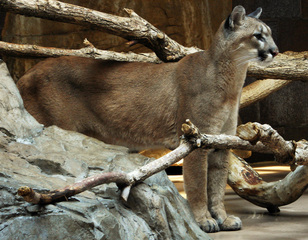
Introduction
The cougar is the largest wild cat in North and South America and one of the most wide-ranging terrestrial mammals in the Western Hemisphere. Also known as the puma, mountain lion, panther, and catamount, this solitary predator is found from the Canadian Yukon to the southern Andes of Chile and Argentina, inhabiting deserts, forests, mountains, and grasslands. Remarkably adaptable both ecologically and behaviorally, the cougar has the widest geographic range of any wild cat in the Americas, and it is capable of taking down prey many times its own body weight. Despite its wide distribution and adaptability, the cougar remains a secretive and largely nocturnal animal that avoids human contact whenever possible.
Taxonomy
The cougar belongs to the family Felidae, subfamily Felinae, and genus Puma. Its scientific name, Puma concolor, translates from Latin as “cat of one color,” a reference to its uniformly tawny to grayish coat. Once classified in the genus Felis alongside domestic cats and small wild cats, molecular phylogenetic studies confirmed that the cougar is most closely related to the jaguarundi and the cheetah of the Old World, sharing a common ancestor with these species approximately 6 to 10 million years ago. The cougar’s closest living relatives within the Americas are the jaguar in South America and the ocelot.
Physical Characteristics
Adult cougars are large, powerfully built cats with males weighing 53 to 100 kilograms and females between 29 and 64 kilograms. Their coat is typically tawny or grayish-brown with lighter underparts, and they have a long, thick tail that makes up about one-third of their total body length. Unlike most big cats, cougars lack the distinctive markings—spots, stripes, or rosettes—common to jaguars, leopards, and tigers. They have large paws, powerful hindquarters built for leaping, and can jump more than 7 meters horizontally and over 4 meters vertically from a standing position. Cougars are built for ambush predation, with exceptional acceleration over short distances.
Habitat
Cougars occupy a remarkable diversity of habitats across the Americas, from the dense rainforests of the Amazon and the Pantanal to the arid deserts of the Sonoran and Mojave, the high Andes above the treeline, and the boreal forests of Canada. They require large home ranges to maintain sufficient prey populations and are highly sensitive to human disturbance and habitat fragmentation. In North America, cougars were largely extirpated from the eastern United States by the early 20th century, though small populations persist in Florida and a remnant population of the eastern subspecies exists in Canada.
Diet
The cougar is an obligate carnivore and a versatile apex predator capable of taking prey ranging from small rodents to adult elk and horses. Deer species, particularly white-tailed deer and mule deer, constitute the majority of its diet across most of its range, though it also hunts feral hogs, capybaras, peccaries, guanacos, and numerous smaller mammals and birds when ungulates are scarce. Cougars kill by stalking to within striking distance and then delivering a suffocating bite to the throat or nape of the neck. They typically cache large kills by covering them with debris and return to feed over several days.
Reproduction
Cougars are solitary except during mating and when females are raising cubs. Females reach sexual maturity at approximately two and a half years and give birth to litters of one to six kittens after a gestation period of about 90 days. Kittens are born blind and helpless and remain with their mother for 12 to 20 months, during which time they learn to hunt and establish their own territories. Female cougars typically raise one litter every two to three years, and there is no fixed breeding season in most populations, though births may peak during certain months in some regions.
Conservation
The cougar is listed as Least Concern globally by the IUCN, with populations in North America generally stable or increasing following successful reintroduction programs. However, the Florida panther subspecies is endangered, with fewer than 230 individuals remaining in the wild, and the eastern cougar is believed to be extinct. Major threats include habitat loss and fragmentation, vehicle collisions, and targeted hunting. Large-scale connectivity projects that allow cougars to recolonize historical habitat in the eastern United States are increasingly seen as a priority for long-term species resilience.
Fun Facts
The cougar can jump up to 4.5 meters vertically from a standing start—taller than a one-story building. Its roar is unusual among wild cats; instead of roaring, cougars communicate through screams, whistles, purrs, and growls, with females’ mating calls sometimes mistaken for the screams of a human woman. Cougars are among the few cat species that can purr continuously, both while inhaling and exhaling. A single cougar may travel 50 kilometers or more in a single night during dispersal, and their tracks are distinctive for their lack of claw marks—a feature shared only with the cheetah among the world’s big cats.