 By st20113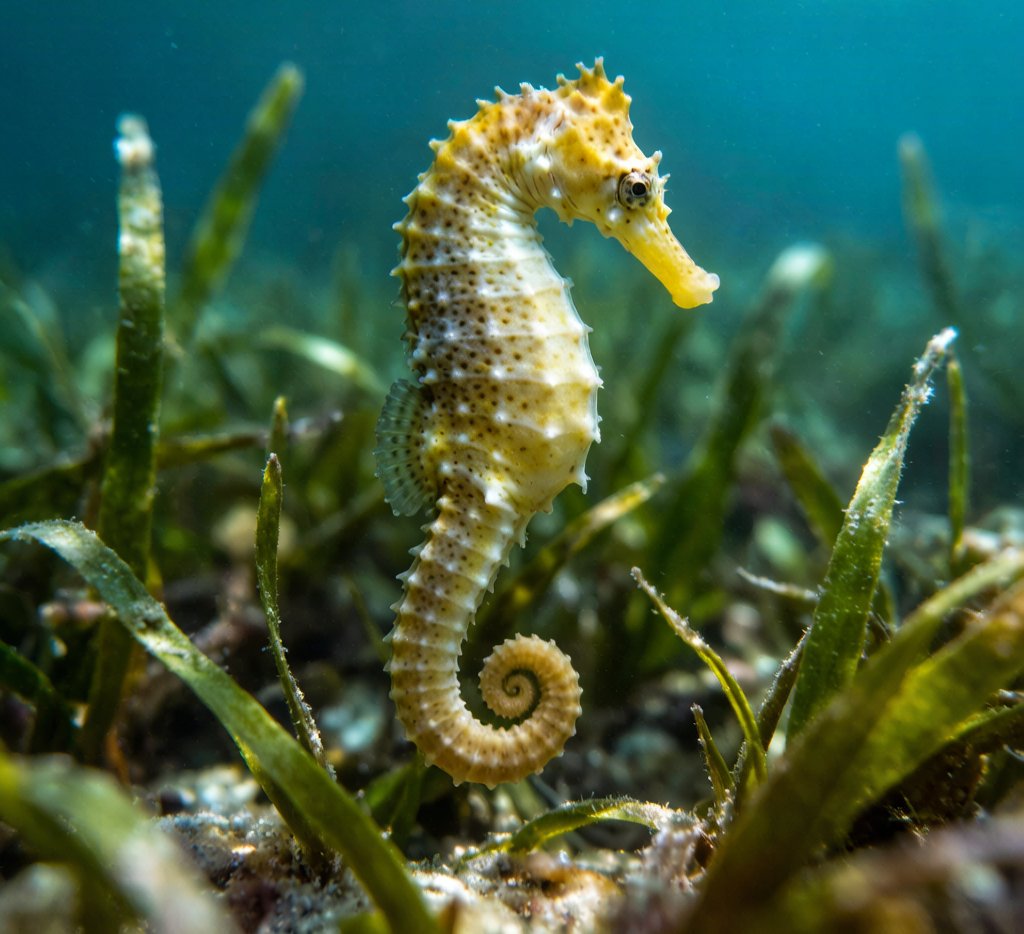
Introduction
The spotted seahorse is one of the most distinctive and beloved marine creatures in the world’s oceans. Unlike almost any other fish, seahorses swim upright, have a horse-shaped head, a curled prehensile tail, and a brood pouch in which males—not females—carry and gestate their young. Found in shallow coastal waters across the Indo-Pacific region, these small fish inhabit seagrass beds, coral reefs, and mangrove forests, where they anchor themselves with their tails while waiting for tiny prey to drift past. Their remarkable appearance and unusual reproductive biology have made them icons of marine conservation, though they remain threatened by habitat loss and overharvesting for traditional medicine and the aquarium trade.
Taxonomy
The spotted seahorse belongs to the family Syngnathidae, which includes pipefishes and seadragons, order Syngnathiformes, and genus Hippocampus. The species name kuda comes from the Malay word for horse. The taxonomy of the genus Hippocampus has been the subject of considerable revision, with genetic studies identifying numerous distinct species within what were previously considered single, widespread species. The spotted seahorse is now understood to represent a species complex rather than a single uniform population.
Physical Characteristics
The spotted seahorse typically reaches 15 to 17 centimeters in height, with a horse-shaped head positioned at a right angle to the body, large eyes capable of independent movement, and a curled, grasping tail used to anchor to vegetation. Its body is covered in a series of bony plates rather than scales, giving it a somewhat armor-plated appearance. As the common name suggests, this species is characterized by numerous small dark spots and markings across its body and snout. Coloration varies widely and can change to match their surroundings, ranging from yellow and orange to brown, black, and even bright red.
Habitat
Spotted seahorses are found in shallow coastal waters throughout the Indo-Pacific, from Hawaii and Japan to Australia, Southeast Asia, and the Indian Ocean. They prefer calm, sheltered environments such as seagrass meadows, coral reefs, rocky reefs, and mangrove prop roots, where they can anchor and find adequate food. They are poor swimmers, relying primarily on their dorsal fin for propulsion, and are most active at dawn and dusk. Density can reach more than 100 individuals per square meter in highly favorable habitats.
Diet
The spotted seahorse feeds almost exclusively on tiny crustaceans, including copepods, amphipods, shrimp larvae, and other zooplankton that drift past on the current. It is a suction feeder: by rapidly expanding its skull, it creates a pressure differential that pulls prey into its tubular snout with remarkable precision. Because of their small size and unique feeding mechanism, seahorses must consume thousands of tiny prey items every day to meet their energy requirements. They have no teeth and swallow their prey whole.
Reproduction
The reproductive biology of the spotted seahorse is among its most remarkable features. During courtship, males and females perform elaborate daily greeting dances for several days, changing color and circling each other while anchored. The female transfers her eggs into the male’s brood pouch, where he fertilizes and incubates them for approximately two to three weeks. The male provides oxygen, nutrients, and waste removal within the pouch, and gives birth to fully formed, free-swimming juveniles through a series of muscular contractions. Broods can range from a few dozen to more than 1,500 juveniles per pregnancy.
Conservation
The spotted seahorse is listed as Vulnerable on the IUCN Red List, with populations declining across much of its range due to targeted and incidental fishing, habitat destruction, and pollution. Seahorses are heavily harvested for use in traditional Asian medicine, as aquarium specimens, and as curios, with millions of individuals removed from the wild each year. Conservation efforts include marine protected areas, seagrass habitat restoration, and international trade regulations under CITES, though enforcement remains a significant challenge in many regions.
Fun Facts
The spotted seahorse is monogamous and forms a single pair bond during each breeding season, greeting its mate each morning with an elaborate dance. Seahorses are among the very few animal species in which the male becomes pregnant, a trait shared with their pipefish relatives. The spotted seahorse can change color rapidly to communicate mood, attract a mate, or camouflage against its surroundings. Despite their small size and fragile appearance, seahorses are powerful swimmers capable of covering several kilometers per day by swimming vertically with their dorsal fin.
[…] close kin include the Spotted Seahorse, an Indo-Pacific cousin. That fish shares the same upright body and bony plates. Both are true […]
[…] genus Hippocampus holds about 45 species worldwide. One relative is the Spotted Seahorse, an Indo-Pacific species. That fish has the same upright body and the same bony plates. It also […]
[…] This family holds the pipefishes, the seahorses and the seadragons. Its close kin, the Spotted Seahorse, shares its traits. It has the same tube snout and the same ringed armour. Its male also gets […]