 By st20113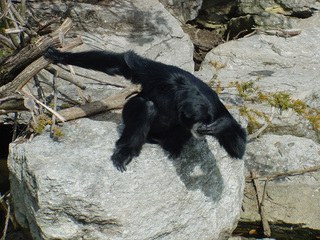
Introduction
The siamang is the largest of the gibbons, a group of small apes famous for their agility in the trees. With its booming calls and remarkable arm-swinging locomotion, the siamang is one of the most distinctive primates of Southeast Asia. It lives only on the island of Sumatra and a small part of the Malay Peninsula, where it has become a symbol of the region’s rainforests.
Taxonomy
The siamang belongs to the family Hylobatidae, which contains all gibbons and is sometimes called the lesser apes, to distinguish them from the great apes such as orangutans, gorillas, chimpanzees, and humans. The siamang is the only species in the genus Symphalangus, and its scientific name is Symphalangus syndactylus. The species name refers to the webbing between the second and third toes, a feature that gives the siamang its alternative name. Genetic studies show that the siamang diverged from other gibbons millions of years ago, making it a unique branch of the ape family tree.
Physical Characteristics
The siamang is the largest gibbon, standing about one meter tall and weighing up to fourteen kilograms. Males and females look very similar, though males are slightly heavier. Its fur is jet black, and the skin of its face, hands, and feet is dark. The most unusual feature is the gular sac, a large throat pouch that inflates to amplify the voice. The siamang also has exceptionally long arms, which span more than 1.5 meters when outstretched, and its fingers are long and hook-like for gripping branches. Unlike most other gibbons, the siamang has webbing between its second and third toes, which helps it grip wet branches during rainstorms.
Habitat
Siamangs are found in lowland and montane rainforests of Sumatra and the Malay Peninsula. They spend nearly all their lives high in the forest canopy, rarely coming to the ground. A family group defends a territory of around twenty to forty hectares, and the animals travel through their range using brachiation, swinging hand over hand beneath the branches. Siamangs prefer primary forest with tall trees, though they can survive in selectively logged areas if enough fruit trees remain. They share these forests with large predators such as tigers and clouded leopards, though adults are seldom attacked.
Diet
The siamang is primarily frugivorous, with fruit making up more than half of its diet. Figs are especially important, and a single group may visit dozens of fig trees in a year. The siamang also eats young leaves, flowers, and buds, and occasionally insects, eggs, and small vertebrates. Unlike most gibbons, the siamang eats a large proportion of leaves, which allows it to survive when fruit is scarce. Its digestive system is adapted to process fibrous plant material, and it spends a large part of each day feeding and resting to digest its meal.
Reproduction
Siamangs live in small family groups made up of a mated pair and their offspring. Pairs form long-lasting bonds and stay together for many years, reinforcing their relationship with daily duets. The female gives birth to a single infant after a gestation period of about seven to eight months. The infant clings to its mother’s fur and is carried constantly for the first few months, later riding on her back. Young siamangs remain with their parents for several years and learn to sing and swing by imitating the adults. Females reach sexual maturity at around five to seven years, and the interval between births is usually two to three years, which makes population recovery slow.
Conservation
The siamang is listed as Endangered by the International Union for Conservation of Nature. Its populations have declined sharply because of deforestation, illegal logging, and the expansion of oil palm plantations across Sumatra. Siamangs are also captured for the illegal pet trade, and many die during transport. Protected areas such as national parks provide the best hope for their survival, and reintroduction programs have had limited success because family bonds are difficult to recreate. Community-based forest protection and ecotourism projects now give local people a reason to protect siamang habitat rather than clear it.
Fun Facts
Siamangs are famous for their duets, in which the male and female sing together in a loud, coordinated performance that can be heard more than three kilometers away. The gular sac acts like a resonance chamber, making the call much louder than any other gibbon’s voice. Siamangs also have a remarkable memory for the locations of fruit trees and return to them season after season. When a group travels, the adult male usually leads, while the female and young follow. Despite their size, siamangs are incredibly graceful in the canopy and can leap more than ten meters between trees.