 By st20113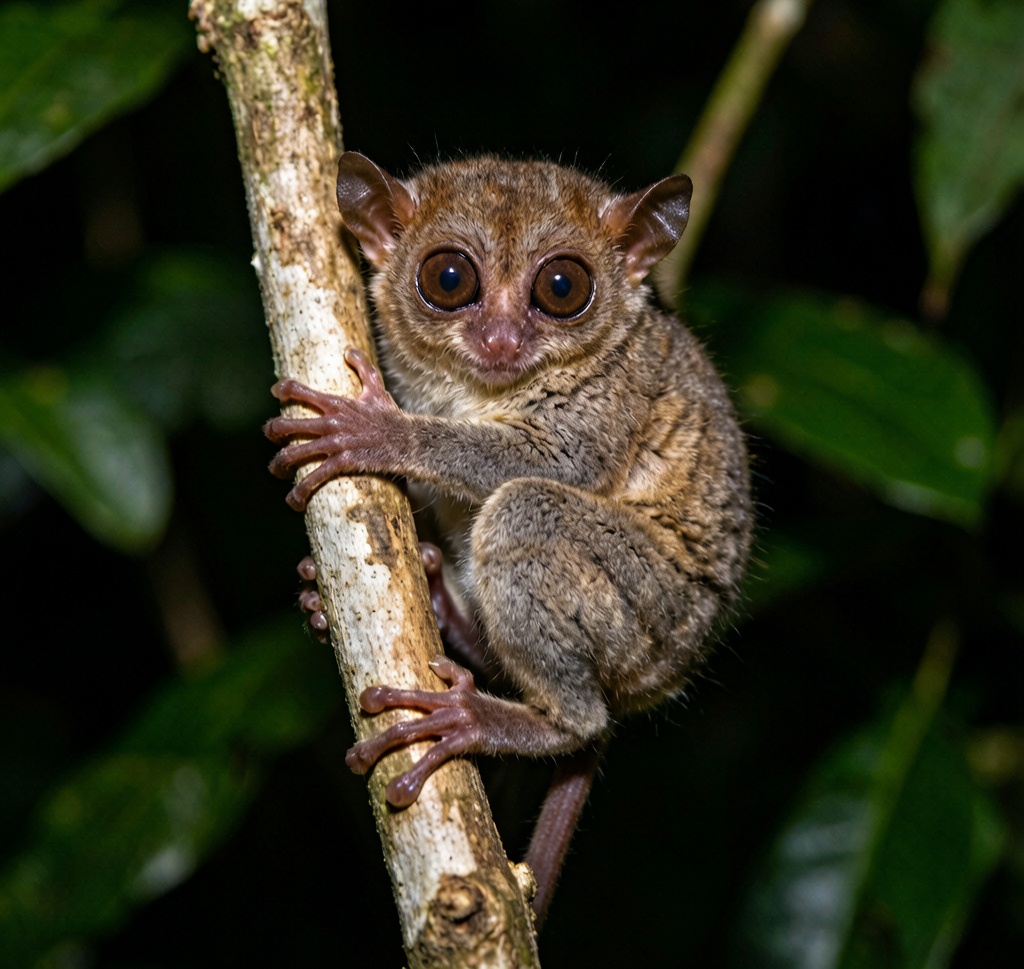
The Philippine tarsier (Carlito syrichta) is one of the smallest and most bizarre primates on Earth, a tiny, ancient inhabitant of the dense forests of the Philippine archipelago whose outsized eyes have made it both a celebrity of the wildlife world and a symbol of the urgent need to protect the Philippines’ rapidly vanishing forests. Each of the tarsier’s eyes is approximately 16 millimeters in diameter — larger than its brain — and is fixed in its skull, meaning the tarsier must rotate its head nearly 180 degrees to look behind itself, a trait it shares with owls. Found only in the forests of the Philippine islands of Bohol, Leyte, Samar, and Mindanao, the Philippine tarsier represents one of the most ancient lineages of primates. Despite its miniature size, the tarsier is a fierce, purely carnivorous predator — the only primate known to be exclusively insectivorous.
## Physical Characteristics
The Philippine tarsier is among the smallest primates in the world, with a body length of 8 to 16 centimeters and a weight of 80 to 160 grams. Its most remarkable feature is its enormous eyes: each eye is approximately 16 millimeters in diameter — about six times larger, relative to body size, than a human eye. These massive, immobile eyes are surrounded by a bony cup. The fur is soft and velvety, typically grey-brown to buff in color, lighter on the face and underside. The tail is long and hairless except for the tip, which has a small pad of skin and acts as a fifth hand. The fingers and toes are long and slender, ending in pads that help the tarsier grip smooth surfaces. The hind limbs are disproportionately large and powerful, enabling the tarsier to leap distances of up to 3 meters.
## Habitat and Distribution
The Philippine tarsier is endemic to the Philippines, where it is found only on the islands of Bohol, Leyte, Samar, and Mindanao. Within these islands, tarsiers inhabit tropical and subtropical rainforest, as well as secondary-growth forest, mangrove forest, and even plantation areas adjacent to forest. They require dense, tangled vegetation — including thickets of bamboo, shrubs, and tall grasses — near trees for sleeping sites. Tarsiers sleep in a characteristic upright position, clinging vertically to a tree trunk or branch, often in a tangle of vines or in a dead log. Within the last century, the Philippines has lost approximately 80 percent of its forest cover.
## Behavior and Diet
The Philippine tarsier is exclusively nocturnal and exclusively carnivorous — the only known truly insectivorous primate. It emerges at dusk to hunt, using its enormous eyes and extraordinary hearing to locate prey in the darkness. Its diet consists primarily of insects — including crickets, katydids, beetles, moths, cicadas, and ants — but tarsiers have also been documented catching small birds, snakes, frogs, and lizards. The tarsier hunts by sitting still and scanning its surroundings, then making sudden, precise leaps of 3 meters or more to capture prey with both hands. A unique aspect of tarsier behavior is its refusal to breed in captivity — one of the few mammals that has never been successfully bred in zoos.
## Reproduction
Breeding appears to be non-seasonal, with births recorded throughout the year. After a gestation of approximately six months — remarkably long for such a small animal — the female gives birth to a single, highly precocial infant, which is born fully furred and with its eyes open. The newborn tarsier can cling to branches within one day of birth and is capable of making short leaps within a week. The infant is carried by the mother for approximately two months, after which it begins to forage independently. The long period of parental investment and the single-infant births mean that tarsier populations grow very slowly, making them highly vulnerable to any increase in mortality.
## Conservation
The Philippine tarsier is classified as Vulnerable to Near Threatened on the IUCN Red List. The primary threats are habitat loss due to deforestation for agriculture, logging, mining, and development; the illegal pet trade; and the difficulty of breeding the species in captivity. Tarsiers are extremely sensitive to stress and have been known to commit suicide by beating their heads against cage bars when kept in captivity. Conservation efforts include the protection of remaining forest habitat; the establishment of community-based “tarsier sanctuaries” that protect wild populations while allowing controlled ecotourism; and public education campaigns.