 By st20113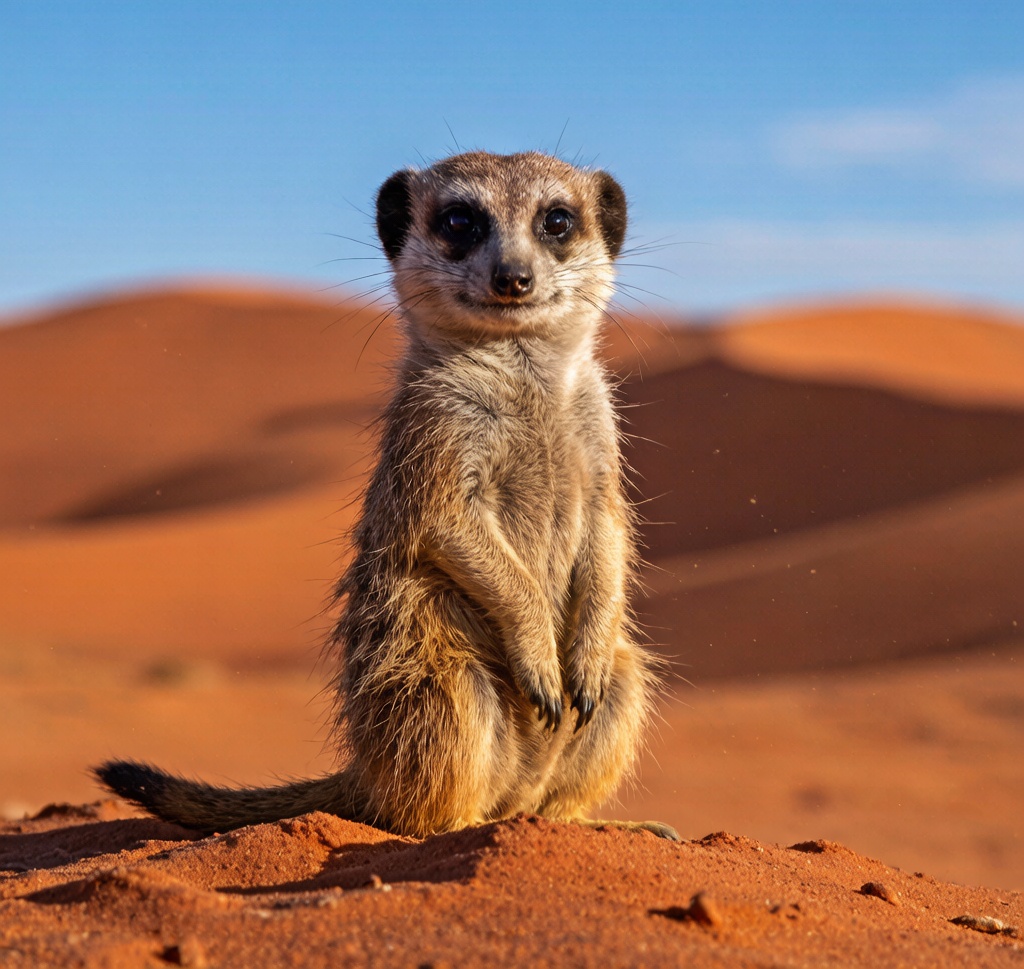
The meerkat (Suricata suricatta) — technically a mongoose rather than a cat — is one of the most socially complex and visually striking small mammals in Africa. Found throughout the arid and semi-arid regions of southern Africa, particularly the Kalahari Desert, the meerkat lives in highly cooperative family groups called mobs, within which individuals share the duties of foraging, sentry duty, and cooperative pup-rearing in an intricate social system that has fascinated biologists and wildlife filmmakers for decades. Each mob is led by a dominant breeding pair, and subordinate group members help dig and maintain an extensive network of burrows, forage for food, and act as sentinels — standing upright on their hind legs and scanning the horizon for predators, emitting distinctive alarm calls that send the entire group diving for cover.
## Physical Characteristics
The meerkat is a small, slender mongoose with a body length of 25 to 35 centimeters, plus a tail of 20 to 25 centimeters, and a weight of approximately 600 to 900 grams. Its fur is short and coarse, typically a pale tan to grey-brown color, with dark brown transverse stripes across the back — each individual’s stripe pattern being unique. The face is pale, almost white, with distinctive dark patches around the eyes — patches that function like built-in sunglasses, reducing glare and allowing the meerkat to scan the sky for aerial predators even while facing the sun. The forelimbs are equipped with long, sturdy claws — approximately two centimeters — adapted for digging burrows. Males and females are similar in size and appearance.
## Habitat and Distribution
Meerkats inhabit the arid and semi-arid regions of southern Africa, including southern Angola, Namibia, southwestern Botswana, and across most of South Africa. They are found specifically in the Kalahari Desert and the Karoo — regions characterized by hard, stony ground, sparse vegetation, and extreme temperatures. Meerkats avoid areas with tall grass or dense vegetation, preferring open, flat savanna with short grass and scattered shrubs where they can easily spot predators. Within their range, meerkats occupy a network of burrow systems — complex underground tunnels with multiple entrances, chambers, and escape routes — that provide refuge from predators and extreme temperatures.
## Behavior and Diet
Meerkats are diurnal foragers, spending the morning and late afternoon searching for food in their desert and savanna habitat. Their diet consists primarily of insects — including beetles, grubs, caterpillars, centipedes, and spiders — supplemented by small vertebrates such as lizards, geckos, and occasionally small rodents. While most group members forage, at least one individual acts as a sentinel — standing upright on its hind legs and scanning the surroundings for up to an hour at a time. Upon spotting a predator, the sentinel issues a specific alarm call (different for aerial versus terrestrial threats) that sends the mob into immediate flight toward the nearest burrow. Meerkat groups are fiercely territorial.
## Reproduction
Meerkats are cooperative breeders, with only the dominant pair in each group breeding — subordinate members assist with pup-rearing. The dominant female typically gives birth to two to five pups after a gestation of approximately 77 days. Newborn meerkats are hairless and blind, and remain in the burrow for the first two to three weeks of life. From approximately four weeks of age, the pups begin accompanying the group on foraging expeditions, where they learn to recognize food items and predators under the guidance of adult “teachers.” Pups are fully weaned at approximately one month and become independent at approximately three to four months. Sexual maturity is reached at approximately 10 months.
## Conservation
The meerkat is classified as Least Concern on the IUCN Red List, as its population is large, widespread, and relatively stable. The primary threats include habitat degradation due to livestock grazing and agricultural expansion, predation by jackals and raptors, and occasional persecution by farmers. Long-term studies of meerkat populations at the Kuruman River Reserve in South Africa have provided invaluable insights into the evolution of cooperative behavior and the ecological factors that drive dispersal and population dynamics in group-living mammals.